Freedom of speech in Pakistan explained
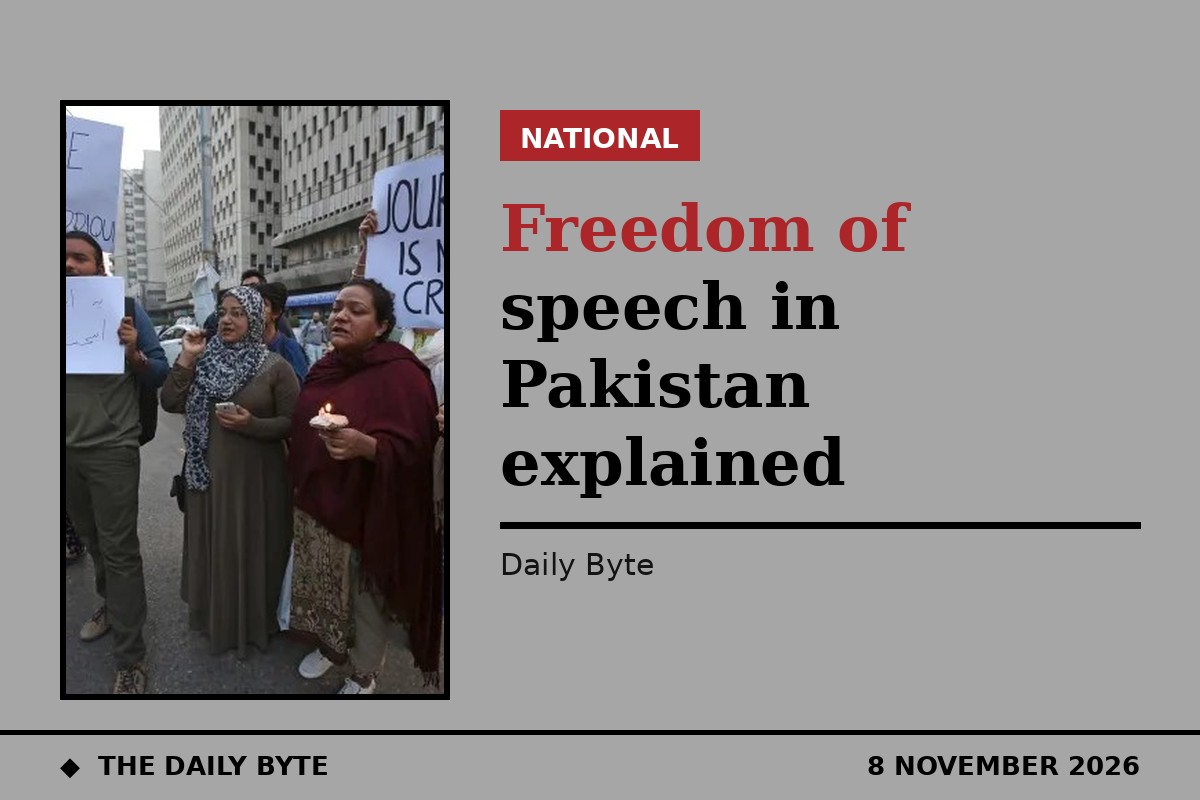
Yes, freedom of speech is guaranteed in Pakistan — but it is not absolute. Article 19 of the Constitution of Pakistan, 1973, gives every citizen the right to freedom of speech and expression and says there shall be freedom of the press, subject to reasonable restrictions imposed by law. In practice, those restrictions, and the way regulators and the courts apply them, decide how much free speech Pakistanis actually enjoy.
This explainer sets out what the law says, who enforces the limits, what the courts have ruled, and what the position looks like in 2026.
What the Constitution actually says
Article 19 states: "Every citizen shall have the right to freedom of speech and expression, and there shall be freedom of the press, subject to any reasonable restrictions imposed by law in the interest of the glory of Islam or the integrity, security or defence of Pakistan or any part thereof, friendly relations with foreign States, public order, decency or morality, or in relation to contempt of court, [commission of] or incitement to an offence."
That list of grounds is wide. It covers religion, national security, relations with other countries, public order and morality — and each of those terms has been interpreted broadly at different times. The Constitution also added a related right in 2010, through the Eighteenth Amendment: Article 19-A gives every citizen the right to have access to information in all matters of public importance, subject to regulation and reasonable restrictions imposed by law.
The key word in Article 19 is "reasonable". The restrictions must be imposed by law, and the superior courts have held that a reasonable restriction must not be arbitrary, excessive or disproportionate, and must reflect intelligent care and deliberation. A restriction that fails that test is not supposed to stand — but it is often left to the courts, after the event, to decide whether it does.
Who enforces the limits
Three bodies and laws do most of the work. The Pakistan Electronic Media Regulatory Authority, known as PEMRA, was established on 1 March 2002. It licenses private television and radio channels and can issue, suspend or withdraw licences. It regulates broadcast content, and it has repeatedly ordered channels not to carry particular speeches or coverage.
The Pakistan Telecommunication Authority regulates internet and telecoms services, including blocking websites and online content. Alongside it sits the Prevention of Electronic Crimes Act, known as PECA, passed in 2016. PECA gives the government powers over online platforms, including the removal of online material said to be hostile to national security.
Amendments adopted in 2025 strengthened those powers. The Prevention of Electronic Crimes (Amendment) Act 2025 introduced Section 26-A, creating criminal penalties for the intentional dissemination of false or fake information likely to cause fear, panic, disorder or unrest. In September 2026, journalist Asad Ali Toor received a notice from the National Cyber Crime Investigation Agency under Section 26-A. Human Rights Watch's World Report 2026 records authorities using vague laws, including the amended PECA, to arrest journalists and block critical broadcasts.
A law points the other way: the Protection of Journalists and Media Professionals Act, passed in 2021, was meant to protect journalists, though Reporters Without Borders notes its protection is conditional on reporters adopting a certain "conduct". A federal commission for the protection of journalists was established in November 2025.
What the courts have said
The courts have pushed back against the broadest bans. The clearest example concerns PEMRA's blanket ban on broadcasting live or recorded speeches by former prime minister Imran Khan on all electronic media channels. The ban was later suspended by the court. The Pakistan Press Foundation, drawing on the original Dawn analysis, explains that such blanket bans rest on the "doctrine of prior restraint" — stopping expression in advance, rather than punishing it afterwards if it breaks the law.
The Islamabad High Court has held that Section 27 of the PEMRA Ordinance, the provision PEMRA used for the prohibition order, does not empower PEMRA to impose a blanket ban on speech. The argument is that the restrictions in Article 19 are consequential, not pre-emptive: if speech falls within one of the seven restriction grounds, the authorities can take action afterwards, but a ban imposed in advance, on mere anticipation, cannot pass the test of reasonableness. Such orders have also been criticised for violating the fair-trial guarantee in Article 10-A of the Constitution, because a person facing adverse action has the right to be heard.
Bans are frequently challenged and sometimes suspended, but cases are decided slowly — the restriction often takes effect long before a court rules on it.
What it looks like in practice in 2026
International monitors describe a difficult environment. Reporters Without Borders' 2026 World Press Freedom Index ranks Pakistan 153rd out of 180 countries, with a score of 32.61. That is an improvement from 158th in 2025, but RSF still describes Pakistan as one of the world's most dangerous countries for journalists, pointing to the use of sedition, anti-terror and other laws against journalists, online harassment campaigns, censorship and restrictions on critical reporting — especially reporting on military affairs.
New rules in 2026 also tightened the position of foreign media: outlets covering stories outside Islamabad, Karachi and Lahore must first obtain a no-objection certificate, with no fixed approval timeline — criticised by press-freedom groups as access control rather than security management.
So the short answer to the question is this: freedom of speech in Pakistan is a constitutional right, written into Article 19 and reinforced by a right to information in Article 19-A. But the Constitution itself allows restrictions, and the laws and regulators built on those restrictions — PEMRA, PECA and its 2025 amendments — give the state wide powers that are regularly used against critical speech. The courts have set limits, notably against blanket bans, but the practical result, reflected in Pakistan's 153rd-place ranking, is a press that operates under legal pressure and, very often, self-censorship.
Frequently asked questions
Does Pakistan's Constitution guarantee freedom of speech? Yes. Article 19 of the 1973 Constitution guarantees freedom of speech and expression and freedom of the press, subject to reasonable restrictions imposed by law.
What are the limits on free speech in Pakistan? The Constitution allows restrictions in the interest of the glory of Islam, the integrity, security or defence of Pakistan, friendly relations with foreign states, public order, decency or morality, contempt of court, or incitement to an offence. Courts have said those restrictions must be reasonable — not arbitrary, excessive or disproportionate.
What is PEMRA? The Pakistan Electronic Media Regulatory Authority, established on 1 March 2002. It licenses and regulates private television and radio, and can suspend or withdraw licences.
What is PECA? The Prevention of Electronic Crimes Act, passed in 2016 and amended in 2025. It governs online crime and gives the state powers over online content. Its 2025 amendment added Section 26-A, criminalising the intentional spread of false information likely to cause fear, panic, disorder or unrest.
Where does Pakistan rank for press freedom? Pakistan ranks 153rd out of 180 countries in Reporters Without Borders' 2026 World Press Freedom Index, up from 158th in 2025.