Fresh Tanker Fire East of Hormuz on Second Day of Attacks
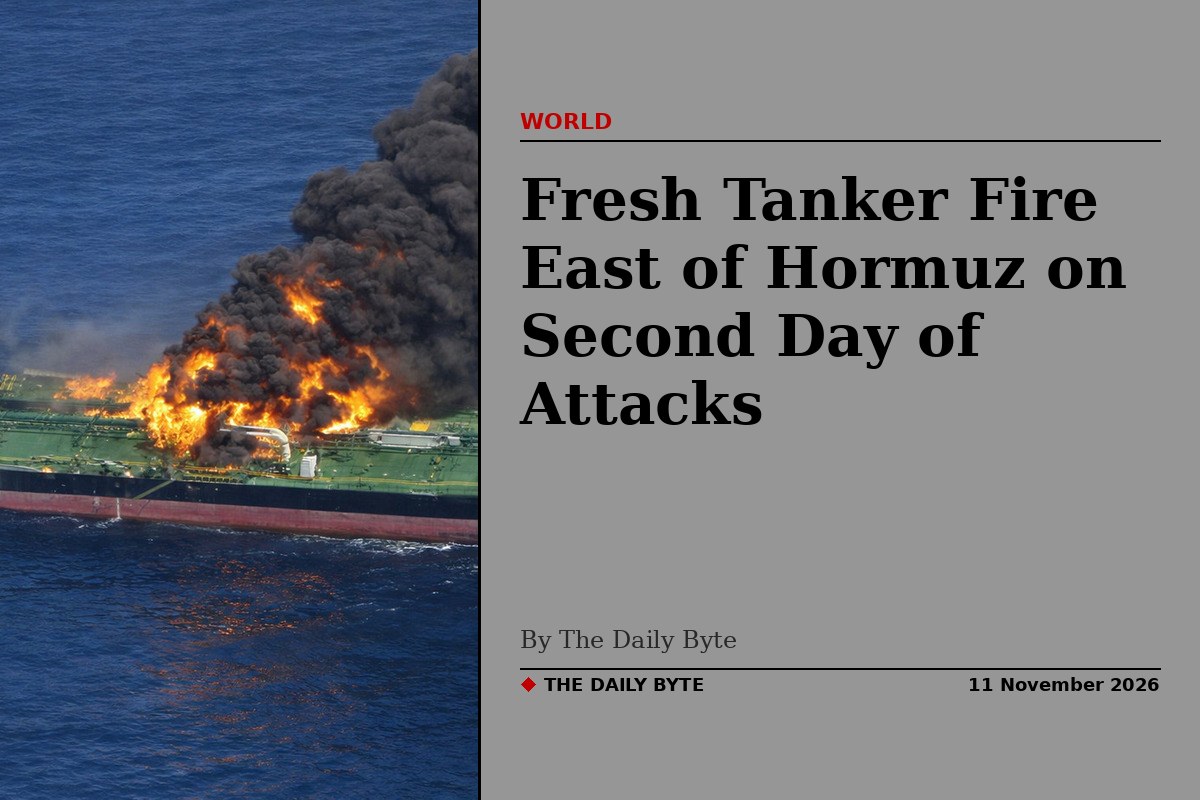
An oil tanker caught fire in the early hours of Wednesday, 11 November 2026, after striking naval mines in waters east of the Strait of Hormuz, Iran's army navy said. It is the second consecutive day of tanker explosions in the strategically important waterway, raising fears of a wider maritime confrontation.
The navy said the tanker was transiting an area it describes as unsafe and forbidden without advance coordination with Iranian forces. It said its forces were actively monitoring the strait's eastern waters, signalling that enforcement operations were continuing rather than one-off incidents.
Second day of explosions in the strait
The latest fire follows a statement on Tuesday, 10 November, by the navy of Iran's Islamic Revolutionary Guard Corps (IRGC), which said two tankers suffered massive explosions on what it called an unauthorised route through the strait. According to the IRGC's official outlet, Sepah News, one vessel, described as a supertanker, struck a naval mine and exploded, while a second tanker was set ablaze in a separate incident.
The IRGC said both vessels had switched off their navigation and identification systems before attempting the passage, and claimed the second tanker was operating under the protection of US military aircraft. The United States has not confirmed that account, and the names, flags, ownership and crews of the vessels involved have not been disclosed.
Reuters, citing the United Kingdom Maritime Trade Operations agency, reported that another tanker was struck north-east of Oman's Lima on Tuesday. Videos posted on social media on Sunday and verified by Reuters showed a Navig8 tanker on fire near the coast of Oman, one of three tankers hit that day for using what Iranian state media called unauthorised routes.
Iranian military chief warns US and Israel
Separately on Wednesday, the chief of staff of the Iranian armed forces, Ali Abdollahi, issued a pointed warning to the United States and Israel against what he called any new miscalculation. He said any point that served as a focal point for threats against the existence of the Islamic Republic of Iran would become a direct target of asymmetric operations.
Abdollahi said in a message carried by Iranian state media that the armed forces would carry out orders from Supreme Leader Mojtaba Khamenei without hesitation. The warning underlines the chain of command behind what appears to be a deliberate naval enforcement campaign in the strait.
Oil prices rise as attacks continue
Oil prices rose on Wednesday after falling to two-month lows in the previous session. Brent futures climbed 71 cents, or 0.78 percent, to 92.20 dollars a barrel, while US West Texas Intermediate crude rose 49 cents to 86.53 dollars a barrel, Reuters reported.
Data from the Washington Institute for Near East Policy showed that 37 ships were attacked in the Strait of Hormuz and surrounding waterways in October, the highest monthly total since the war began, with 10 attacks recorded so far in November. The International Maritime Organization has confirmed 130 incidents, most of them attacks, in the region since the conflict began in late February.
Analysts at LSEG said in a note on 10 November that even if a deal were struck, an increase in flows through the waterway would still depend on mine clearance, insurance costs and whether shipowners were willing to take the risk. Meanwhile, attacks have not slowed, they said.
Why the strait matters
Iran tightened its grip on the Strait of Hormuz on 28 February 2026, barring safe passage to vessels belonging to or affiliated with Israel and the United States, following joint US-Israeli strikes on Iranian territory. Tehran requires prior authorisation for transit and confines safe passage to designated northern corridors.
The strait carries an estimated 20 percent of global oil trade, making any sustained disruption a significant energy-market risk. How the United States and Israel respond, and whether shippers change their routing, will determine how quickly the situation escalates into a wider maritime crisis.


