Frontline Profit Soars as Tanker Rates Hit Records
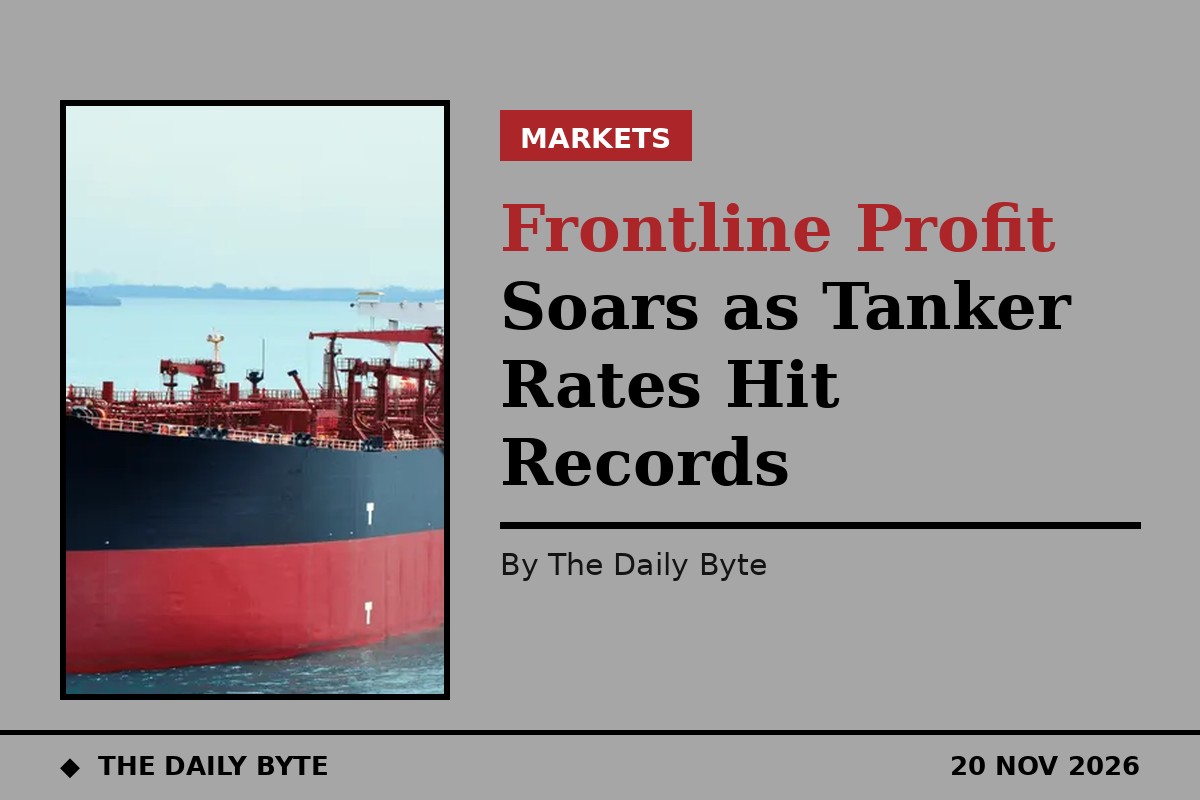
Tanker operator Frontline made a profit of $641.4 million in the third quarter of 2026, or $2.88 per share, as freight rates for oil tankers reached record highs. Revenue of $921.3 million was 112.9% higher than a year earlier and beat market expectations by $203.84 million, and the company declared a cash dividend of $2.38 per share.
Adjusted profit, which strips out one-off items, was $530.9 million, or $2.38 per share, against expectations of $2.26. Frontline shares rose about 2.8% in New York on Friday, trading at $46.00 in the afternoon, while its Oslo-listed shares rose 2.1% to 442.60 kroner.
Record bookings for the fourth quarter
The strongest part of the report was the outlook. Frontline said its bookings so far in the fourth quarter were at the highest levels it had ever recorded across all three of its vessel classes. Very large crude carriers, or VLCCs, have 68% of their spot days booked at $562,600 a day, Suezmax tankers 69% at $324,300 a day, and LR2 and Aframax tankers 68% at $190,800 a day.
Chief executive Lars Barstad said that with most of its spot days already fixed, Frontline was positioned to deliver its strongest result ever, both for the fourth quarter and for the full year of 2026. The company cautioned that the rates it finally earns across the whole quarter will be lower than the rates currently contracted, because of ballast days — days spent sailing empty to pick up the next cargo — during the quarter.
Why rates have surged
Barstad said the third quarter had been defined by the escalation in the Middle East, logistical challenges and time-consuming trading patterns. Since then, he said, utilisation had reached extraordinary levels and freight rates had moved to all-time highs, with vessel values following and the whole tanker market benefiting.
In the third quarter itself, Frontline's VLCCs earned an average of $148,500 a day on the spot market, Suezmax tankers $102,500 a day and LR2 and Aframax tankers $67,800 a day. Those are the daily earnings after voyage costs, known as time charter equivalent rates, and they compare with cash breakeven costs of roughly $24,100 a day for a VLCC, $25,200 for a Suezmax and $20,600 for an LR2 or Aframax.
Fleet sales and cheaper borrowing
Frontline sold two VLCCs built in 2017 for a total of $270 million during the quarter. The sales generated net cash of $179 million, which was returned to shareholders through a special one-off dividend of $0.80 per share paid in September.
The company also refinanced its debt on better terms, agreeing a new senior secured revolving credit facility of up to $731.8 million in November. Its weighted average interest rate margin has fallen to 118 basis points, from 178 basis points at the end of the first quarter, cutting its borrowing costs and its breakeven rates. It also signed a three-year charter for one Suezmax tanker built in 2016 at $80,000 a day, starting in October.
After its remaining new VLCCs are delivered and the two sales are completed, Frontline's fleet will stand at 40 VLCCs, 19 Suezmax tankers and 18 Aframax and LR2 tankers. Barstad said the last nine months were likely to change oil trading patterns considerably, leaving him optimistic about the company's earnings capacity in the years ahead.
Frequently asked questions
What is a VLCC? A very large crude carrier, the biggest class of oil tanker, typically able to carry around two million barrels of crude oil. Frontline's VLCCs are the largest part of its fleet and earn the highest daily rates.
What is a time charter equivalent rate? It is the shipping industry's standard way of expressing earnings: voyage revenue minus voyage costs such as fuel and port fees, divided by the number of days. It lets rates be compared across different routes and cargoes.


