FTSE 100 falls 1.76% to 10,689.87 in worst day since March as Nvidia nerves hit Europe
By aminah
·18 Nov 2026
·4 min read
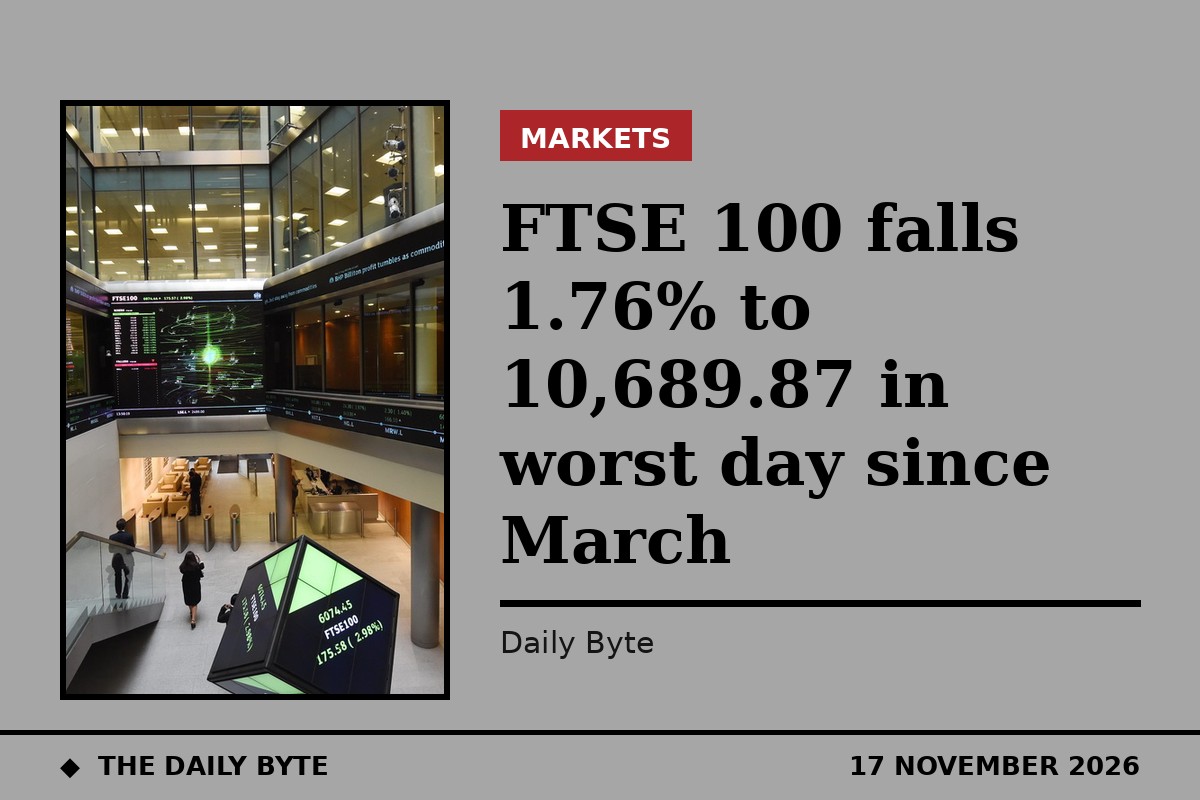
The FTSE 100 fell sharply on Tuesday 17 November 2026, closing down 191.68 points, or 1.76%, at 10,689.87, in its worst day since March. London's blue-chip index ended at its lowest closing level since Friday 6 November, as a sell-off in technology and artificial intelligence shares spread from Wall Street to Europe.
The fall came ahead of quarterly results from Nvidia, the AI chipmaker at the centre of the market's recent turmoil, which were due after the US market closed on Tuesday. Investors shied away from risky bets during the London session, and the selling gathered pace through the afternoon. According to [Reuters](https://www.reuters.com/commentary/reuters-open-interest/global-markets-trading-day-graphic-2026-11-17/), Europe and the UK both fell 1.8% on the day, their worst day since March.
## European markets fall together
The slide was not confined to London. Germany's DAX fell 553.27 points, or 2.08%, to 26,045.37, while France's CAC 40 dropped 135.22 points, or 1.62%, to 8,216.78. The pan-European STOXX 600 had already slipped 0.7% by late morning, after touching record highs last week, according to [Reuters](https://www.reuters.com/world/uk/uk-stocks-fall-investors-edge-ahead-of-nvidia-results-uk-data-keeps-rate-bets-2026-11-17/).
In the United States, the S&P 500 fell 1%, the Nasdaq dropped 0.7% and the Dow Jones Industrial Average lost 1.6% on Tuesday, with all 11 sectors of the S&P 500 lower. The FTSE 100 had closed on Monday at 10,881.55, down 0.2%, before retreating further on Tuesday.
## Why investors sold ahead of Nvidia
Nvidia has dominated market sentiment for weeks. Its chief executive, Jensen Huang, resigned suddenly last week, and the company has since faced reports of a US Securities and Exchange Commission investigation, tighter US curbs on AI chip sales to China, and questions about the pace and payoff of heavy AI spending. Since 6 October, the Philadelphia Semiconductor index is down 30% and Nvidia is down nearly 40%, according to Reuters.
"Despite its limited exposure to AI, the UK market could not entirely shake off the negative sentiment in markets as tech stocks chalked up further losses," AJ Bell investment director Russ Mould said, as reported by Reuters.
Wall Street's tech sell-off from the previous session spilled over into global markets on Tuesday, with US tightening curbs on AI chip sales to China adding to concerns. Nvidia's third-quarter earnings were in focus following Huang's exit, and options traders had priced in a swing of roughly $335 billion in the company's market value after the results.
After London closed, Nvidia reported third-quarter earnings and sales that beat Wall Street estimates and guided fourth-quarter revenue to between $126 billion and $134 billion, above the analysts' average estimate of just over $125 billion, according to data compiled by LSEG and reported by [Reuters](https://www.reuters.com/business/view-nvidia-earnings-beat-estimates-attention-turns-call-2026-11-17/). Its shares rose in late trading, but that came too late to rescue the London close.
## Banks and miners lead London lower
Banks and industrial metal miners were among the weakest sectors in London, falling 0.7% and 1.9% respectively in morning trading, according to Reuters. Mining shares have come under particular pressure as falling copper prices and uncertainty about Chinese demand weigh on the sector.
There were a few risers. IQE, the chip components maker, rose 1.4% after raising its annual outlook and forecasting more than 40% revenue growth in fiscal 2026, boosted by AI-driven data centre demand.
## UK jobs data keeps a December rate rise in play
Mixed UK labour market data did little to change expectations for the Bank of England. UK wage growth slowed to 3.6% in the third quarter, while job vacancies fell to their lowest since 2021. Unemployment, however, dipped to 4.6%, leaving a mixed picture for inflation pressures.
Traders see a roughly 90% chance of a Bank of England rate hike in December, broadly unchanged after the jobs data, according to LSEG data cited by Reuters. "The period of softness in the labor market is over, which removes a hurdle to further Bank of England rate hikes," Kathleen Brooks, research director at XTB, said.
## Frequently asked questions
**How much did the FTSE 100 fall on 17 November 2026?**
The FTSE 100 fell 191.68 points, or 1.76%, to close at 10,689.87, according to Dow Jones Market Data via Morningstar.
**Why did European markets fall on 17 November 2026?**
Investors sold shares ahead of Nvidia's quarterly results, after a tech sell-off on Wall Street, tighter US curbs on AI chip sales to China, and the sudden exit of Nvidia chief executive Jensen Huang.
**What is the chance of a Bank of England rate hike in December?**
Traders see a roughly 90% chance of a rate hike in December, according to LSEG data, after mixed UK jobs figures left wage growth slower but unemployment lower.
Sources: [Morningstar / Dow Jones Market Data](https://www.morningstar.com/news/dow-jones/202611176738/ftse-100-index-ends-176-lower-at-1068987-data-talk); [Reuters](https://www.reuters.com/world/uk/uk-stocks-fall-investors-edge-ahead-of-nvidia-results-uk-data-keeps-rate-bets-2026-11-17/). This article is for information only and is not financial advice.
Source
Morningstar / Dow Jones Market Data — https://www.morningstar.com/news/dow-jones/202611176738/ftse-100-index-ends-176-lower-at-1068987-data-talk 

