FTSE Miners Lose Over 10% in Week as Metals Slide
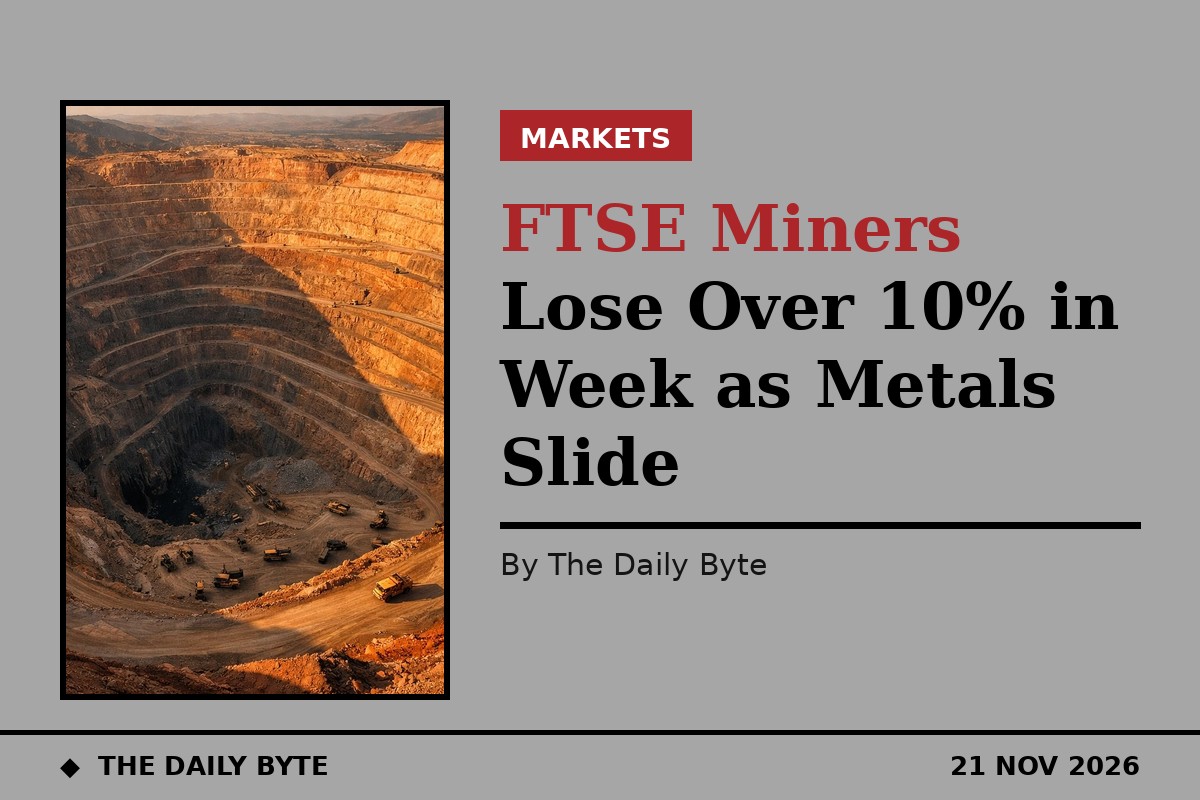
London's mining shares were among the worst hit in the FTSE 100's bruising week, heading for a weekly loss of more than 10% as gold and copper prices slid. Reuters reported that precious and industrial metal miners were on course for a weekly loss of more than 10%, making them one of the index's worst-performing sectors, as a global sell-off driven by worries over artificial intelligence valuations and higher US interest rates dragged risk assets lower.
The FTSE 100 closed down 1.0% on Friday at 10,346.34, a five-month low, and lost 5.1% over the week, according to Alliance News. The mid-cap FTSE 250 fell 2.2% to 23,651.73, while miners, banks and energy shares led the decline.
Friday: Endeavour leads the fallers
Endeavour Mining was among the biggest fallers in the FTSE 100 on Friday, dropping 200p to 3,174p, a fall of 5.9% on its previous close. The gold miner has now fallen sharply twice this week, tracking bullion lower as the metal's sell-off deepened.
Gold was quoted at $3,545.53 an ounce at the London close on Friday, against $3,686.50 on Thursday, Alliance News reported. Brent crude stood at $91.88 a barrel, down from $92.56, and Shell dropped 1% while Ithaca Energy fell nearly 5% as oil prices eased, Reuters reported. The selling was not confined to miners: HSBC dropped 3.6%, Standard Chartered lost 5.6%, Barclays fell 3.3% and NatWest slipped 2.5%, while defensive names offered some support, with Unilever up 2.2%, National Grid up 1.1% and GSK adding 0.8%.
Wednesday set the pattern
The miners' rout built up all week. On Wednesday, the six biggest fallers in the FTSE 100 were all miners, and their decline helped push the index down 138.70 points, or 1.30%, to 10,551.17, according to Kalkine. Antofagasta fell 237p, or 7.9%, to 2,782p; Endeavour Mining dropped 268p, or 7.2%, to 3,434p; Anglo American lost 255p, or 7.2%, to 3,294p; Glencore fell 30.05p, or 6.1%, to 461.40p; Fresnillo dropped 112p, or 4.7%, to 2,265p; and Rio Tinto eased 4.7%.
None of the six companies released fresh news of their own that day. The selling was driven entirely by the commodity and currency markets, Kalkine reported. Copper fell 6.4% and silver 5.2% on Wednesday, while gold dropped to $3,742.80 an ounce from $3,869.59 the day before, a fall of about 3.3%. Brent crude slipped to $91.94 a barrel from $93.20.
Dollar strength and rate fears behind the slide
Three forces combined against the miners, according to market reports cited by Kalkine: a firmer dollar was pushing commodity prices lower; the prospect of further US interest rate rises had reduced the appeal of precious metals, which pay no income; and doubts about the roll-out of artificial intelligence infrastructure had hit expectations for copper demand. The dollar index climbed to a 19-month high above 103.50 on Wednesday, and the US 10-year Treasury yield stood at 5.08%.
Reuters said the broader sell-off was tied to concern over AI-linked valuations and expectations for higher US interest rates. In the UK, consumer prices rose 3.6% in the year to October, a 12-month high, and Bank Rate stands at 4%, with a 0.25-percentage-point increase in December widely discussed. A stronger dollar makes commodities priced in dollars more expensive for buyers using other currencies, adding to the pressure on metals.
A narrow fall with a wide impact
Wednesday showed how much weight miners carry in London. The FTSE 100 is weighted by market value, so when several large companies in the same sector fall sharply together, their combined effect on the index is substantial, even if most other constituents move only slightly or rise. On Wednesday the FTSE 250, which has less exposure to the big global commodity producers, fell just 0.1%, while several FTSE 100 stocks rose, led by Convatec, up 9.4% after raising its full-year revenue guidance.
By Friday the selling had broadened. Decliners outnumbered advancers by 5.7 to one across the London market, Reuters reported, and the FTSE 250 recorded its seventh consecutive daily fall, its longest losing streak since November 2025. Stronger-than-expected UK retail sales, up 0.7% in October, and government borrowing of £17 billion, below forecasts of £18 billion, could not offset the gloom.
The miners' week underlines London's heavy exposure to commodities: when metals fall, the FTSE 100 feels it first. Whether the sector steadies next depends on the dollar, on what the Federal Reserve signals about rates, and on whether the doubts over AI spending that hit copper demand begin to ease.


