Fugaku breach: 430 SSH keys stolen, 233 unprotected
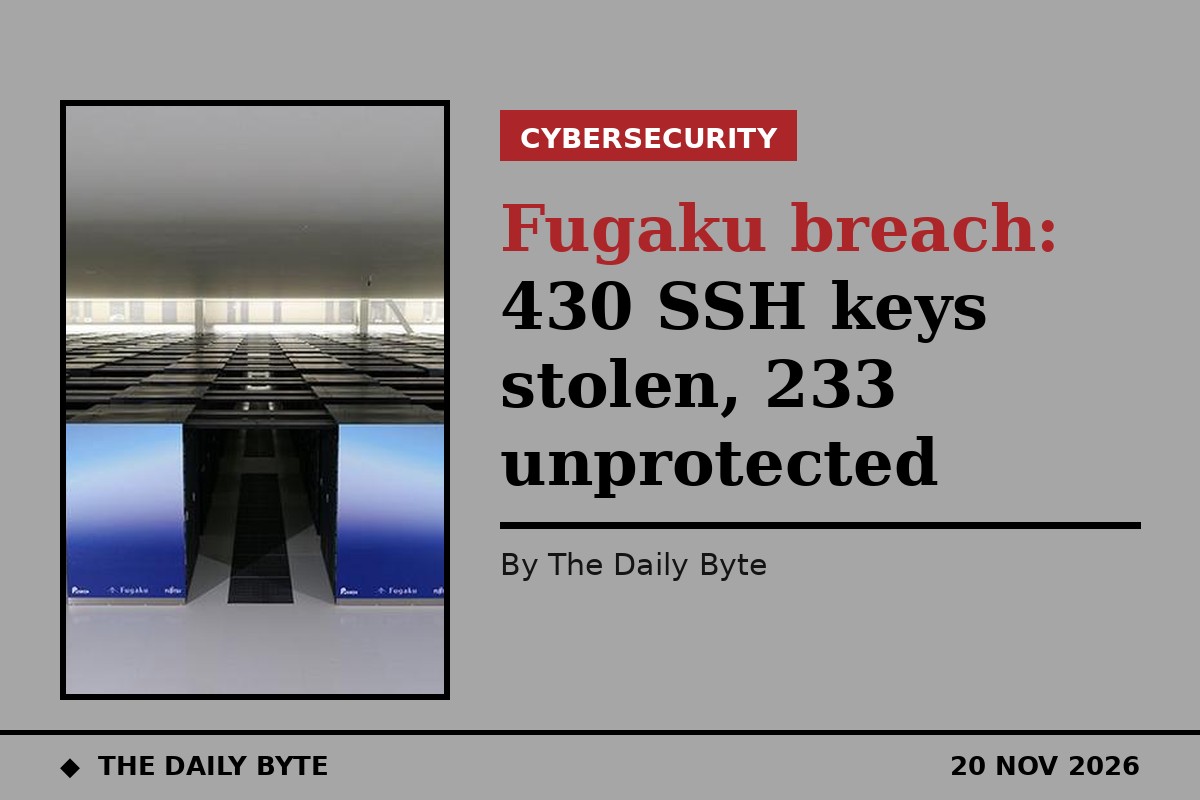
Attackers who broke into Japan's Fugaku supercomputer took 430 SSH private keys and other credentials that researchers stored on the machine for logging in to other institutions' supercomputers and cloud services. Japan's national research institute RIKEN confirmed the figure on Friday in its second report on the incident, saying 233 of the stolen keys had no passphrase at all and 197 had one. RIKEN is treating all 430 as leaked and is contacting their owners one by one. Fugaku has been out of operation since 14 November, and RIKEN has still set no date for it to return.
The keys matter because of what they open. They were stored in users' home directories on Fugaku and belong to systems outside RIKEN: other supercomputers, cloud services and research platforms that Fugaku users connect to. A private key with no passphrase can be used by whoever holds it, with no second secret to guess. RIKEN says it has already found traces of the intruder trying to connect to other systems with some of the stolen credentials, although it has seen no other misuse so far.
What the second report confirms
The second report, published on 20 November, also widens the personal data now treated as leaked. In its first report on 16 November, RIKEN said the names, email addresses and user IDs of up to 4,222 Fugaku users may have been affected. It now says the intruder also accessed addresses, affiliations and other details given at account registration, contact details including phone numbers, and a record of which type of document each user showed to verify their identity. The documents themselves did not leak, RIKEN says, only the record of which kind was shown.
RIKEN reached these conclusions through log analysis using AI and other methods, which identified traces of the intruder accessing the information. It says no misuse outside its own systems has been confirmed, but it is responding on the premise that a leak occurred, to prevent the damage spreading. The affected population remains up to 4,222 Fugaku users, plus up to 375 users of Rikyu, a newer AI-for-science supercomputer RIKEN also runs, for a total of up to 4,597.
How the attack unfolded
Between 10 and 13 November, an outside attacker used a web dashboard showing Fugaku's operating status, which was exposed to the internet, as a foothold into the internal operations network. RIKEN has referred to a software vulnerability that was exploited but has not named it or the dashboard software involved. Inside the network, the attacker operated several servers and planted malicious programs on some of them.
Suspicious traffic was detected on 12 November. RIKEN confirmed unauthorised access at 16:33 Japan time on 13 November, isolated the system used for the intrusion that evening, and stopped Fugaku and cut off outside access at 04:30 on 14 November. It replaced its administrative keys, and on 15 November emailed users, disabled every user's login public key and stopped all running and queued jobs. RIKEN has reported the incident to Japan's Personal Information Protection Commission, the science ministry and the organisations behind HPCI, the national research computing network, and briefed police in Saitama and Hyogo prefectures.
What happens next
RIKEN says Fugaku will return only after it separates its public services from the management network and rebuilds servers, and it has not set a date. It is setting up an investigation committee that includes outside experts and drawing up a reform plan. At a press conference on 20 November, education minister Yoshihiro Seki said work would continue towards resuming operations so the impact on users' research could be kept to a minimum.
For users, the advice is direct. RIKEN asks everyone who stored an SSH private key or other credential on Fugaku to revoke it at the service it belongs to and issue a new one. Administrators of other supercomputers and services that Fugaku users connect to should remove keys that were stored on Fugaku from authorised-keys files, rotate access keys issued to those users, and check logs for logins since 10 November from unfamiliar places. RIKEN also warns of emails pretending to come from RIKEN or Fugaku, and says it never asks for passwords by email.
Fugaku, built by RIKEN and Fujitsu for about 130 billion yen, began full operation in March 2021 in Kobe. It has been used for COVID-19 research, weather forecasting and drug discovery. Because researchers book time on the machine in advance, a prolonged shutdown will disrupt scientific work waiting for its turn, and schedules for allocating computing time will have to be reviewed. RIKEN has not named the vulnerability or the dashboard software, said who was behind the attack, or which other institutions' systems the stolen keys open.
Sources: RIKEN second report, 20 November 2026 | CyberSIXT


