G7 Warns of Lebanon Security Void as UNIFIL Mandate Ends
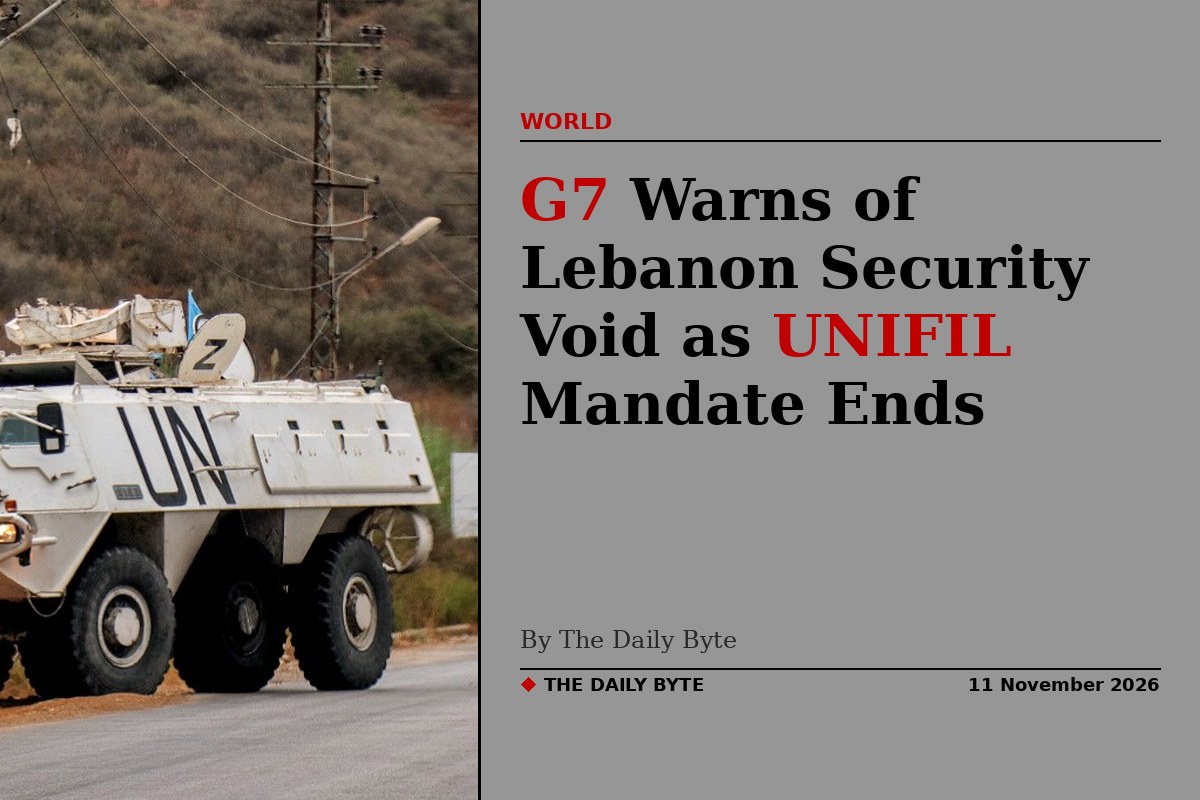
Foreign ministers from the Group of Seven have agreed that Lebanon must not be left with a security gap when United Nations peacekeepers withdraw at the end of the year, France's foreign minister said on Tuesday, although the group failed to agree on what should replace the force.
Jean-Noël Barrot told reporters in Paris after two days of G7 talks that ministers had agreed on “the need to avoid a security void” in Lebanon once the United Nations Interim Force in Lebanon, known as UNIFIL, leaves. They also backed “the need to move quickly toward a new security architecture” for the country's south, he said.
But Barrot acknowledged there had been no breakthrough on the replacement for UNIFIL, which has patrolled southern Lebanon since 1978 and now counts some 7,500 personnel from nearly 50 countries. The UN Security Council voted last year, under pressure from the United States, to end the mission's mandate on 31 December 2026.
What the ministers agreed
In their final communiqué, the ministers said they had “underscored the need for a robust, credible, and long-lasting security architecture in Lebanon in support of the Lebanese Armed Forces”. Barrot said the shared objective was the withdrawal of Israeli forces from southern Lebanon, the disarmament of Hezbollah and the restoration of a state that holds a monopoly on the use of arms.
“I am hopeful that we will reach a consensus,” Barrot said. “The objective is widely shared: the withdrawal of Israel (from southern Lebanon), the disarmament of Hezbollah (which is pro-Iranian), and the restoration of a strong state that holds a monopoly on the use of arms — a state capable of ensuring the security and prosperity of all the populations and all the communities in Lebanon.”
Israel now maintains troops in a self-declared “security zone” running around 10 kilometres inside Lebanon along the border. Lebanon says Israeli attacks have killed more than 4,300 people since Hezbollah drew the country into the wider regional war.
Washington leans towards a civilian mission
US Secretary of State Marco Rubio, who attended the Paris talks, said on Monday that he had discussed the issue with President Emmanuel Macron and suggested that whatever replaces UNIFIL “doesn't have to be a military mission; it could be a civilian mission”.
“We need a verification system trusted by everyone and trusted by both sides that both sides are complying with their obligations under the agreements that are in place,” Rubio said.
A transitional mechanism using UNIFIL forces is among the options on the table, a European diplomat said, asking not to be named. But that could require a UN Security Council resolution and could therefore run into an American veto, the diplomat warned.
The Europeans are also pushing a proposal for an international military coalition tasked with supporting the Lebanese Armed Forces in their mission to disarm Hezbollah. That plan faces hesitation from Italy, which diplomats said “remains strongly committed to its presence in Lebanon but appears reluctant to join an ad hoc coalition”, partly because such missions are not funded by the UN.
Warnings of a vacuum
The UN's peacekeeping chief, Jean-Pierre Lacroix, warned last week that Lebanon risked a “security vacuum” once the peacekeepers leave, with no one left to stop border incidents turning into clashes. Secretary-General António Guterres put forward options for a future UN presence in June, but the Security Council has yet to agree on any of them.
EU foreign policy chief Kaja Kallas told the AFP news agency in October that the bloc favoured a UN peacekeeping mandate in south Lebanon. Lebanese officials have called for UNIFIL's mandate to be extended, but the decision to end it stands, leaving barely seven weeks to agree on what comes next.


