G7 Ministers Hold Ukraine Session in Paris Today
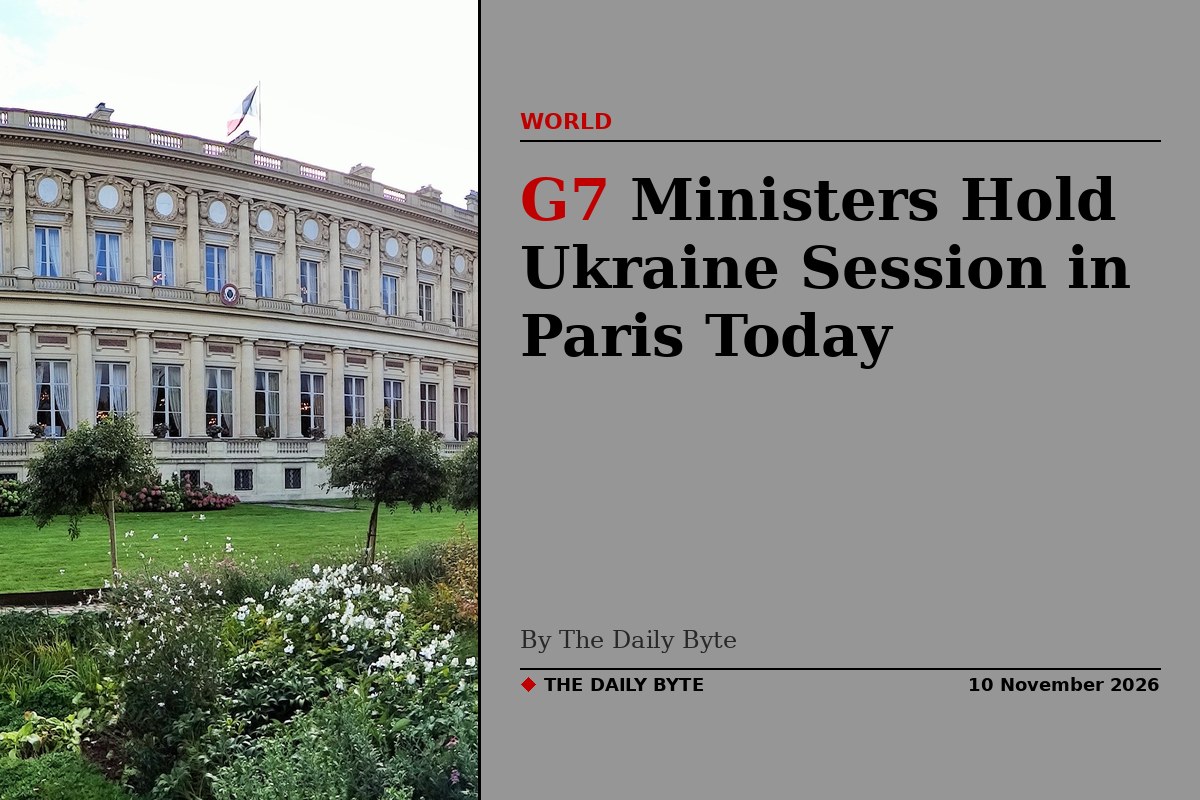
Foreign ministers from the Group of Seven leading industrialised democracies hold the second day of their talks in Paris today, Tuesday 10 November 2026, with a dedicated session on Ukraine at the centre of the agenda.
The meeting, hosted by France under its presidency of the G7 this year, brings together the United States, Britain, Canada, France, Germany, Italy and Japan, along with the European Union. Ministers from Ukraine, Saudi Arabia, Egypt, South Korea and Brazil are also taking part in selected sessions.
Ukraine's Foreign Minister Andrii Sybiha is due to join the ministers for the Ukraine session today. The talks come a day before Russian and Ukrainian negotiators are due to meet United States officials in Abu Dhabi for US-mediated discussions, the first direct meeting between the two sides since February.
Rubio faces allies after US midterm elections
US Secretary of State Marco Rubio is attending his first meeting with allies since the midterm elections in the United States on 3 November, in which the Democrats made gains and Republicans lost ground. Diplomats said the Paris gathering would be the first chance for Washington's allies to judge whether the election result changes the Trump administration's approach to Ukraine, the Middle East and relations with its closest partners.
Those diplomats also cautioned against expecting a swift return to traditional American multilateralism, noting that foreign policy remains firmly under President Donald Trump's control. The meeting was moved at short notice from Marseille to Paris for security reasons, after weeks of protests across France.
Ukraine tops the agenda before Abu Dhabi talks
With Ukraine at the top of the agenda, the Paris meeting is a chance for allies to coordinate positions before the Abu Dhabi talks. Officials from France, Britain, Germany, NATO and the European Commission are also aiming to be in the Emirati capital, although they are not expected to take part in the trilateral format itself, and Russia has made clear it does not want Europeans involved in the negotiations.
Diplomats painted a sombre picture of the situation in Ukraine. While the front line has largely stabilised, making major breakthroughs unlikely, they warned that Russia has shifted tactics towards systematically targeting energy infrastructure in an effort to trigger a nationwide winter blackout.
Shortages of Patriot interceptors and other air defence systems are Kyiv's most urgent military vulnerability, the diplomats said. One objective of the Paris meeting is to sustain pressure on Russia while mobilising additional military, financial and energy support for Ukraine.
Iran and the question of a joint statement
Iran is also expected to feature prominently in the discussions. Washington's G7 allies have repeatedly voiced scepticism over the war and fear that further US military action could worsen rather than resolve the crisis. Artificial intelligence and energy security are also on the agenda.
France has indicated that the meeting may end without a joint statement, a sign of the difficulty of finding language acceptable to every member. Italian Prime Minister Giorgia Meloni warned on 5 November that Europe risks becoming irrelevant in efforts to end the war in Ukraine if member states continue pursuing separate diplomatic tracks instead of agreeing on a common representative and strategy.
No breakthrough is expected from the Paris talks themselves. Their value, diplomats say, lies in whether allies leave with a shared approach to the negotiations ahead, and with practical commitments on the military and energy support Ukraine needs to get through the winter.


