Galaxy S27 Ultra Drops Laser Autofocus for AI Focus
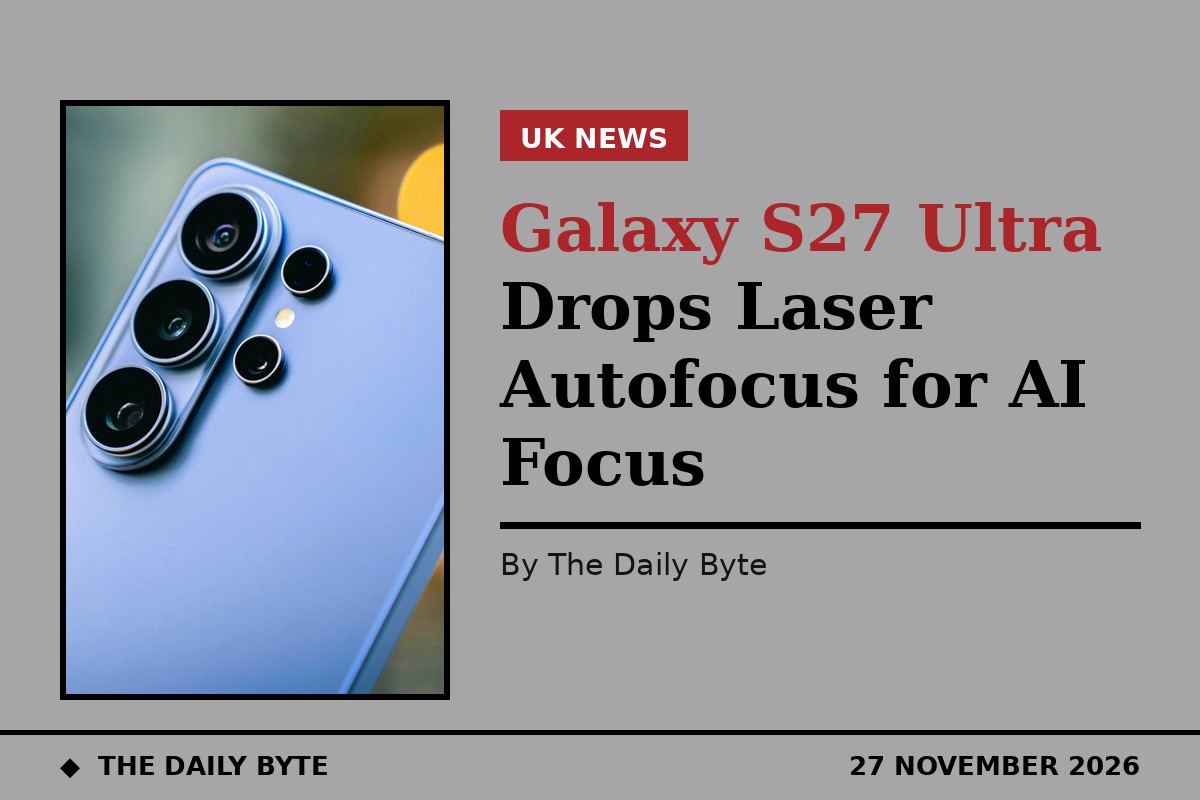
Samsung's next flagship phone may arrive with fewer camera parts than the model it replaces, if new reports about the Galaxy S27 Ultra are accurate. Tipster Ice Universe reports that Samsung plans to drop the dedicated laser autofocus module from the S27 Ultra and replace it with a software system called AI Focus.
The report, covered on 27 November, also says the phone could lose its dedicated 3x telephoto camera. That would leave the 5x periscope zoom as the only dedicated telephoto lens on the rear of the phone. Samsung has not announced the Galaxy S27 Ultra and has confirmed none of these details.
What the leak claims
Ice Universe reports that the S27 Ultra will not carry a separate laser autofocus sensor. Instead, Samsung is said to be relying on AI Focus, a computational approach to focusing that uses the image sensor and software rather than an infrared laser rangefinder to judge distance.
The same reports point to a slimmer rear camera system. The Galaxy S26 Ultra carries four rear cameras, including dedicated 3x and 5x telephoto lenses. The S27 Ultra is reported to move to a three-camera array, with the 3x lens removed and mid-range zoom handled by cropping from the main sensor or by processing. Leaked design sketches also point to a horizontal camera bar, with two larger lens assemblies and two smaller cutouts for the secondary camera and flash.
A five-year hardware streak ends
Laser autofocus has been part of Samsung's Ultra phones since the Galaxy S21 Ultra, which Samsung unveiled on 15 January 2021 with a dedicated Laser AF module. The hardware first appeared on the Galaxy Note20 Ultra in August 2020, and Samsung has kept a laser sensor on every S Ultra flagship since, including the Galaxy S26 Ultra.
Samsung has positioned the laser as an aid for close-range focusing and low-light scenes. Removing it would end a run of more than five years. Modern image sensors already use on-chip phase and contrast detection, so dropping the laser would not remove autofocus itself, but it would remove an active distance-measuring aid that behaves predictably in dim light.
What AI Focus would have to prove
The question facing the reported change is consistency. A dedicated laser sensor behaves the same way under the same conditions, while software-led focusing can behave differently depending on lighting, motion and scene contrast.
Reports suggest AI Focus could bring faster lock-on and smarter subject tracking, and a separate report from the same tipster claims the S27 Ultra's new main camera will bring clear improvements to night photography and video, with brighter and more detailed results. Whether software focusing can match a laser sensor for close subjects and dim indoor scenes cannot be verified until independent hands-on testing takes place.
The reports also describe a new Galaxy AI feature called Zoom Enhancer in One UI 9.5, which would work in the Gallery app to improve zoomed images. That would fit the same pattern: hardware simplified, software asked to fill the gap.
What is still unconfirmed
The Galaxy S27 series is widely reported to be due in early 2027, but Samsung has said nothing official about the phones, their cameras, their prices or their launch date. All of the camera changes, the AI Focus system and the launch timing remain unconfirmed and subject to change.
If the reports hold up, the S27 Ultra would be the first Galaxy S Ultra since the S21 Ultra to ship without a separate laser autofocus module. For buyers who use an Ultra phone mainly for close-up shots, portraits or low-light photography, real-world samples will matter more than the component list.


