Ganges Treaty Talks Stall as Expiry Nears
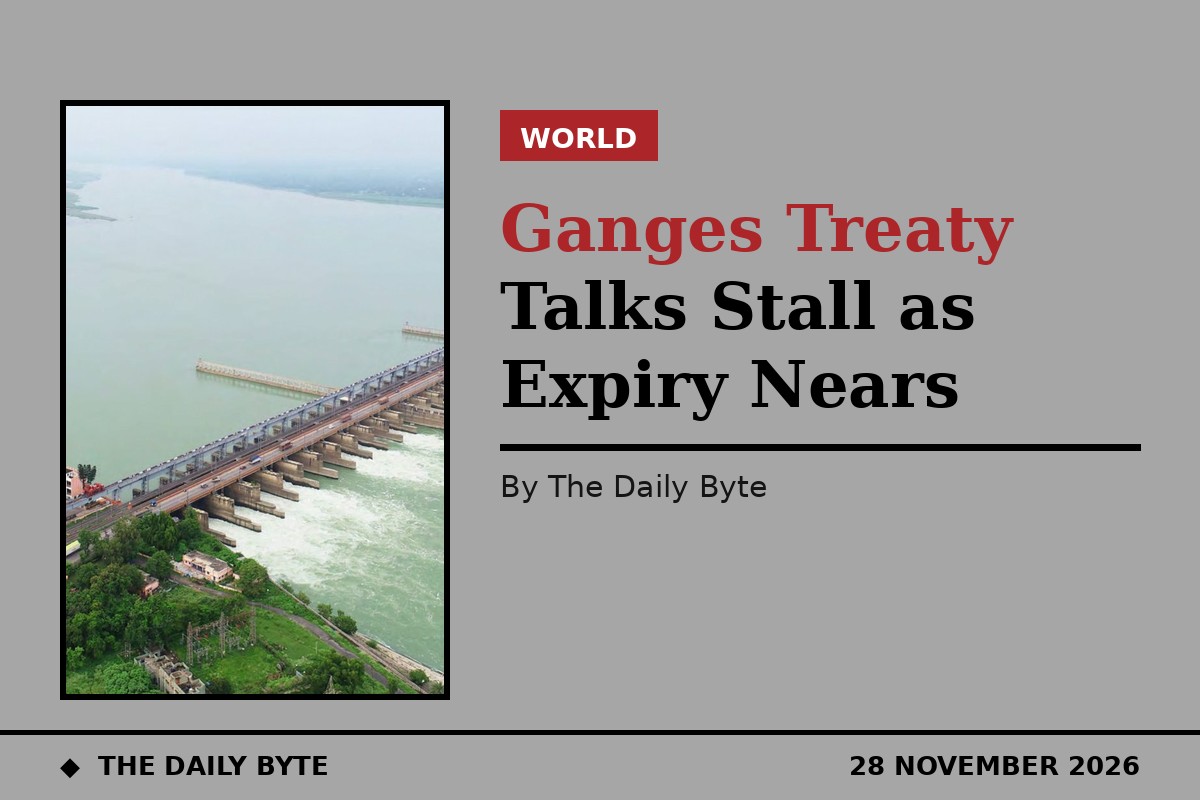
Bangladesh and India remain divided over how to begin talks on the future of the Ganges Water Sharing Treaty, with two weeks left before the 30-year agreement expires on 12 December 2026 and no agreed route into negotiations.
The treaty was signed in New Delhi on 12 December 1996. Its sharing rules govern dry-season flows from the Farakka Barrage in West Bengal to the Hardinge Bridge in Bangladesh between 1 January and 31 May each year. For 2026, that season has already ended: the last scheduled release of Ganges water reached Bangladesh on 31 May.
Two letters, no reply
Dhaka says it has done the groundwork. Bangladesh formed a high-level technical committee in June 2026 to prepare for discussions, informed India of the decision and asked New Delhi to form a corresponding committee. It renewed the request in August. Water Resources Minister Shahiduddin Chowdhury Anee said Bangladesh has sent two letters to India about the treaty and received no response. "We have sent two letters to the neighbouring country regarding the Ganges treaty. I personally sent a letter, but have not received any response so far," he said.
Professor Rashed Al Mahmud Titumir, the prime minister's finance and planning adviser and head of Bangladesh's technical committee on Ganges water, said Dhaka has completed all necessary preparations and hopes India will act before the current term ends so formal negotiations can begin.
India's position is that the machinery already exists. Randhir Jaiswal, spokesperson for India's Ministry of External Affairs, said the Joint Rivers Commission is the established mechanism for discussing all water-related and cross-boundary river issues, including the Ganges. "The government of India remains committed to a constructive and forward-looking relationship with Bangladesh while safeguarding India's interest," he told reporters in New Delhi.
A new deal, not a renewal
Dhaka has made clear it wants a new agreement rather than a simple extension of the old one, and a minimum guarantee clause is expected to be its central demand. Under a 1977 arrangement, Bangladesh was guaranteed at least 80 per cent of its scheduled allocation during specified lean-season periods, even when river flows fell short. Water Resources Minister Anee said: "We certainly want a new agreement. We want to conclude it while protecting the interests of our country."
That demand is likely to be the hardest part of any negotiation. Dr Nilanjan Ghosh, vice-president of development studies at the Observer Research Foundation in Kolkata, noted that India has kept an almost perfect record in following the Farakka release schedule set out in the treaty. But he argued that a fixed volumetric guarantee, binding whatever the actual flows, would place an unequal hydrological burden on the upstream country. "India therefore cannot commit to such an impracticable demand," he wrote, warning it could leave India carrying a disproportionate share of climate-driven shortages regardless of its own domestic needs.
Ghosh also pointed to deeper limits in the existing treaty. He said it deals only with the volumetric distribution of water and sets up no integrated framework for managing the river basin as a whole, nor does it adequately recognise the river's sediment, biodiversity, ecosystem services or changing economic demands. The continuing ecological distress of the Bengal Delta, he argued, raises questions about simply carrying the old agreement forward.
Others in Dhaka agree the treaty needs revision rather than renewal. Professor Shahab Enam Khan, executive director of the Bangladesh Centre for Indo-Pacific Affairs, said it was very important for both countries to renew the Ganges treaty, "but it has to be revised", because it was drawn up almost three decades ago.
Bangladesh's foreign minister, Khalilur Rahman, has called for a new or revised treaty that guarantees the essential needs of both countries' people, describing the shared rivers as a common legacy and a common interest. Speaking on the sidelines of the ninth Indian Ocean Conference in Mauritius, he said the two sides should look beyond the next five or ten years and build a framework for the next 25 to 50 years, with mutual climate resilience at its heart.
With the expiry date now two weeks away, the immediate task is procedural: agreeing how talks should even start. Until Dhaka and New Delhi settle that question, the river that waters tens of millions of people on both sides of the border will enter 2027 without a treaty to govern its sharing.


