GAO warns US food supply open to cyberattacks
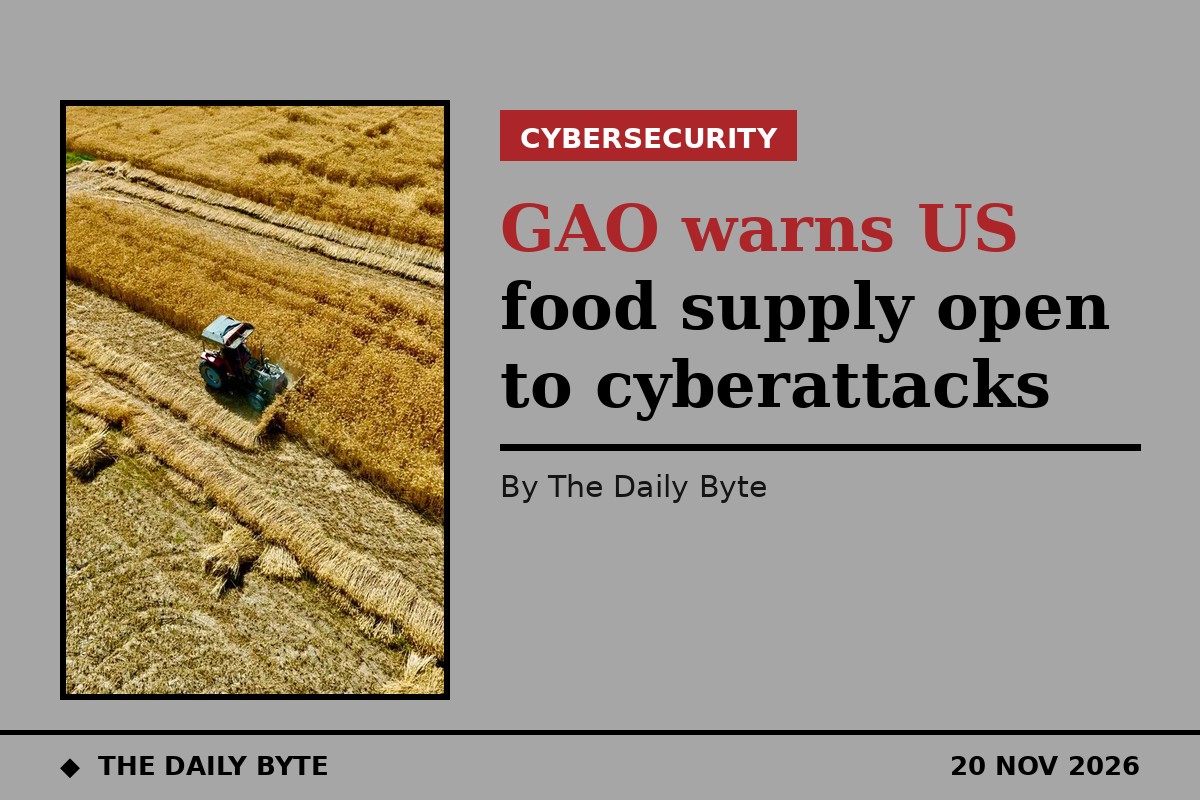
The US Government Accountability Office has warned that federal efforts to protect the food and agriculture sector from cyberattacks remain incomplete, leaving the nation's food supply open to ransomware and operational disruption. In a report published on 19 November, the watchdog found that the Department of Agriculture and the Food and Drug Administration had met most of their cybersecurity responsibilities, but had only partially met or failed to meet five of 16 requirements set by the fiscal year 2021 National Defense Authorization Act, in the areas of information sharing and emergency preparedness.
The food and agriculture sector is one of the nation's 16 critical infrastructure sectors, and it is essential to the nation's health, security and economy. The GAO says the sector's increased use of technology has made it more vulnerable to attacks. Farmers use GPS-guided tractors and real-time soil sensors, processors run automated lines, and distributors track shipments digitally, and each connected system is a possible way in if adequate controls have not been put in place.
Five recommendations, and a split response
The GAO made five recommendations: three to the Department of Health and Human Services, which oversees the FDA, and two to the Department of Agriculture. Both departments were urged to fully implement the information-sharing and emergency-preparedness requirements and to assess whether resources should be reprioritised or additional funding requested. The Department of Health and Human Services agreed with its recommendations. The Department of Agriculture disagreed with its two recommendations and asked the GAO to remove or redirect them, and the GAO said it continues to maintain that the recommendations are warranted.
Both agencies reported that a lack of resources and staffing hindered their efforts. The GAO found that the agencies met most of the requirements, including sector coordination and risk assessment, but the weak spot was information sharing: three of four requirements were met and one was only partially met. The partially met requirement concerns giving the Cybersecurity and Infrastructure Security Agency and the sector awareness of ongoing and real-time threats, vulnerabilities and mitigations. The USDA supplied input for a June 2026 advisory on hardening automatic tank gauge systems, but the agencies do not give CISA continuous, real-time awareness, and the FDA has no structured mechanism for continuously collecting cybersecurity data.
Ransomware is the sector's most common attack
Ransomware has been the most commonly reported cyberattack type in the food and agriculture sector since 2021. The Food and Ag-ISAC, the sector's information-sharing centre, recorded 167 ransomware incidents in 2023, 206 in 2024 and 295 in 2025. In August 2026 it reported 227 ransomware incidents through July 2026 and noted that 2026 is on pace to be one of the highest-volume ransomware years on record for the sector. Most reported attacks sought ransom payments by shutting down food production and distribution systems.
The report cites a series of costly incidents. A 2021 ransomware attack on a global meat processing company shut down some of the world's largest slaughterhouses and caused meat shortages in the US and other countries; the company, JBS, paid an 11 million dollar bitcoin ransom. A January 2021 attack on a US farm, carried out through compromised administrator credentials, caused a 9 million dollar production loss. A February 2023 ransomware attack on Dole's legacy servers and end-user computers shut down production plants, disrupted US grocery supplies and cost 10.5 million dollars. A May 2022 ransomware and data exfiltration campaign against farming equipment maker AGCO halted operations for about two weeks, including a tractor assembly facility. More recently, a July 2026 ransomware intrusion into Fairlife's systems, including production systems, prompted production halts at US plants during a Coca-Cola investigation.
Connected farms, widening exposure
The GAO gives a concrete example of what is at stake. It says failure to implement basic security measures, such as changing default passwords, can be exploited by threat actors, who could then manipulate data related to food quality, contamination testing or traceability, potentially resulting in the distribution of unsafe or contaminated food products. That in turn could pose public health risks, trigger product recalls and damage the reputation of food producers.
The watchdog also found structural blind spots. The USDA and FDA lack authority to require sector-wide reporting and have no established voluntary incident-reporting mechanisms, while the Food and Ag-ISAC relies on voluntary member submissions and CISA offers a voluntary reporting mechanism, so the true volume and impact of incidents extends beyond what is publicly reported. The agencies' draft risk management plan, submitted in early January 2025, remains unfinalised.
Until the agencies assess whether they can reprioritise existing resources and staff, or need additional resources, the GAO warned, the sector will remain more vulnerable to attacks that could disrupt food and agriculture supply chains and carry significant economic and environmental consequences.


