GAO: ICE paid $13m a month for empty detention beds
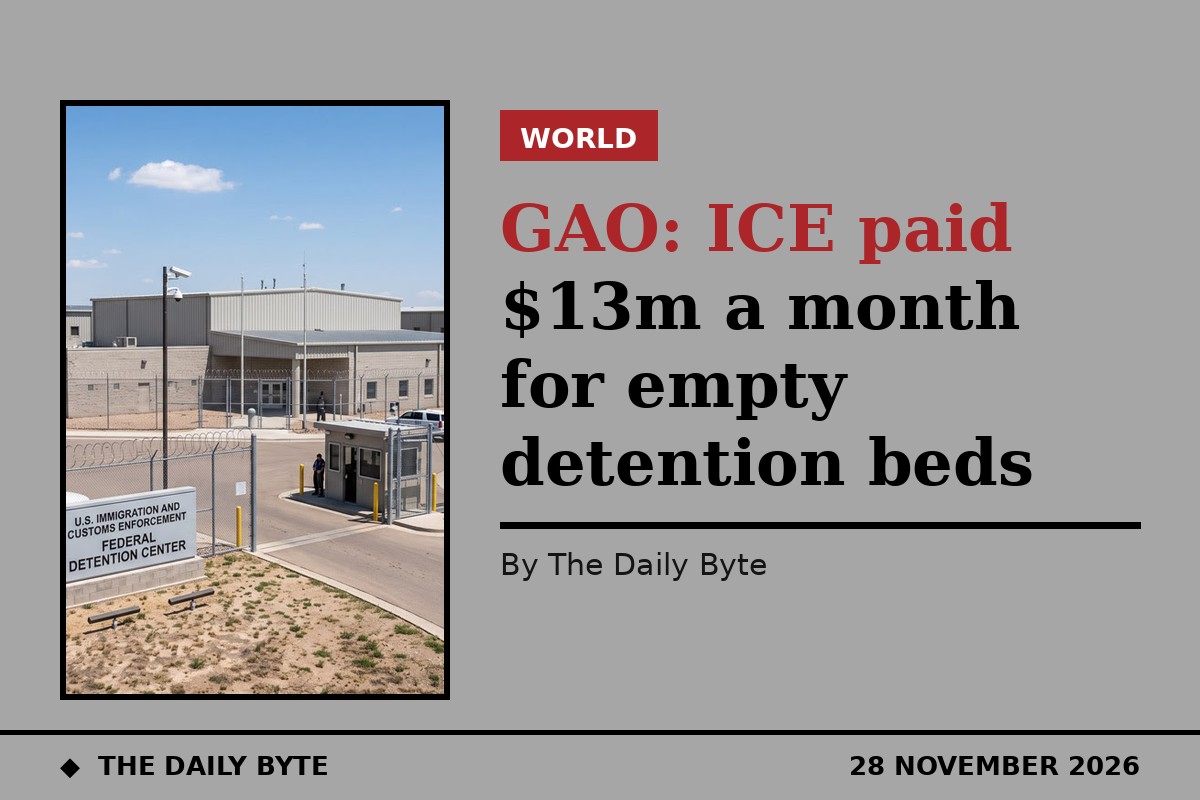
United States Immigration and Customs Enforcement paid about 13 million dollars a month for detention beds that sat empty at five recently acquired facilities, according to a report from the Government Accountability Office (GAO), Congress's nonpartisan watchdog. The audit also found the agency may have overpaid for warehouses it bought to hold detainees and is now trying to sell.
The report, GAO-27-108665, was released on 19 November 2026 and examined how ICE is using 45 billion dollars in detention funding provided under the reconciliation law signed by President Donald Trump in July 2025. The money is available through 2029. So far, ICE has committed about 9 billion dollars of it, the report found.
Many ICE contracts guarantee the operator payment for a fixed number of beds whether or not ICE fills them. As of April 2026, ICE had committed to 46,688 fixed beds at 64 facilities. From October 2025 through April 2026, an average of 9,733 of those beds sat empty each day, roughly one in five of the beds the agency was contractually bound to pay for.
The GAO looked closely at the five largest fixed-bed facilities ICE added in fiscal 2025. Together they averaged 2,614 empty beds a day, which the watchdog estimated cost about 13 million dollars a month. Two facilities accounted for most of it. California City in California had 2,560 fixed beds, an average population of 1,353 and 1,207 empty beds, costing an estimated 5.02 million dollars a month. Diamondback in Oklahoma had 1,200 guaranteed beds but held an average of only 364 people, leaving about 70 per cent of the paid space unused at a cost of 5.84 million dollars a month.
The other three facilities were North Lake in Michigan, with 422 empty beds a day at 1.63 million dollars a month; the Folkston D. Ray Processing Center in Georgia, with 149 empty beds at 540,000 dollars a month; and Delaney Hall in Newark, New Jersey, which ran above its guaranteed count of 700 beds and had no empty beds.
Between January and March 2026, ICE bought 11 warehouses for about 1.07 billion dollars under a plan for 92,600 beds at an estimated cost of 38.3 billion dollars. For nine of the 11 warehouses, ICE paid at least 50 per cent more than the local tax assessment. Six of the seven warehouses it now plans to sell were bought for at least double their assessed value, although the GAO cautioned that assessed values are an imperfect proxy for market prices.
ICE now intends to sell seven of the warehouses and keep four, which would hold at most 6,000 beds. The seven had already cost about 20.5 million dollars in due diligence, utilities and security as of August 2026, and auditors warned the sales could result in losses for taxpayers.
The agency has nonetheless kept buying. In July and August, it purchased four existing detention facilities for more than 2 billion dollars, despite failing to fully evaluate the long-term costs of expanding its detention network, the GAO said.
The report also highlighted the cost of military sites. Camp East Montana at Fort Bliss in Texas carries a flat fee of more than 38 million dollars a month, and its obligations topped 1 billion dollars from October 2025 through June 2026, about 36 per cent of all ICE detention obligations in that span.
The GAO questioned ICE's spending plan, which still assumed roughly 38 billion dollars in fiscal 2026 obligations. The watchdog called the idea of obligating another 29 billion dollars in two months unrealistic. It made two recommendations, both listed as open: that ICE keep its detention spending plans current and complete, and that it develop life-cycle cost estimates and weigh alternatives before making significant new detention investments. The Department of Homeland Security, which oversees ICE, agreed with both.
The findings drew sharp reactions from Arizona Democrats in Congress. Senator Ruben Gallego said lawmakers had to establish whether there was any level of corruption in the spending, calling it American taxpayer dollars. Representative Greg Stanton said the spending needed to be fully investigated.
The report also set out the context. ICE's detained population has surged, from 39,314 people in custody on 20 January 2025 to 67,180 on 30 July 2026, according to the GAO's count. The Department of Homeland Security announced on 12 November that ICE had set records for arrests and deportations in fiscal 2026.
Congress is now deciding how much more to give the Department of Homeland Security and on what terms, with the current funding deadline falling on 11 December. The GAO report hands both sides audited numbers on how ICE has spent the detention money it already has.


