Gaza Peace Plan Scores 4 Out Of 26, Aid Groups Say
One year after the Gaza ceasefire was agreed, five leading humanitarian organisations have given the peace plan a failing grade: 4 points out of a possible 26.
The scorecard, published on 19 November by the Danish Refugee Council, the Norwegian Refugee Council, Oxfam, Refugees International and Save the Children, assesses the Trump administration's 20-point plan against its own stated objectives — civilian protection, humanitarian access, reconstruction and economic development, and freedom of movement and return. The plan was endorsed by the United Nations Security Council in Resolution 2803 in November 2025.
"One year after an internationally backed 'peace' plan for Gaza was launched, it has received a failing grade," the organisations said, "with nearly five deaths a day on average and over half the population living in temporary shelters."
The score is worse than the one the same organisations gave six months ago. In April 2026, their first scorecard rated the plan at 5 out of 26. At the one-year mark it has fallen to 4 — and humanitarian access, graded on the plan's own terms, again scores zero.
The killing did not stop
At least 1,650 people have been killed and 5,975 wounded in Gaza since the ceasefire was declared in October 2025, according to the scorecard — more than double the toll recorded at the six-month mark. The ceasefire formally began on 10 October 2025 and secured the release of the remaining living Israeli hostages, but attacks have continued on both sides ever since.
Civilian protection earned just one point out of the scorecard's total. The plan's second phase — disarmament, Israeli withdrawal and reconstruction — remains stalled, and the organisations say the agreement has delivered almost nothing visible to the people it was meant to protect.
The same warning came this week from the body set up to oversee the agreement. The Board of Peace told the United Nations Security Council on 17 November that the ceasefire risks collapse if its terms are not fully implemented, saying "a ceasefire that delivers nothing visible cannot be sustained indefinitely."
A fourth winter in tents
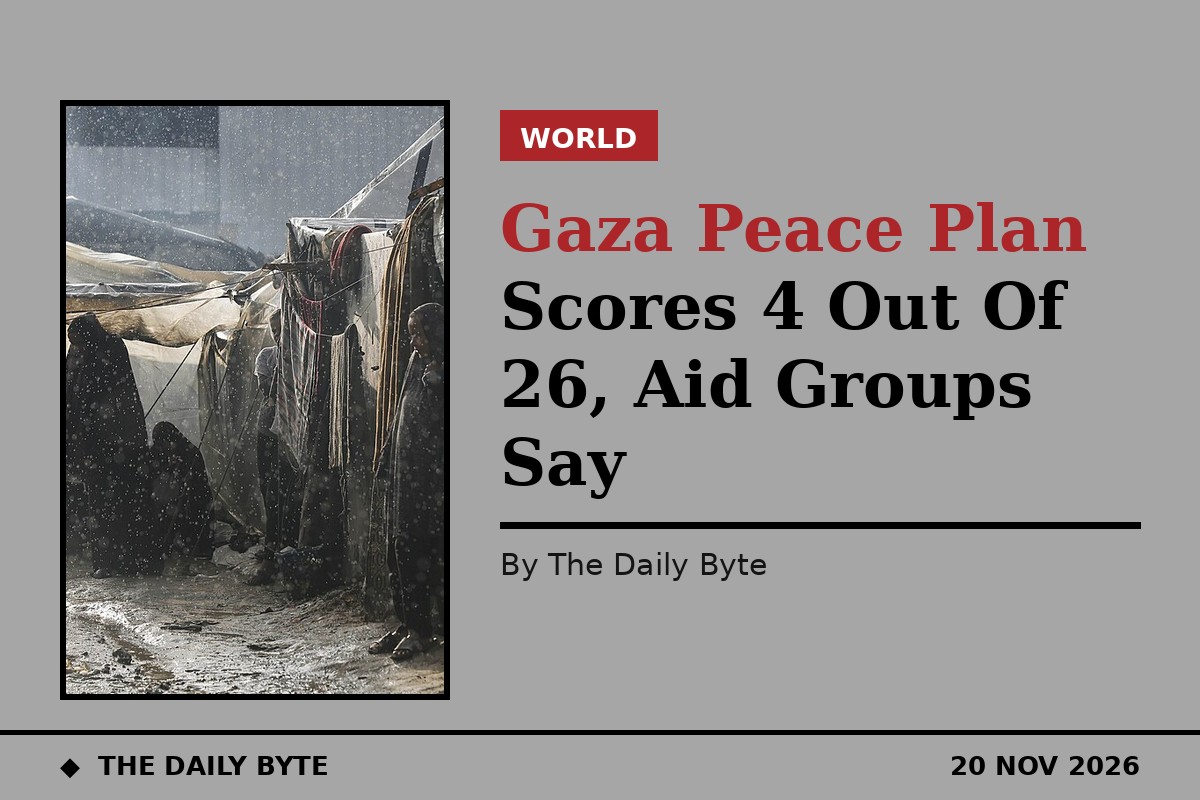
For the people of Gaza, the failure of the plan is measured in shelter, food and cold. As Gaza faces its fourth winter since the war began, nearly one million Palestinians are living in sites at medium or high risk of flooding, and 89 per cent of households report rodents inside their shelters.
Already this month, a rainstorm flooded more than 70,000 tents, and a nine-month-old child was reported to have died of hypothermia. The ceasefire stipulates an agreed minimum of 600 United Nations-coordinated aid trucks entering Gaza every day — but the scorecard grades humanitarian access at zero, the same failing mark it gave in April, and says critical shortages of basic medicines and supplies have led to deaths from treatable injuries and illnesses.
Israel says more than 93,000 tents have entered Gaza and that Hamas, not Israel, is the obstacle to aid. The four governments that urged Israel on 15 November to let 150,000 tents in before winter — Australia, Canada, Italy and the United Kingdom — put the number held at the border far higher. The two sides are counting different things, and neither count settles how many families are still without shelter.
What the scorecard asks for
The organisations behind the scorecard are not asking for a new plan. They are asking for the one that was agreed to be carried out: the aid the agreement promises, the withdrawal and reconstruction it sets out, and the freedom of movement and return it guarantees on paper.
"A ceasefire that delivers nothing visible cannot be sustained indefinitely," the Board of Peace warned the Security Council. The scorecard puts numbers to that warning: 4 out of 26, zero for humanitarian access, and a death toll that has more than doubled since the last time the same organisations measured it.
Sources: ReliefWeb; Refugees International.


