Gaza Now a Toxic Wasteland, Oxfam Report Finds
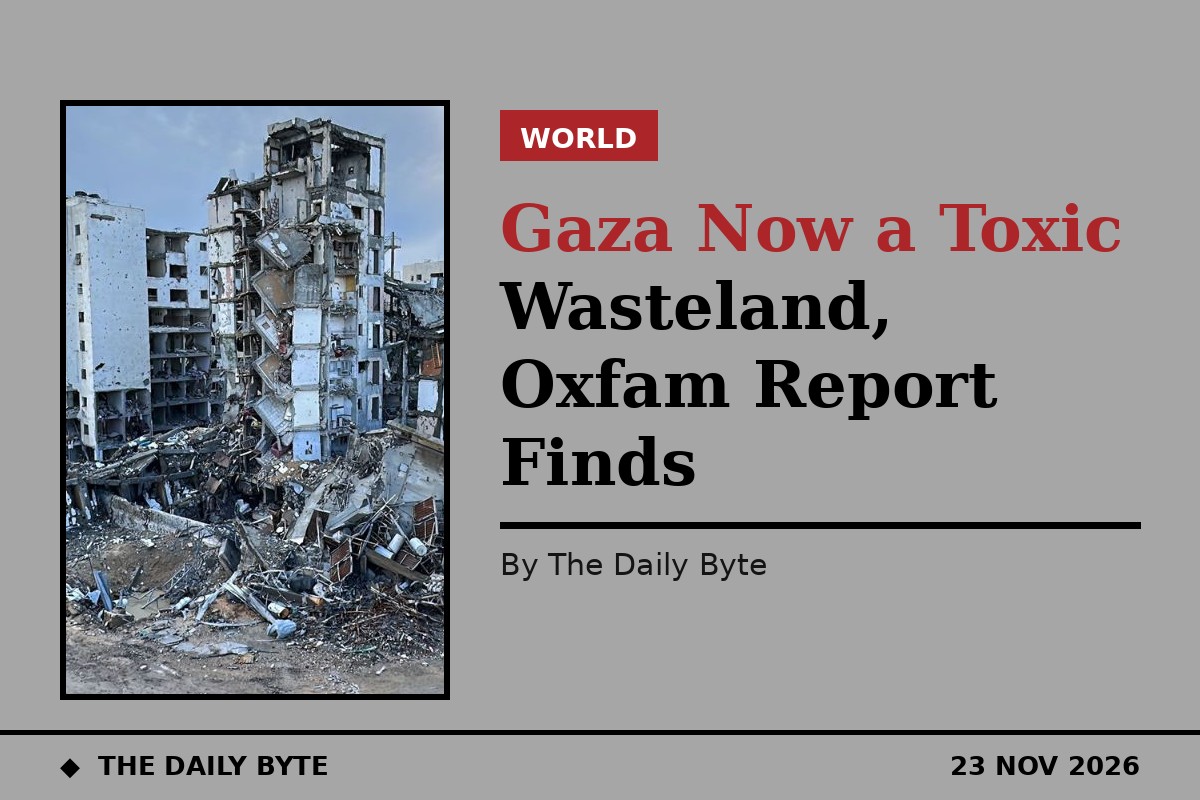
More than 99 per cent of Gaza shows indicators of potential environmental contamination after Israel's military assault, according to a new report published on Monday, 23 November 2026, by Oxfam and the Conflict and Environment Observatory. The report, titled "Environmental War Crimes: How Israel's military assault has turned Gaza into a toxic wasteland, threatening human survival", says the extensive use of explosive and incendiary weapons has made the air, soil and water dangerous to Palestinians now and for decades to come.
The report found that the scale and intensity of the assault has affected about 78 per cent of Gaza's land area, with its spatial analysis identifying indicators of potential contamination across more than 99 per cent of the territory. It identified widespread risks from heavy metals, explosive residues, asbestos from destroyed buildings, dioxins and biological contaminants, threatening the environmental systems people in Gaza depend on for survival.
What the report found
Using satellite imagery, remote sensing and scientific analysis, the report concludes that the evidence already available is sufficient to show that contamination is widespread, severe and consequential, with serious implications for public health. It also cautions that restrictions on bringing testing equipment and technical expertise into Gaza continue to prevent a full assessment.
The highest levels of potential contamination are concentrated in Gaza City, Khan Younis, Rafah, Jabalia and along the Salah al-Din Road, the report says. Areas around Beit Hanoun, Wadi Gaza and north-east Khan Younis face heightened risks of long-term soil contamination because their clay-rich soils are more likely to retain pollutants, threatening the safety of food crops when farming resumes.
The United Nations Environment Programme estimates that Israel's military operations have generated more than 61 million tonnes of debris across Gaza, turning destroyed homes, neighbourhoods and infrastructure into a vast reservoir of potentially hazardous materials.
Water, sewage and the air people breathe
About 85 per cent of Gaza's water infrastructure has been damaged or destroyed, according to the report, leaving people with roughly 18 litres of water per person per day. Faecal coliform bacteria were found in 19 per cent of 79 groundwater wells sampled in July 2026, compared with 2 per cent of wells reported as contaminated in 2021.
Only 19 per cent of sewage pumping stations remain functional, with just 30 per cent of the wastewater network having some operational capacity. About 40,000 cubic metres of raw sewage is pouring into the Mediterranean Sea each day, with a further 15,000 cubic metres a day lost from the wastewater collection system through cesspits and other leaks, the report says.
Gaza City, Jabalia and the North Gaza governorate face the highest risk of air contamination, as pollutants from intensive bombardment are stirred back into the air as contaminated dust by wind, vehicle movement and debris clearance. People in Gaza face growing respiratory health risks from dust and pollution caused by the destruction of buildings and the burning of waste. The report warns that because Gaza's health and monitoring systems have been destroyed, much of the harm caused by the toxic waste will go undetected and unattributed for years.
What Oxfam is calling for
"The destruction and contamination of Gaza will have fundamentally degraded the environmental conditions necessary for human safety and survival," said Oxfam International executive director Amitabh Behar. The report's authors said environmental destruction on such a large scale "may constitute, facilitate or provide powerful evidence of war crimes, crimes against humanity and genocide", CNN reported.
Oxfam calls for a full, independent, field-based post-conflict environmental assessment to establish what contaminants are present, where they are found and at what concentrations. It also calls on Israel to allow unrestricted access for aid, environmental assessment and essential equipment, and for states to halt arms transfers to Israel where they sustain what Oxfam describes as the unlawful occupation of the occupied Palestinian territory, or where they are used to commit serious violations of international law.
Israel's foreign ministry called the report "shameful and scandalous" and said Oxfam had "traded its credibility for campaigning". In a statement to CNN, the ministry said: "The scale of destruction in Gaza reflects the scale of the terror network Hamas built there, including a 500+ kilometer tunnel system and weapons depots, inside and beneath civilian areas."
Report author Lama Abdul Samad, a global water and sanitation specialist at Oxfam, said fixing Gaza's environment would be highly challenging because contamination is dispersed across urban rubble, farmland, water systems and soils, while unexploded ordnance restricts safe access to most areas. "Rebuilding Gaza without simultaneously understanding and addressing the extent of environmental contamination risks creating long-term public health consequences for generations to come," Behar said.
By November 2026, Oxfam says Israeli forces have killed more than 74,000 Palestinians and wounded over 175,000 since October 2023, with thousands still unaccounted for under the rubble.


