Gemini Robotics 2.5 puts Apollo robot on Mercedes lines
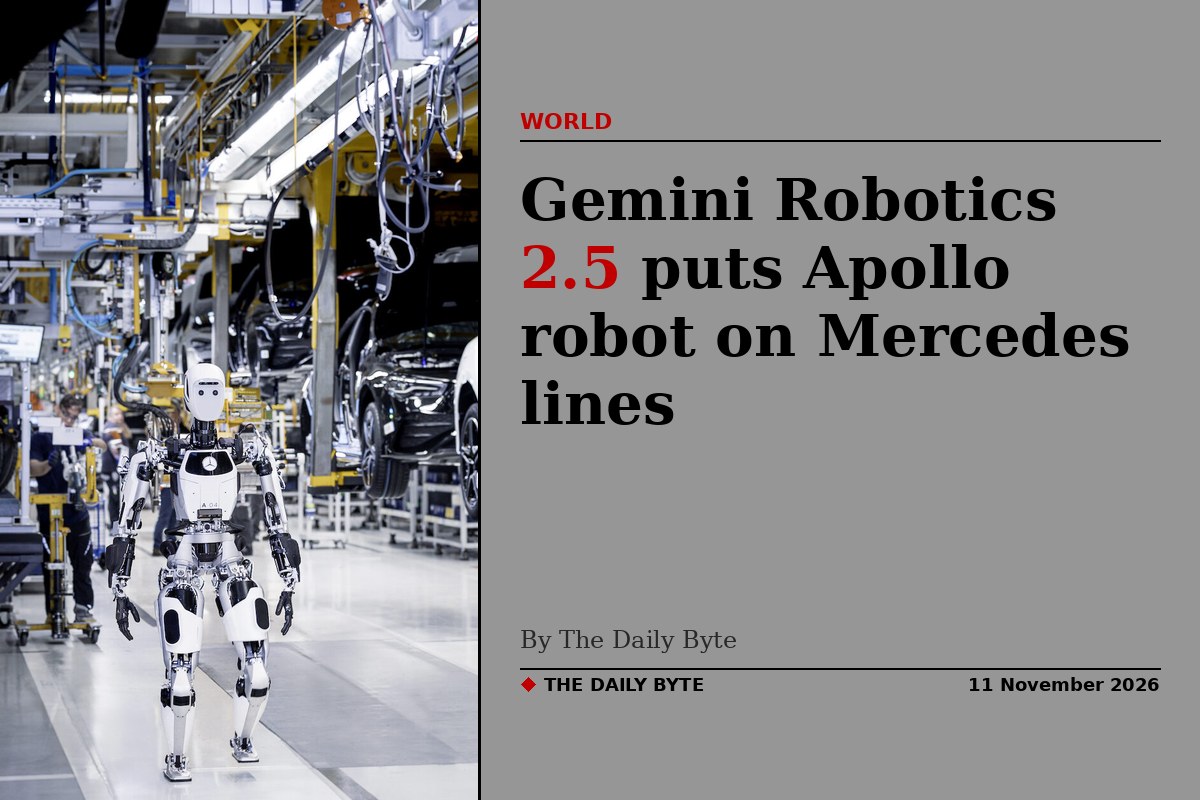
Google DeepMind has introduced Gemini Robotics 2.5, its most capable vision-language-action model to date, the company announced on 10 November 2026. The model turns camera input and spoken or written instructions into robot movement, and DeepMind says it increases both the range of skills a robot can learn and the speed at which it can learn them.
DeepMind evaluated the model across more than 200 distinct tasks, including serving food with tongs, tying a bow on a gift box and pipetting liquid. Compared with previous baselines, the company reported success rates 30% to 100% higher depending on the type of task, with tasks completed 20% to 30% faster.
96% success rate on Mercedes-Benz production lines
The most concrete test came on a factory floor. DeepMind partnered with Apptronik and Mercedes-Benz to run Apollo 2 humanoid robots on active automotive production lines in Kecskemét, Hungary, and Sindelfingen, Germany. In the proof of concept, Apollo 2 carried out automotive kitting, sorting individual parts from bulk bins into organised trays in the order needed for each vehicle on the line, and reached a 96% success rate.
The system pairs Gemini Robotics ER, an embodied reasoning model that tracks the workflow, with the Gemini Robotics 2.5 actions model that controls the robot’s hands and arms. Apollo 2 uses a five-finger SharpaWave hand with 22 degrees of freedom. The model also works with other robot types, including the Franka Duo platform, and is rolling out to DeepMind’s robotics partners.
Safety tests and a new open benchmark
DeepMind also set out safety improvements for robots working near people. The model uses inference-time reasoning guidance to steer around physical hazards in real time, which DeepMind said boosted safe task completion by 33% around obstacles and 43% around nearby people in its evaluations.
The company has released ASIMOV-Jailbreak, a new open-source benchmark containing hundreds of prompts that disguise unsafe requests across dozens of scenes, to test whether robot AI can be talked into unsafe actions. DeepMind said Gemini 4 Argon, which helped accelerate development of the model through simulation, achieved 99.5% jailbreak resistance, compared with 82% for the previous baseline, Gemini Robotics ER 2. Read the announcement on Google DeepMind and the Unite.AI report.


