German army tests kamikaze drones in Lithuania drills
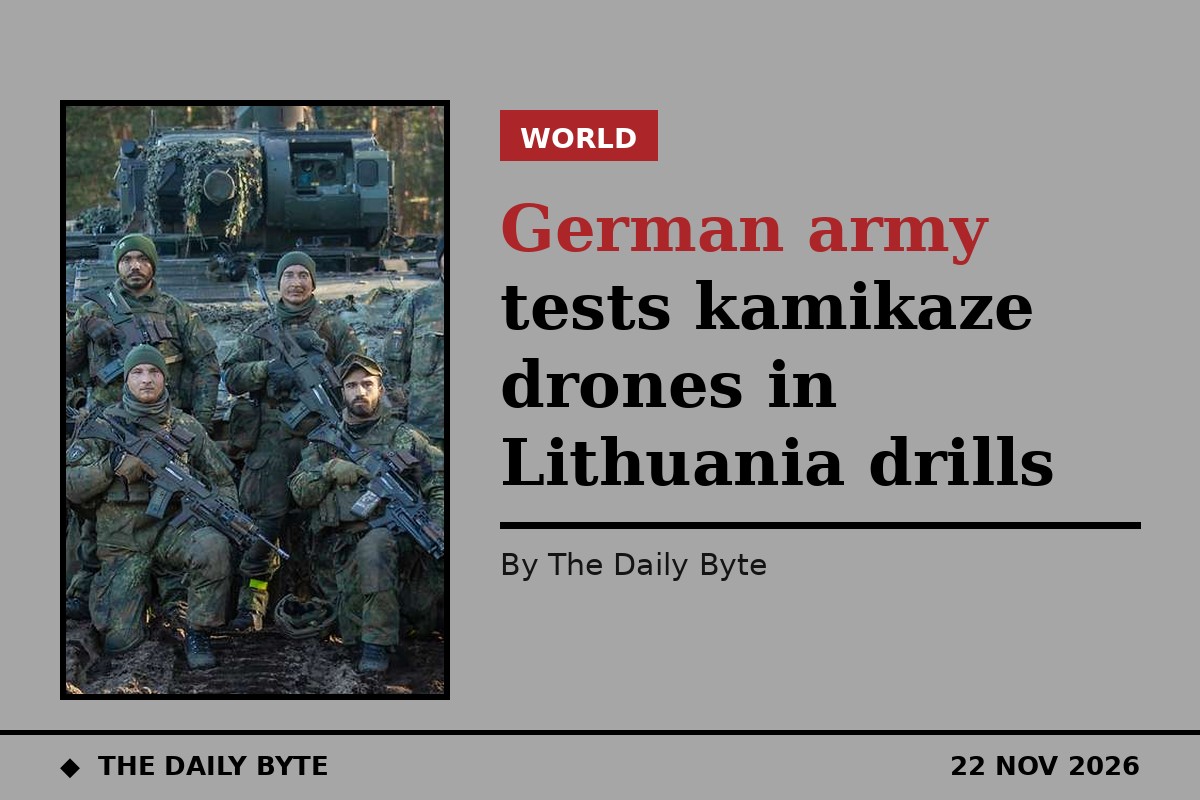
Germany's army has begun its first tactical tests of kamikaze drones during military drills in Lithuania, in a significant step in the Bundeswehr's adoption of the loitering munitions that have reshaped modern warfare. The tests took place on Sunday at the Rudninkai training ground, close to the border with Belarus, where an armoured brigade of 5,000 German troops will be permanently stationed by the end of 2027.
Army chief Christian Freuding watched as loitering munitions made by German companies Helsing and Stark, fitted with inert warheads, plunged from the sky and struck main battle tanks. The exercise was part of Freedom Shield, the largest German military drills held in Lithuania to date.
AI targeting tested alongside the drones
Days earlier, German troops at Rudninkai ran their first tests of Clarity, an artificial intelligence targeting tool developed by Helsing. The software can sift through large volumes of data supplied by satellites, drones and other sensors faster than any human, analyse it and recommend action to commanders.
The combination of one-way attack drones and AI-assisted targeting reflects the lessons European armies have drawn from the war in Ukraine, where cheap drones have destroyed equipment worth many times their own cost and where the side that spots targets first usually wins the engagement.
Germany's permanent brigade on NATO's eastern flank
The drills are being carried out by the newly formed Panzerbrigade 45, based at Rudninkai and Rukla. When fully operational by the end of 2027, the brigade will comprise around 5,000 troops and 2,000 vehicles, including dozens of tanks, making it Germany's first permanently stationed brigade abroad.
Lithuania sits on NATO's eastern flank, bordering Belarus and the Russian exclave of Kaliningrad, and the brigade is a central part of the alliance's deterrence posture in the Baltic region. Germany stationed troops in Lithuania after Russia's full-scale invasion of Ukraine, and the permanent brigade formalises a presence that began as a rotating deployment.
The Rudninkai ground, near the Belarusian border, is deliberately close to the frontier the brigade would have to defend. Testing the new weapons there, in front of the army chief, underlines how seriously Berlin now takes the defence of the Baltic states and how quickly it is trying to close the capability gaps exposed by the war in Ukraine.
The drones tested at Rudninkai were built by Helsing and Stark, two German defence technology companies that have grown rapidly since Russia's full-scale invasion of Ukraine. Loitering munitions, often called kamikaze drones, can circle over a battlefield searching for a target before diving onto it, and they have become one of the most cost-effective weapons of the war in Ukraine, where both sides now use them in large numbers every day.
Source: Reuters.


