German court voids sacking over church exit
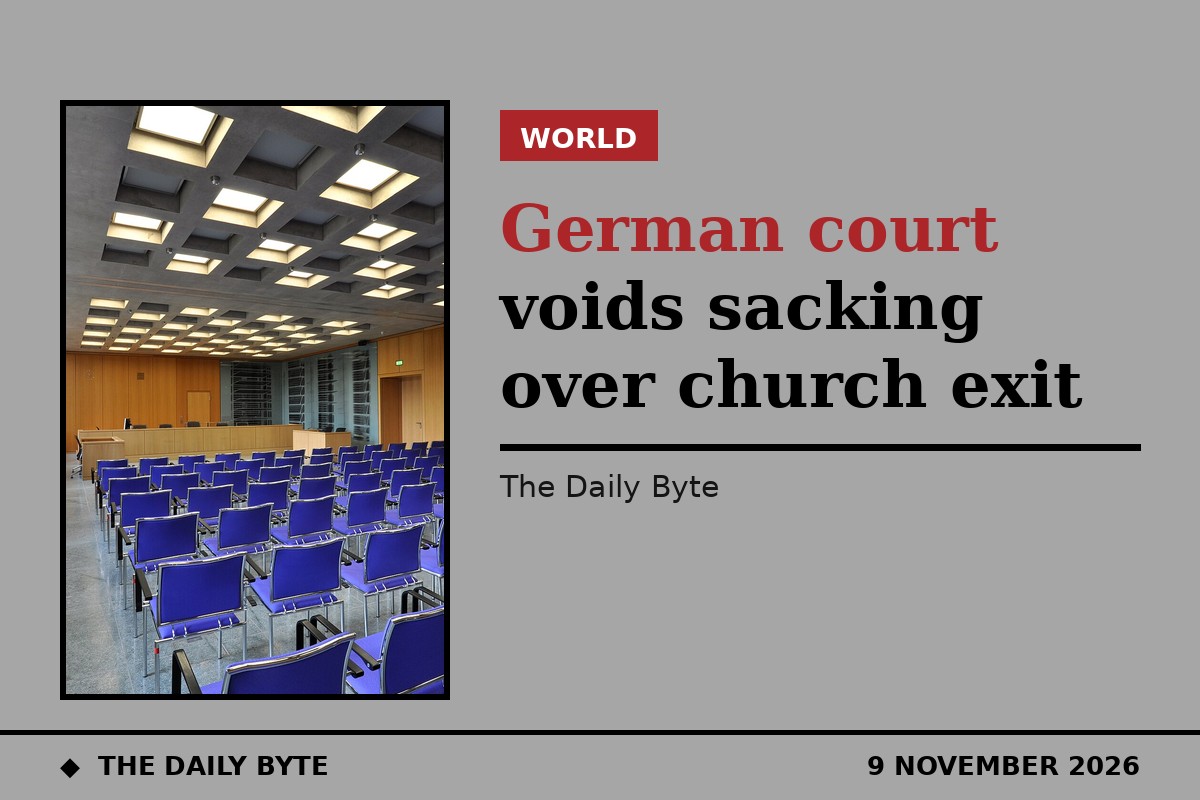
Germany's Federal Labour Court has ruled that a Catholic pregnancy-counselling association unlawfully dismissed an employee for formally leaving the Catholic Church, in a judgment that limits how far religious employers can go in sacking staff over their faith.
The Bundesarbeitsgericht in Erfurt ruled on 5 November 2026 that the dismissal of the counsellor, identified in court documents only as JB, was unlawful discrimination on grounds of religion. The case number is 2 AZR 196/22.
The court held that an employer cannot lawfully dismiss someone solely because they have formally left the Church if it employs non-Catholics to do the same work and the employee has not publicly acted against the Church.
A dismissal six years in the making
JB, a mother of five, had worked for the Katholische Schwangerschaftsberatung, a pregnancy-counselling service run by a Caritas-affiliated association in the Diocese of Limburg, since 2006.
In October 2013, while on parental leave, she formally declared before the local authority that she was leaving the Catholic Church. She did so to protest against an additional church levy charged by the Diocese of Limburg to Catholics in interfaith marriages with higher-earning spouses.
The association asked her to rejoin the Church, citing its Catholic ethos and the protection of the unborn. She refused, and the association dismissed her on 1 June 2019, the day after her continuous parental leave ended on 31 May 2019.
The employer said her departure breached the duty of loyalty to the Church's ethos that formed part of its employment rules. But at the time of the dismissal, the association also employed two members of the Protestant Church in the same pregnancy-counselling work.
Through the courts
JB challenged the dismissal, and the local labour court in Wiesbaden upheld her claim in June 2020. The association appealed, and the case eventually reached the Federal Labour Court, Germany's highest court for employment matters.
Rather than deciding the case itself in 2024, the Federal Labour Court asked the Court of Justice of the European Union whether EU law permits a religiously-grounded organisation to require staff not to leave a particular church, or to make continued employment conditional on rejoining, when it does not otherwise require membership of that church.
The EU court answered in March 2026. In its judgment in Case C-258/24, the Grand Chamber held that a Catholic employer cannot dismiss an employee simply for leaving the Church if it employs other people to carry out the same duties without requiring them to be members of that church, and if the employee does not openly act in a manner hostile to the church.
What the German court decided
Applying that standard, the Federal Labour Court concluded that JB had been discriminated against on grounds of religion. It said she "did not need to be a member of the Catholic Church to perform her duties", and that the mere fact that she had left the Church did not establish that she would no longer provide pregnancy counselling as the association required.
The court also held the dismissal without notice invalid on a separate ground: the employer had missed the statutory two-week period for acting after learning of her departure in 2013.
The judgment followed a press release from the court, Pressemitteilung Nr. 38/26 of 5 November 2026, announcing the decision.
Reaction and wider impact
The Diocese of Limburg expressed disappointment at the judgment and said the former employer should consider whether to take the case to the Federal Constitutional Court.
The ruling raises far-reaching questions about whether formally leaving the Church can be grounds for dismissal, and about how German Catholic charities can preserve their religious identity while complying with employment equality law. The decision is also relevant to Protestant employers in Germany, which operate under similar church employment rules.
In a second case heard by the same senate on the same day, concerning the dismissal of a part-time choir director who had left the Catholic Church, the parties reached a settlement.


