German Growth to Pick Up, Bundesbank Chief Says
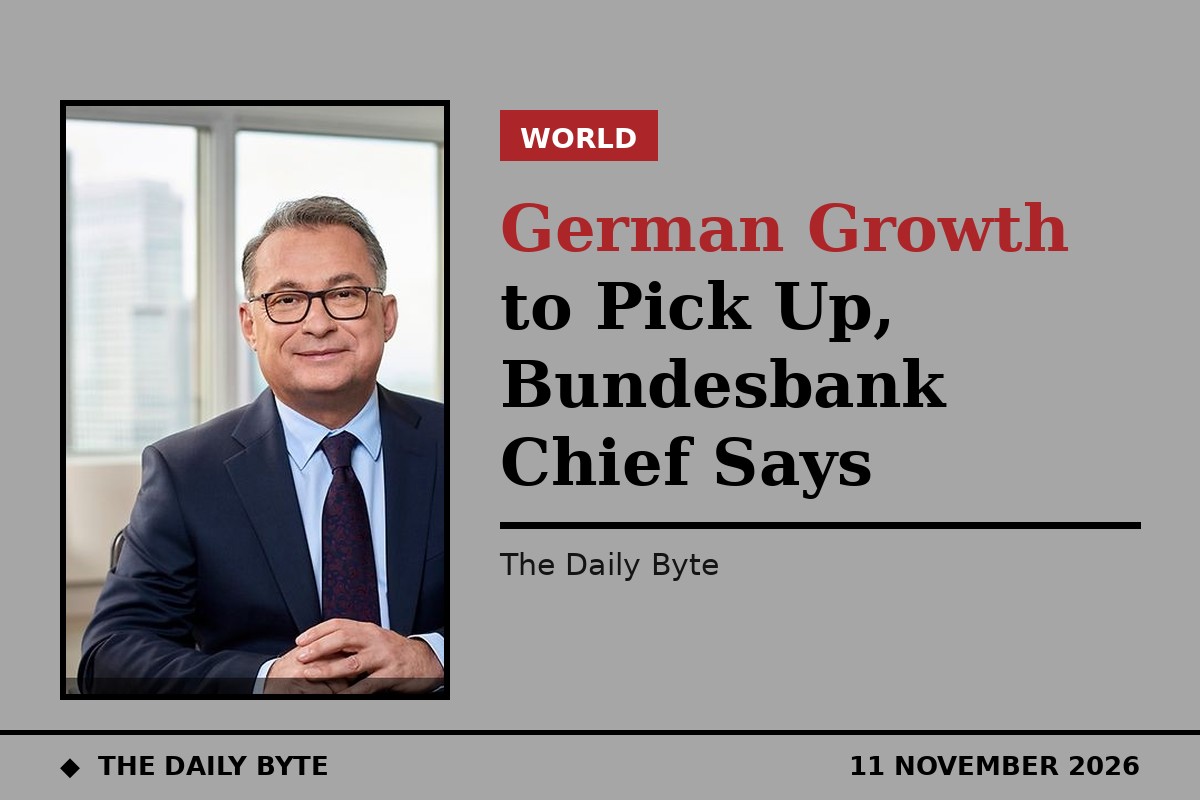
German economic growth is likely to accelerate in the final quarter of the year, Bundesbank President Joachim Nagel said on Wednesday, as Europe's largest economy recovers faster than the central bank had expected.
Speaking at a conference in Riga, Nagel said the Bundesbank's interim assessments pointed to a stronger recovery than it had pencilled in over the summer. Germany, the world's third-biggest economy, has stagnated for most of the past three years as its vast industrial sector lost some of its competitive edge, but a recovery has started to take hold this year.
A surge in government spending on defence and infrastructure has given that recovery an additional boost, alongside a better-than-expected performance from manufacturing.
Manufacturing leads the recovery
The real surprise this year has been the recovery of manufacturing, Nagel said, singling out chemicals and electrical equipment output. Order levels suggest that this trend is likely to continue into the months ahead.
In June, the Bundesbank forecast economic growth in 2026 of just 0.5%. Most major forecasters now see a growth rate of more than twice that figure, and expect it to hold up in the coming years.
Nagel was careful, however, not to overstate the improvement. The recovery, he said, is not yet broad-based. Private consumption remains subdued, and investment in machinery and equipment declined in the second quarter.
Structural challenges remain
The Bundesbank chief also warned that Germany's potential growth rate remains especially low, and that deep structural changes are needed to lift it. He pointed to three areas in particular: labour market reform, as the working-age population shrinks; the transition of the energy sector to carbon neutrality; and finding ways to foster stronger private investment.
Higher defence and infrastructure spending will support demand, Nagel said, but he cautioned that fiscal policy on its own is unlikely to lift Germany's growth potential noticeably. Bundesbank estimates suggest that additional public investment in infrastructure will strengthen potential output only very modestly, while extra defence expenditure is unlikely to raise potential growth in the foreseeable future.
That message matters beyond Germany. As the eurozone's largest economy, Germany's performance shapes growth across the bloc, and a stronger-than-expected final quarter would give the wider European recovery a firmer footing heading into 2027.
What happens next
The Bundesbank will publish its next full forecast in December, which will show whether the central bank formally raises its outlook for 2026 and beyond. For now, Nagel's remarks in Riga are the clearest signal yet from Frankfurt that the economy has turned a corner — even if the recovery still has some way to go before it reaches households and business investment more widely.


