Germany Approves €10-a-Month Child Pension
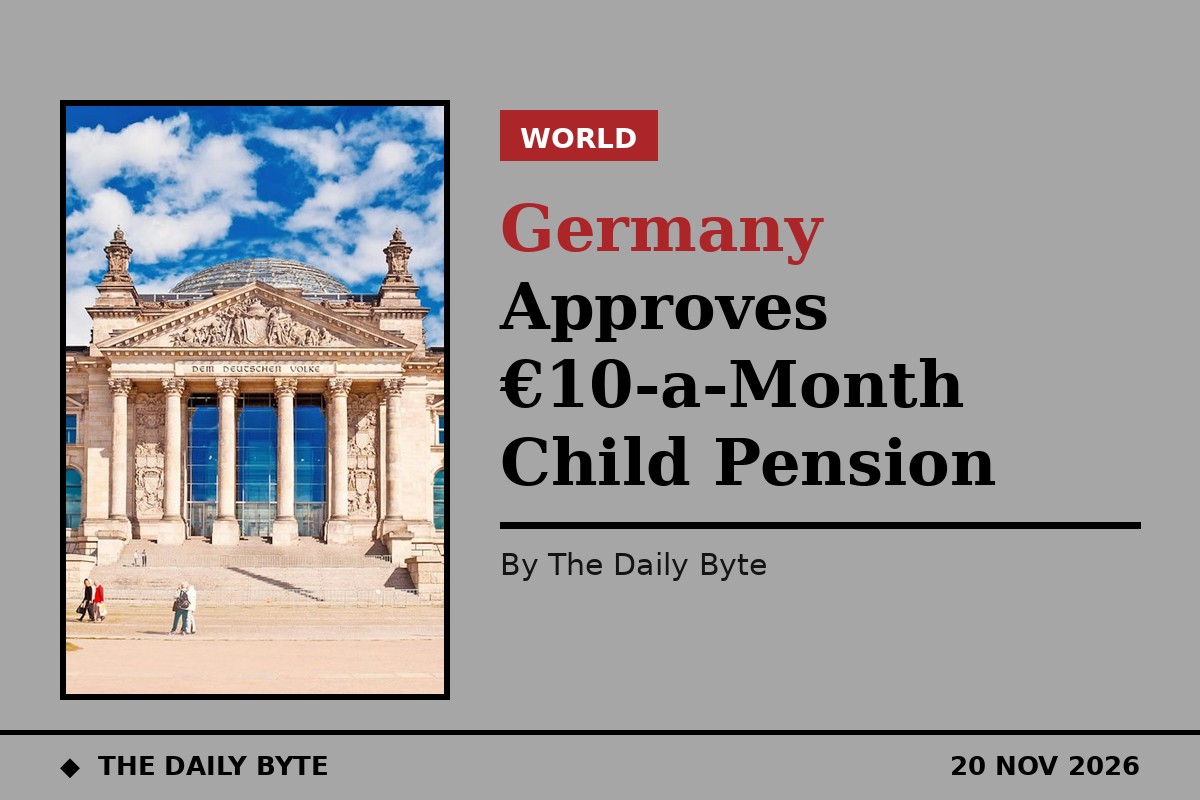
Germany's Bundesrat has approved the Fruehstartrente, the early-start pension that will pay 10 euros a month from the state into a retirement savings account for every eligible child. The upper house gave its consent on Friday, 20 November, clearing the last parliamentary hurdle for a scheme that can now come into force retroactively from the start of 2026.
The Bundestag passed the law on 16 October, following cabinet approval of the draft bill on 12 August. With the Bundesrat's agreement, the parliamentary process is complete, and the first payments are planned for early 2027.
Under the scheme, children receive the state payment each month from their sixth birthday until they turn 18. It starts with children born in 2020, with each new cohort of six-year-olds added automatically in the following years. The first payments in January 2027 will cover the 2020 and 2021 cohorts, with the 2020 cohort's payments backdated to 1 January 2026.
How the money is invested
The 10 euros a month go into an individual, capital-funded retirement savings account, known as an Altersvorsorgedepot, which parents open with a provider of their choice under the reformed private pension system. Parents can top the account up voluntarily, with additional contributions of up to 6,840 euros a year permitted.
The money is invested on the capital markets, for example in broadly diversified funds. The state contribution is paid automatically, without a separate application, through the chosen provider. Returns remain tax-free until the payout phase, and the savings are normally locked away until retirement.
The government says the long time horizon is the point. On its own figures, the total state funding of 1,440 euros per child could grow to around 2,200 euros by the age of 18, assuming average nominal growth of seven percent a year. Left untouched until retirement, that sum could become around 53,000 euros, and if parents add 50 euros a month themselves, the pot could exceed 300,000 euros by retirement.
No child left out
Children whose parents do not open an account are not excluded. For them, the state invests the money collectively on the capital markets, managed by Germany's central bank, the Deutsche Bundesbank, through a dedicated special fund to be established on 1 January 2028.
The entitlement from that collective investment can be transferred as start capital into the young person's own pension contract up to the age of 35. The government says the scheme is designed to reach every child in a year group, regardless of their parents' initiative or financial circumstances, and to give young people a positive early experience of investing.
Part of a wider pension reform
The early-start pension is one element of a broader overhaul of Germany's retirement system, which still relies mainly on a pay-as-you-go model in which today's workers fund today's retirees. The government is strengthening the state pension and company pensions while adding a funded, capital-market element through the reformed private pension system, with new products due to be available from January 2027.
A pensions commission has also put forward proposals for a more fundamental reform, including a mandatory funded component, which the governing coalition has agreed to implement in a legislative package. The Fruehstartrente is intended to sit alongside those measures, introducing children to capital-market saving decades before they retire.
For parents, the practical message is simple: a depot needs to be opened with a provider for the state money to flow into an individual account, but no child loses out if that does not happen, because the collective route covers them instead.


