Germany to Spend €140bn on Defence in 2027
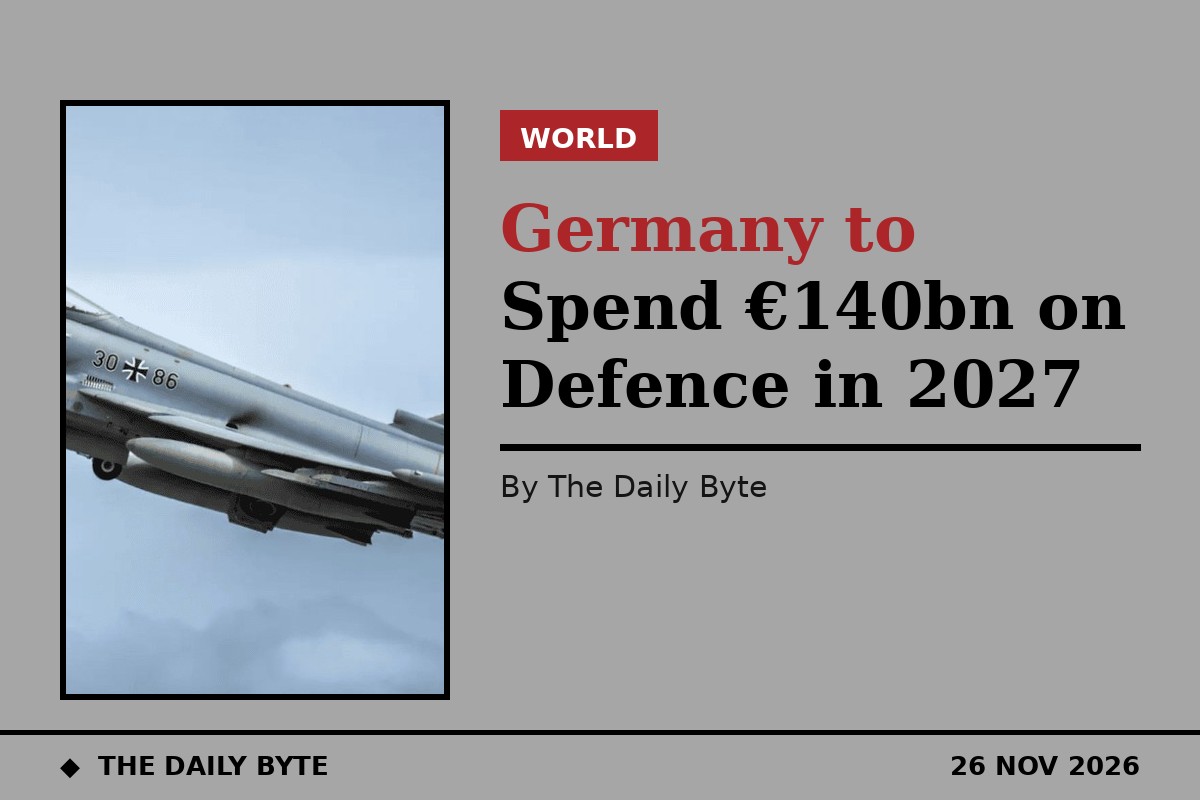
Germany is preparing to spend almost €140 billion on defence in 2027, more than twice as much as France, in a rearmament programme that is redrawing the military balance of power in Europe.
According to budget documents discussed by the Bundestag on 25 November, Germany plans to allocate about €109.75 billion to its regular defence budget in 2027, alongside another €29.65 billion from the Bundeswehr's special fund. Together, that amounts to around €139.4 billion.
France, by comparison, plans to spend €63.4 billion under its 2027 defence budget, excluding military pensions. Paris is also increasing expenditure, by an additional €6.5 billion compared with 2026. The two countries' budget figures do not cover exactly the same categories, but the gap in financial capacity is clear.
Berlin is planning to go further. Current financial projections envisage regular German defence expenditure reaching about €162.9 billion in 2029 and €183.7 billion in 2030. Germany is also expanding its military personnel, with plans to increase active troop numbers to around 260,000 by 2035.
The Bundestag is expected to hold its final vote on the 2027 budget on 27 November. Defence Minister Boris Pistorius told reporters after a defence committee hearing that lawmakers had shown much agreement on the record request, even as he pushed back against criticism that Germany is buying too much legacy hardware rather than new technology.
The scale of the spending has prompted debate in France, where politicians from both sides of the political spectrum have begun questioning what German rearmament will mean for the balance of power in Europe. The French newspaper Le Journal du Dimanche published an article examining growing concerns over Germany's military expansion. Jean-Philippe Tanguy of the National Rally has warned about the consequences of German rearmament, while Jean-Luc Mélenchon has questioned Berlin's ambition to build Europe's strongest conventional army.
France has long regarded itself as Europe's leading military power, with its own nuclear arsenal, advanced defence industry and the ability to conduct operations abroad. Germany, by contrast, has been Europe's largest economy but has struggled for decades with the condition and readiness of its armed forces. That balance is now changing.
The strains are already visible in Franco-German military cooperation. The joint FCAS fighter aircraft project collapsed in June 2026, while the MGCS future tank programme also failed. Both countries continue to cooperate, but their industrial interests are increasingly difficult to reconcile.
Washington, meanwhile, has identified Berlin as a central pillar of NATO's future conventional defence. On 17 November, US Under Secretary of Defence for Policy Elbridge Colby explicitly highlighted Germany's growing importance for NATO, describing Berlin's efforts to rebuild its military capabilities and defence industry as central to restoring Germany's position in European collective defence.
Under the approach known as NATO 3.0, Washington expects European allies to assume primary responsibility for the continent's conventional defence. Germany is one of the countries the Americans expect to play a leading role, alongside Poland and the Nordic countries.
Germany also remains a particularly important US military partner. About 30,000 American troops are stationed on German territory, and Berlin participates in NATO's nuclear-sharing arrangements. The Bundeswehr is replacing its Tornado aircraft with F-35As to maintain its role in delivering American nuclear weapons if required under NATO procedures.
France occupies a different position. It possesses its own independent nuclear deterrent and continues to argue for greater European strategic autonomy. Although the Pentagon recently praised Paris for assuming additional responsibilities in NATO's Force Model, Washington is increasingly emphasising Germany's central role in conventional defence.
For NATO's eastern flank, a stronger Bundeswehr has an obvious practical value. Germany is establishing its 45th Armoured Brigade in Lithuania, with about 4,800 soldiers expected to be permanently stationed in the country by the end of 2027, close to the borders of Russia and Belarus.
Some of the French concerns relate less to current German policy than to the country's political future. The growing influence of the AfD has raised questions among politicians in France and elsewhere about how Germany's foreign and defence policies could develop under a future government.
Germany's military expansion is taking place within NATO and under democratic civilian control. Yet the scale of the investment means that decisions taken in Berlin will increasingly affect the military and industrial balance across Europe. What will matter is not only how much Berlin spends, but how quickly that investment translates into stronger military capabilities on NATO's eastern flank.


