German Gen Z protests hit 73 cities over conscription
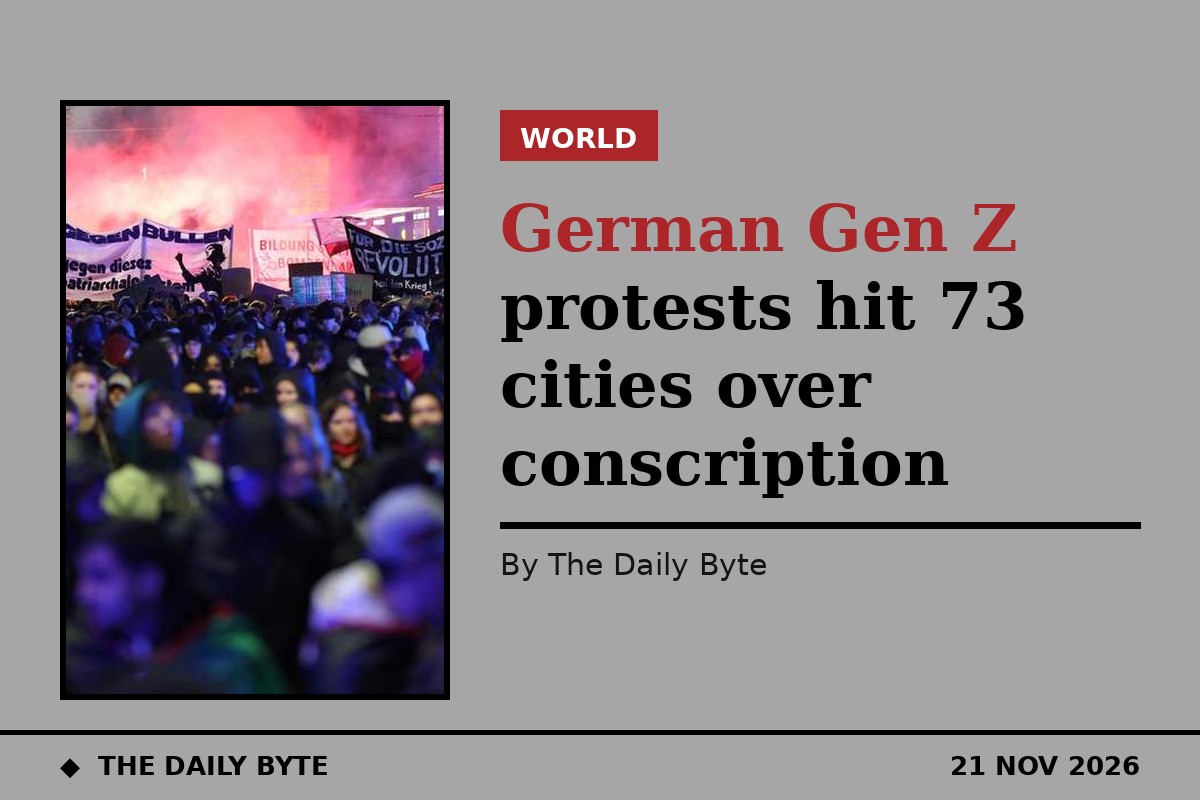
Tens of thousands of young people marched across Germany on Friday to protest against military conscription, education cuts and the rising cost of living, in the second nationwide day of action by the Gen Z Takes Charge movement. Demonstrations were held in 73 cities, from Berlin and Frankfurt to Leipzig, Hamburg, Bremen and Cologne.
The group, known in German as Gen Z Regelt, said about 87,000 people demonstrated nationwide, including in the eastern cities of Erfurt, Potsdam and Magdeburg. Police in Berlin put turnout there at around 4,000, while organisers put it at 15,000. About 21,000 people had registered in advance for the day's actions.
The movement is demanding more money for schools, addiction support and psychotherapy, affordable living, opposition to conscription and consistent action on climate change. School Strike Against Conscription held separate anti-conscription marches, including around 400 people in Frankfurt.
Flashpoints in Leipzig and Frankfurt
In Leipzig, police deployed water cannon after officers were pelted with fireworks when demonstrators moved to the south of the city following a march. Police in Saxony said roughly 2,500 people had taken part in the Leipzig demonstration. In Bremen, police briefly halted a march after demonstrators set off fireworks and threw paint-filled Christmas ornaments.
Around 2,000 officers were deployed in Frankfurt to prevent a repeat of the unrest that accompanied youth protests in several cities three weeks ago, when shops were vandalised and looted. Some shops in Hamburg, Bremen and Cologne boarded up their windows ahead of Friday's marches. Gen Z Takes Charge has distanced itself from violence. Co-organiser Akram Selo told RBB-Inforadio: "Those who seek violence aren't at our demonstrations, I'd say."
Why conscription dominates the debate
The conscription debate centres on the Military Service Modernisation Act, which came into force on 1 January 2026. It sets out new targets to grow the army by the mid-2030s, increasing its full-time force to about 260,000, plus 200,000 reservists. Service remains voluntary, but the law introduces so-called compulsory service of need, under which the Bundestag could vote to make service compulsory if volunteers do not fill the recruitment quota in a given year.
All 18-year-old men must complete a military registration questionnaire, while participation is voluntary for women. Official figures show that by the end of October, nearly 600,000 letters had been sent out this year to young Germans, of which about 286,800 were sent to young men and 271,700 to women and people of other genders. Men who fail to respond face a fine of 250 euros. From July 2027, men born in 2008 or later must attend a medical examination.
The recruitment drive is one element of Germany's broader military expansion, begun in 2022 after Russia's full-scale invasion of Ukraine. Under the current draft budget for 2027, defence spending is expected to rise to 109.7 billion euros from 82.7 billion euros the year before, while the budget for the Ministry for Education and Family is expected to fall to 15.9 billion euros from 16.6 billion euros.
Voices from the marches
Phil Werring, an 18-year-old high school student from Münster, told Al Jazeera the Bundeswehr warned him of a 250-euro fine if he ignored the questionnaire. "As I filled out the form, I realised how serious the government is about taking these steps to reintroduce compulsory military service, and that I may have no choice but to serve," he said. "I don't want my future to be interrupted by the military."
Linus Schneider, 16, from Munich, said his school's roofs have leaked for three years and the city says it cannot afford repairs. "Sometimes we can't have gym class at all because there are buckets of water in the sports hall," he said. "There are big cuts to education and healthcare, while at the same time, military spending has increased drastically."
Selo urged Germany's leaders to act on the protesters' demands. "Talks won't make us stop demonstrating," he said. "Our demands should be addressed, with assurances, not empty promises." Education Minister Karin Prien said young people were right to speak out. "Young people have every right to make their voices heard, and for us to listen to them seriously," she told dpa.
A smaller second wave
Friday's protests were the second major outing for the movement, after a first wave on 31 October drew tens of thousands across the country, with rioting in several cities including Frankfurt later that evening. About 180,000 people had registered for that first day, against about 21,000 registrations for Friday, and organisers say the movement behind the protests is somewhat fragmented, with other factions staging their own demonstrations independently.
Sebastian Koos, a sociologist at the University of Konstanz who researches youth movements, said conscription makes Germany's case unique among Europe's youth protests, even though grievances over living costs and education cuts overlap.


