Germany Passes €556bn 2027 Budget With Record Defence
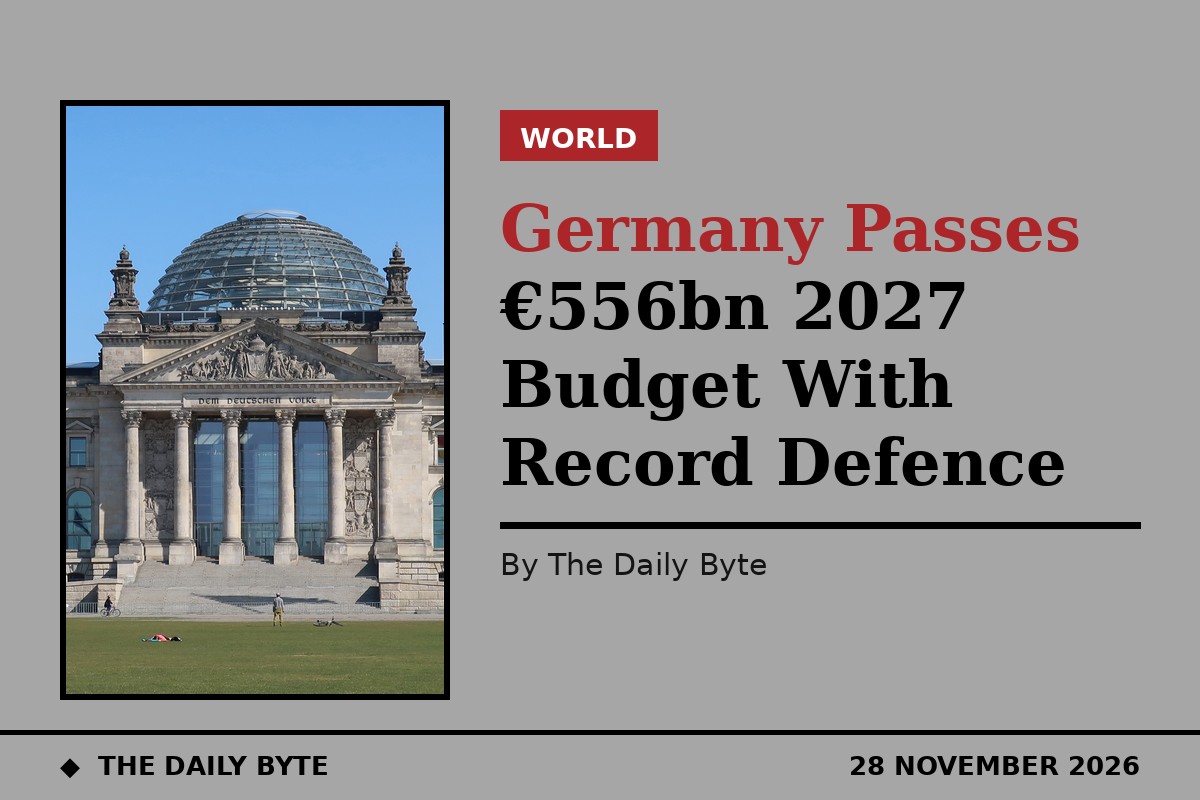
Germany's lower house of parliament has passed a 556 billion euro budget for 2027, approving a sharp rise in defence spending and the second-highest level of new borrowing since the Second World War.
The Bundestag approved the budget on Friday, 27 November, by 317 votes to 260, after months of wrangling inside Chancellor Friedrich Merz's coalition over taxes, welfare and borrowing.
The package marks a decisive shift in German public finances. Defence and infrastructure, long starved of investment, now sit at the centre of spending, paid for with debt on a scale Germany has not seen since the pandemic.
Defence at the centre
Core defence spending will rise to 109.7 billion euros in 2027, up from 82.2 billion euros this year. Once support for Ukraine and other security spending is included, the total reaches 150.9 billion euros.
Finance Minister Lars Klingbeil told parliament the money was essential for Germany's security and for Europe's. "We are putting up the money for defence so that Ukraine can defend its freedom," he said. "No child born in Germany today should ever have to experience war again."
The government has vowed to rebuild the armed forces and strengthen core infrastructure after decades of underinvestment in both. The budget also sets investment in the core budget at 61.8 billion euros, up from 58.4 billion euros in 2026, with further investment coming through special funds.
Borrowing on a scale not seen since the pandemic
Total new borrowing will reach 210.4 billion euros, just below the record of 215.4 billion euros recorded in 2021 during the Covid-19 pandemic. That figure includes about 123 billion euros of borrowing in the core budget, plus debt raised through two special funds for infrastructure and defence agreed last year.
The scale of the borrowing carries a cost that will grow over time. Interest expenses in the core budget will rise to 41.4 billion euros in 2027, and the finance ministry expects that figure to climb to around 81 billion euros a year by 2030.
Klingbeil defended the approach in parliament. "It is right that we invest in the railways and in climate protection. It is right ... that we invest in our security," he said. But he also warned that sacrifices would be needed, adding: "We will have no choice but to ask people to make some sacrifices."
Relief and cuts in the accompanying act
Alongside the budget, the Bundestag passed a Budget Accompanying Act that mixes relief for households with cuts elsewhere. The electricity tax will be reduced to the European Union's minimum rate for all consumers next year, lowering bills for homes and businesses.
In return, the standard rates of basic-income support will be frozen until mid-2028, and the federal subsidy to the pension insurance system will be cut by 3 billion euros in 2027.
The act also raises taxes on spirits from 2027 and introduces a tax on sugary drinks from 2028, while plans for taxes on plastics and sweetened drinks and some welfare cuts were dropped or delayed during the coalition negotiations.
A harder road to 2028
The budget now goes to the Bundesrat, the upper house, which is due to consider it on 18 December. Approval there is the final step before the spending plans take effect in January.
Economists warn that the hardest choices are still ahead. The finance ministry expects a shortfall of around 25 billion euros in the 2028 budget, which could reach 30 billion euros if the electricity tax cut is extended beyond 2027.
Marcel Fratzscher, president of the DIW economic institute, criticised the government on Thursday, saying it lacked the courage to implement reforms, cut subsidies and spending, or raise taxes. "By the 2028 budget at the latest, there will be a massive conflict," he told Reuters. "That's why it would have been better to solve the problem now rather than keep putting it off."
Klingbeil agreed that the next round would be tougher still, saying negotiations for the 2028 budget would be even more challenging than those just concluded. For a coalition that needed months to agree this budget, that is a warning that the arguments over German spending are far from over.


