Germany and Poland to draw up defence pact action plan
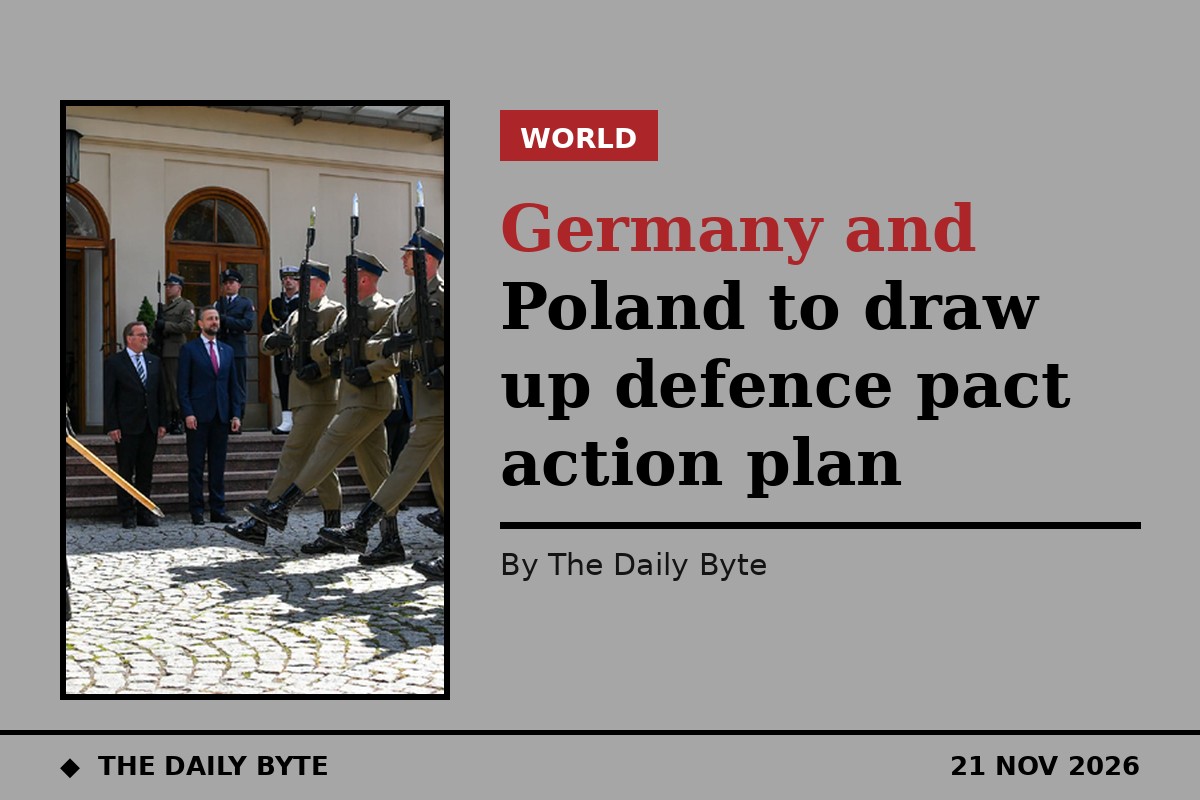
Germany and Poland are to draw up a detailed action plan to turn their June defence agreement into joint military and industrial projects, with the plan ready before bilateral government consultations in January 2027.
German Defence Minister Boris Pistorius announced the timetable after meeting his Polish counterpart, Wladyslaw Kosiniak-Kamysz, in Warsaw on Thursday evening, 19 November. The two ministers agreed to move quickly from political commitments to work that can be carried out on the ground.
"This will strengthen close cooperation between the armed forces and enable us to assume responsibility for Europe together," Pistorius said after the talks.
Industry at the centre of the pact
Kosiniak-Kamysz said the two countries particularly intend to expand cooperation between their defence industries. Joint corporate initiatives are expected to make Europe less dependent on suppliers on other continents, stabilise supply chains and ensure sufficient weapons production.
The June accord, signed in Warsaw on 17 June after a year of negotiations, runs to 14 articles. It commits both countries to a special responsibility for the security of NATO's eastern flank and to intensify joint efforts to strengthen defence and deterrence, with Russia's war against Ukraine named in the preamble as the key context.
Under the agreement, the two sides grant each other the right to transit and deploy armed forces on their respective territories, harmonise administrative and customs procedures for border crossings, and develop joint use of infrastructure. Polish territory is treated as a supply base for the German ground forces deployed in Lithuania, including the 45th Tank Brigade. The text also creates a "Central Northern European Military Mobility Area" to coordinate military movement across northern and central Europe.
Industrial cooperation is covered by Article 6, which plans joint research, development and procurement, voluntary technology transfer between supply chains and a common approach to arms exports for joint projects. Priority areas include deep precision strike systems, unmanned and autonomous weapon systems, advanced missile and combat systems, electronic warfare and artificial intelligence.
Troops, Patriots and joint defences
Operational cooperation is already visible. As part of the Grand Eagle exercise, Germany's Bundeswehr is moving more than 2,000 personnel through Poland, together with about 50 tracked vehicles and 650 wheeled vehicles, testing the infrastructure and logistics needed to transfer substantial forces towards NATO's eastern flank.
Germany is also supporting Poland's air defences by providing Patriot surface-to-air missile systems and Eurofighter combat aircraft. Since the summer, engineering units from both countries have jointly constructed defensive positions.
The agreement contains no new security guarantees beyond Article 5 of the North Atlantic Treaty and Article 42(7) of the Treaty on European Union, and it replaced an earlier agreement dating from June 2011. Its text was published by Germany on 29 July.
History shapes the partnership
The visit carried a heavy historical charge. Before the talks, Pistorius visited the memorial at the former Nazi concentration and extermination camp Auschwitz-Birkenau, where he described Germany's actions as the "greatest rupture of civilization in human history" and said the present generation carries a major responsibility to ensure that such events never happen again. He planned to visit other Warsaw memorial sites on Friday, 20 November.
"We know that nationalism has never been a solution to problems, but has almost always become the cause of much more serious problems," Pistorius said in Warsaw.
The test of the partnership will be whether the January action plan converts that political symbolism and the activity already under way into sustained industrial coordination. If it does, the June pact could become a model for connecting eastern-flank security needs with western European manufacturing capacity.


