Germany Q3 Growth Cut to 0.1% as Exports Fall
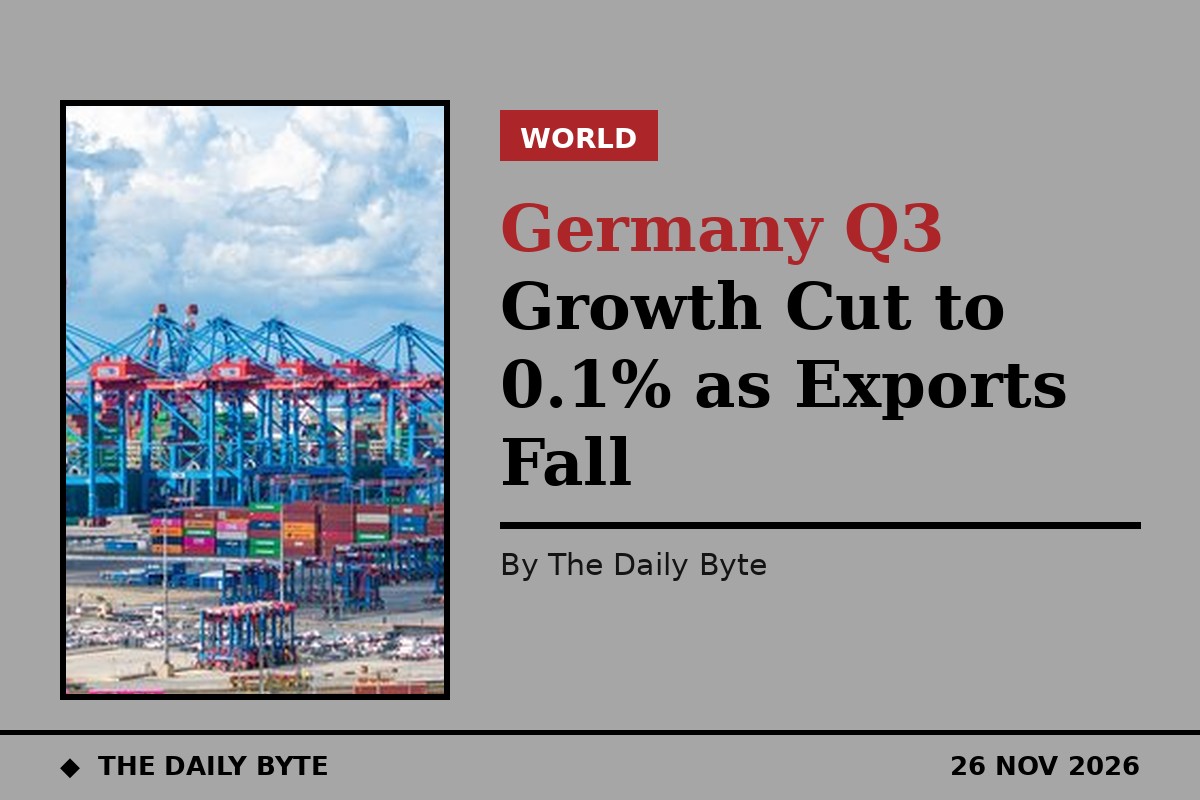
Germany's economy grew by just 0.1% in the third quarter of 2026, the Federal Statistical Office (Destatis) said on Tuesday, 25 November, revising down its first estimate of 0.2% after weaker exports and retail sales in September than first assumed.
The revision means the rebound that followed a strong first half of the year has lost momentum. GDP rose 0.4% in the first quarter and 0.3% in the second, and neither figure changed in the revision. "After Germany's economic performance was robust in the first six months of the year in the face of geopolitical crises, economic growth slowed in the third quarter of 2026," Ruth Brand, the president of Destatis, said.
Exports and investment drag
Exports were the main drag on growth. Total exports fell 1.0% on the quarter, with goods down 0.8% and services down 1.7%. Shipments of motor vehicles, trailers and semi-trailers, chemical products and metals all fell. Imports also dropped, by 1.4%, with goods down 1.5% and services down 1.1%.
Investment fell too. Gross fixed capital formation dropped 1.2% on the quarter, and investment in machinery and equipment was down 3.5%, extending a decline that ran through the first half of the year. Destatis linked the fall to fewer commercial registrations of new passenger cars and to higher producer and import prices squeezing investment. Construction investment slipped 0.3%.
Consumption offered little offset. Total final consumption expenditure rose 0.1%, with household spending also up 0.1% and government consumption up 0.3%. Manufacturing value added fell 0.3% on the quarter, although information and communication grew 1.5%.
Better than a year ago, worse than neighbours
Compared with the third quarter of 2025, GDP was up 1.2%, or 1.1% after adjusting for calendar effects. Exports were 3.1% higher than a year earlier, with goods up 3.8% and services up 1.1%, helped by higher sales of data-processing equipment, electronic and optical products and pharmaceuticals. More goods went to the European Union, while exports to China declined.
Manufacturing value added was 1.5% higher than a year earlier, despite the quarterly fall. But employment kept shrinking: about 45.7 million people worked in Germany in the quarter, 222,000 fewer than a year earlier, a drop of 0.5%, concentrated in manufacturing and construction.
Germany also lagged its neighbours. The European Union economy grew 0.5% on the quarter, Spain 0.6% and the United States 0.8%, while France contracted 0.1% and Italy was flat.
Economists still expect a pickup
Economists quoted by Reuters still expect growth to pick up in the final quarter, pointing to improving business sentiment in the Ifo index and purchasing managers' surveys. Claus Vistesen of Pantheon Macroeconomics put fourth-quarter growth at 0.3% or 0.4%.
Others were more cautious. Carsten Brzeski, global head of macro at ING, said the data were "a strong warning that optimism should not turn into naivety or complacency". Ralph Solveen, senior economist at Commerzbank, said the recovery was still based mainly on stronger government demand. "There can still be no talk of a self-sustaining upswing," he said.
Destatis said the figures would be revised again as more data arrived. For now, the third quarter leaves Europe's largest economy growing only marginally, with exports and business investment, rather than household spending, deciding whether the final months of the year bring a genuine recovery.


