Ghana 2027 budget unveils $10bn New Economy, no new taxes
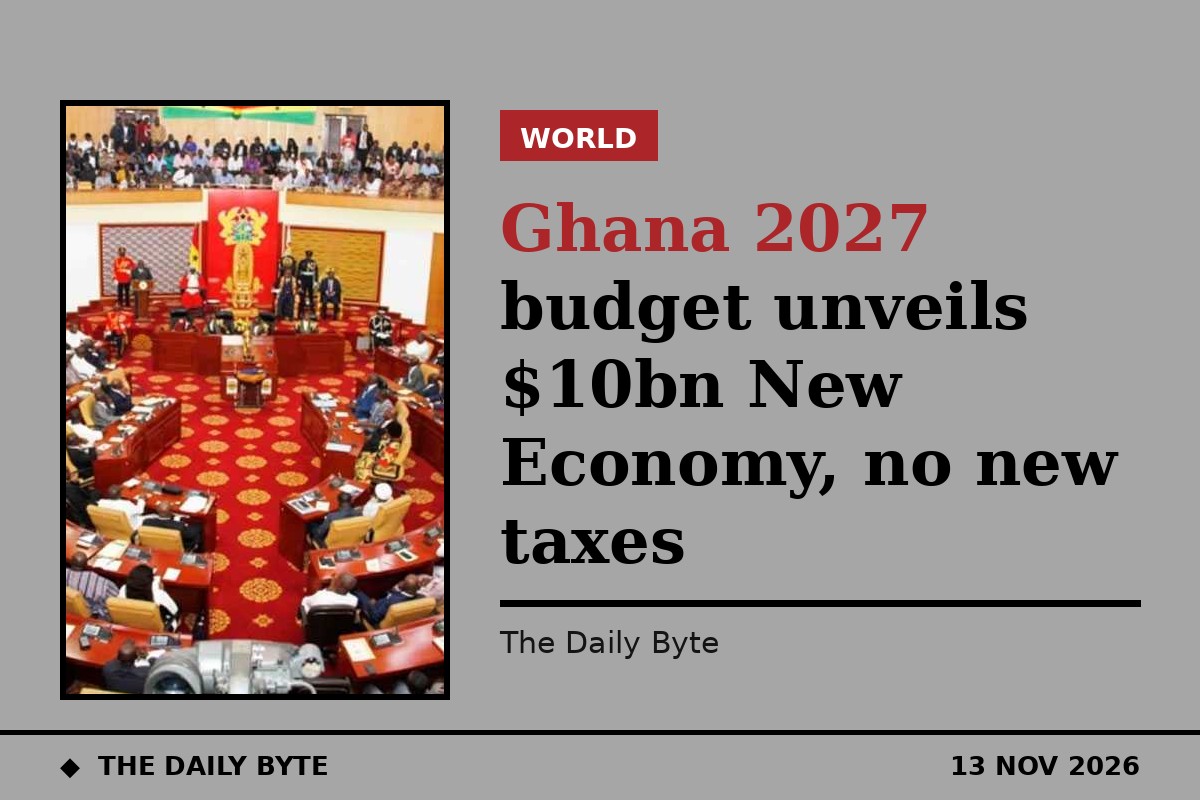
Ghana's Finance Minister, Dr Cassiel Ato Forson, has presented the 2027 budget to Parliament, unveiling a US$10 billion four-year "New Economy" programme and confirming that the budget will introduce no new taxes.
The 2027 Budget Statement and Economic Policy, presented on Thursday, 12 November 2026, sets out total spending of GH¢389.2 billion, equivalent to 21.6% of GDP, with revenue and grants projected at GH¢323.4 billion, or 17.9% of GDP.
A US$10 billion programme over four years
The centrepiece is the New Economy programme — "The New Economy: New Ghana, Jobs and Prosperity" — which will run from 2027 to 2030. The government plans to spend the equivalent of US$10 billion over the four years, about US$2.5 billion a year, with GH¢30 billion, or 1.5% of GDP, committed in 2027.
The programme is designed to transform Ghana's productive sectors, create jobs and reduce dependence on imports, through investment in eight pillars: macroeconomic stability and affordable finance, commercial agriculture, energy infrastructure, critical minerals value addition, tourism, culture and creative arts, textiles and garments, pharmaceuticals and biomanufacturing, and the technology economy. Commercial agriculture alone is earmarked for US$3 billion.
The government plans to finance the investment through domestic fiscal measures, lowering its primary surplus target from 1.5% of GDP in 2026 to 0.5% in 2027 to create room for investment, alongside tax reforms already approved by Parliament and compliance measures.
No new taxes, growth target of 5.2%
"This 2027 Budget will not introduce any new tax," Dr Forson told Parliament. Solar panels and batteries will be exempt from import duty and VAT, and the Income Tax Act, Revenue Administration Act, stamp duty and Communications Service Tax will be reviewed during 2027.
The budget targets overall growth of at least 5.2% in 2027, with non-oil growth of at least 5.7%, end-year inflation of 8%, and reserves of at least six months of imports. The cash-basis fiscal deficit is projected at 3.6% of GDP.
The budget is the first since Ghana completed its $3 billion IMF support programme in July 2026, and it marks a shift from economic recovery and stabilisation towards industrialisation, local production, infrastructure and employment, as the country prepares to mark 70 years of independence in 2027. The government will also redeem GH¢29 billion of Domestic Debt Exchange Programme bonds due in February 2027 ahead of schedule.
Opposition response
Minority legislators in Parliament criticised the fiscal blueprint as a "paper economy", arguing that official figures do not yet reflect the daily transport and market costs faced by ordinary traders. The government maintains that the budget moves the country from stabilisation towards longer-term growth, with the New Economy programme funded from domestic resources rather than new borrowing.
The budget also allocates GH¢600 million for the construction of 10 regional sports stadia across the country, alongside the wider infrastructure spending in the 2027 plan.
Sources: StatsGH and Ghana News Online.


