Ghana Cuts Policy Rate to 11% in Final 2026 Move
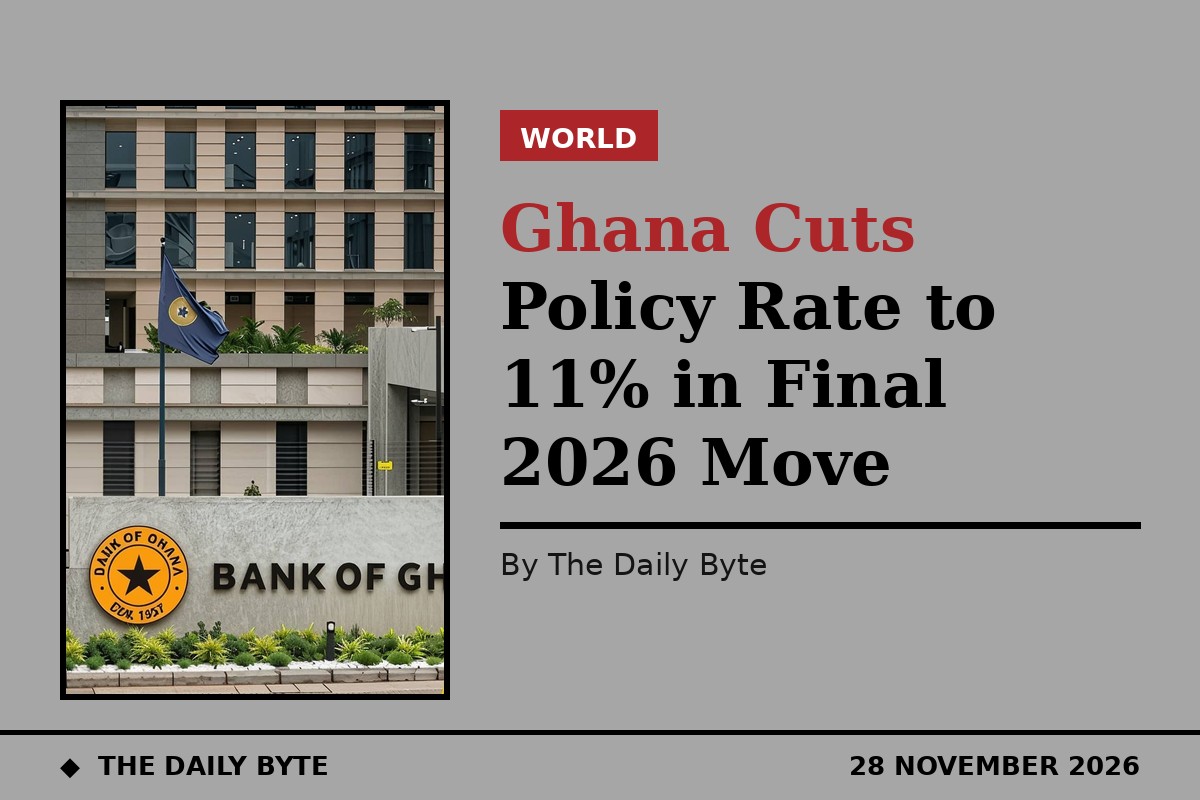
The Bank of Ghana has cut its main policy rate from 14 per cent to 11 per cent, a reduction of three percentage points that brings the benchmark to its lowest level of the year. Governor Johnson Pandit Asiama announced the decision in Accra on Wednesday 18 November, after the Monetary Policy Committee held its 133rd meeting, the last of 2026, from 16 to 18 November.
Announcing the move, Dr Asiama said: “The committee has decided to align the Monetary Policy Rate from 14 per cent to 11 per cent.” The decision was taken even though headline inflation rose slightly in October, and the governor was careful to describe the move as an alignment of the policy rate with market conditions rather than a straightforward loosening of policy. Market interest rates had already fallen below the old 14 per cent rate, so the committee moved the official rate down to where money market rates were already trading.
The Bank of Ghana also narrowed the corridor around the policy rate, from plus or minus 400 basis points to plus or minus 100 basis points, so that market rates stay closer to the official rate. It replaced its 14-day open market operations instrument with a seven-day instrument, allowing the central bank to manage liquidity more often and with greater precision. The governor said the changes reflected improvements in monetary operations that had strengthened liquidity management and improved the transmission of policy signals to money market rates.
Inflation and growth
Headline inflation increased marginally to 5.7 per cent in October 2026, from 5.2 per cent in September, largely because non-food inflation rose to 7.9 per cent after higher utility tariffs and higher crude oil prices. Food inflation, by contrast, fell to 2.9 per cent, supported by improved food supply. Inflation remained below the lower boundary of the Bank of Ghana’s medium-term target band of 8 per cent plus or minus two percentage points, and the Bank expects it to return gradually towards that target, barring shocks from crude oil prices, food production and quarterly utility tariff adjustments.
Economic activity continued to strengthen. The Bank’s Composite Index of Economic Activity grew by 7.7 per cent year on year in September 2026, driven by private sector credit, exports, tourist arrivals and construction activity. Dr Asiama said the decision was supported by strong economic growth, fiscal consolidation that had exceeded its targets, and inflation projections returning to the medium-term target band.
Fiscal position and reserves
On the fiscal front, provisional data showed an overall fiscal deficit of one per cent of gross domestic product for the first ten months of 2026, against a target of three per cent. That produced a primary surplus of 1.4 per cent of GDP, while public debt stood at 759.3 billion cedis, equivalent to 47.5 per cent of GDP, in October.
The trade surplus widened to 13.08 billion dollars in the first ten months of 2026, supported by gold exports, which contributed about 67 per cent of total export earnings. Gross international reserves stood at 12.1 billion dollars as of 17 November, representing about 4.4 months of import cover. The governor said the external sector remained strong enough to provide buffers against external shocks, while fiscal consolidation during the year had produced better-than-target fiscal balances.
The banking sector remained solvent, profitable and liquid, with total assets increasing by 21.2 per cent to 512.9 billion cedis. The industry’s capital adequacy ratio improved to 18.5 per cent, while the non-performing loan ratio fell to 13.1 per cent from 19.5 per cent a year earlier.
What comes next
The rate cut completes a long easing cycle. The Bank of Ghana had cut the policy rate from 28 per cent in April 2025 to 14 per cent by March 2026, before holding it steady through its May, July and September meetings. Analysts noted that the narrower corridor could in practice pull some market rates up towards the new 11 per cent rate, even as borrowing directly from the central bank becomes cheaper. The Monetary Policy Committee is next scheduled to meet in January 2027, when it will test whether the tighter corridor keeps market rates anchored near 11 per cent without slowing the fragile recovery in credit.


