Global Sell-Off Wipes $9 Trillion Off World Stocks
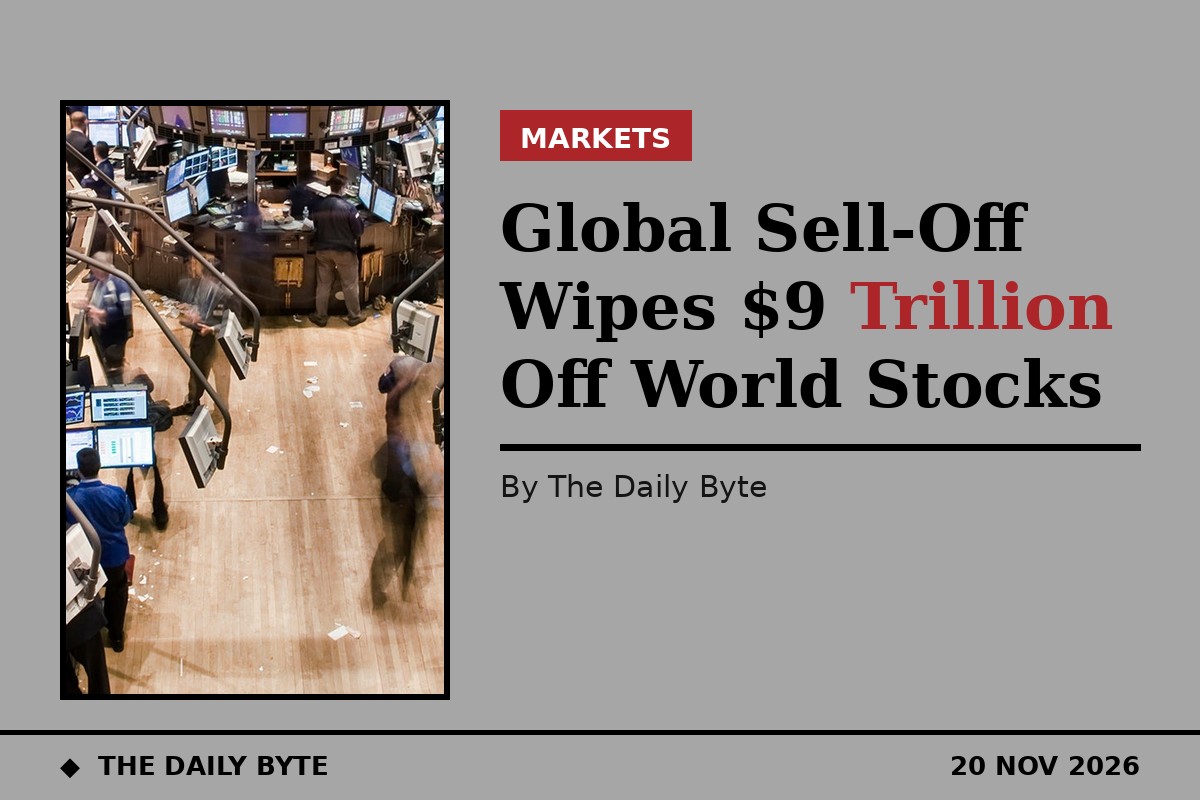
Nearly $9 trillion has been wiped off the value of world stocks since they peaked in August, as a global market rout took a sharp turn for the worse this week. Worries about stretched valuations in artificial intelligence stocks, combined with expectations of further interest rate rises in the United States, have driven selling from shares to copper and gold, according to Reuters.
The sell-off, which began to gather pace last month when it became clear that major economies would need higher rates to tame inflation, spread across Asia, Europe and the United States on Friday. Anthropic's record stock market debut on Thursday, which briefly valued the AI company at about $2 trillion, failed to restore confidence in the sector, and investors kept selling.
Volatility jumps as investors buy protection
Wall Street's fear gauge, the VIX index of US stock market volatility, reached 30 points on Friday, its highest since late March, as investors rushed to buy protection against further swings. Europe's equivalent volatility gauge also hit its highest level since April.
The jump is not yet at the scale of the move after April 2025, when US tariff announcements shook markets, but Reuters reported it is now at a level that could trigger selling by hedge funds that target fixed levels of volatility. Other gauges suggest the stress is not yet spreading everywhere: the MOVE index, which tracks volatility in the US Treasury bond market, remains below last month's highs, as do implied volatility gauges for major currency pairs.
Taiwan leads the week's losses
Taiwan's stock market carried some of the heaviest losses of the week. Its benchmark Taiex index closed down 6.6 percent on Friday, ending the week 17.5 percent lower in its worst week since 1991, according to TradingView. Taiwan Semiconductor Manufacturing, which accounts for more than 40 percent of the index's weighting, slid nearly 5 percent on Friday.
Technology stocks make up more than 70 percent of Taiwan's benchmark index, leaving it heavily exposed to doubts about the returns on AI investment. Regulators in Taiwan have tightened short-selling restrictions twice this month in an effort to steady trading.
Bonds rally while gold falters
Government bonds have performed well as a safe haven in the latest turmoil, shrugging off worries about a more aggressive Federal Reserve. The benchmark 10-year US Treasury yield is on track for its biggest weekly fall since April 2025, down 17 basis points so far this week, while the 10-year German Bund yield fell around 9 basis points on Friday alone.
Gold, however, is failing to play its usual safe-haven role, down around 1 percent on Friday to its lowest since September 2025. "What concerns me isn't so much the correction in technology stocks... but the possibility of the selling spreading into broader financial markets," Bruno Schneller, managing director at Erlen Capital Management, told Reuters. "Even gold has come under pressure, which is interesting given its traditional safe-haven role and may point to investors raising cash rather than simply rotating into defensive assets."
Analysts at Citi said the market could price out US rate rises, lifting bonds, "if the US equity sell-off should morph into a bursting of the AI bubble." Copper, a beneficiary of the AI rollout because of demand from data centres, is on course for its steepest weekly drop since April 2025, while oil has stayed in a relatively tight 90 to 94 dollar range.
Dollar's wrecking ball
The dollar has shown that reports of its demise have been greatly exaggerated. The dollar index, which measures the greenback against the six other top currencies, has risen to a 19-month high this week. For the year it is nearly 7 percent higher against the euro, 3 percent up on the yen and between 4 and 5 percent stronger against sterling and the Canadian and New Zealand dollars.
Emerging market currencies have been hit too. A surprise election result has seen Brazil's currency slump more than 8 percent this month, while Israel's shekel, one of the currencies most correlated with the AI boom, has tumbled almost 5 percent.
Adding to the worries was this month's heavy defeat for US President Donald Trump's Republican Party, which has cast doubts on how many US data centres will get built, and the sudden resignation of Nvidia chief executive Jensen Huang, which rattled investors given the chip company's central role in bankrolling the AI industry. Whether the selling stays confined to technology stocks or spreads further into broader financial markets is now the question dominating trading floors. This article reports market movements only and is not investment advice.