Gold Suffers Steep Weekly Loss as Brent Oil Holds Steady
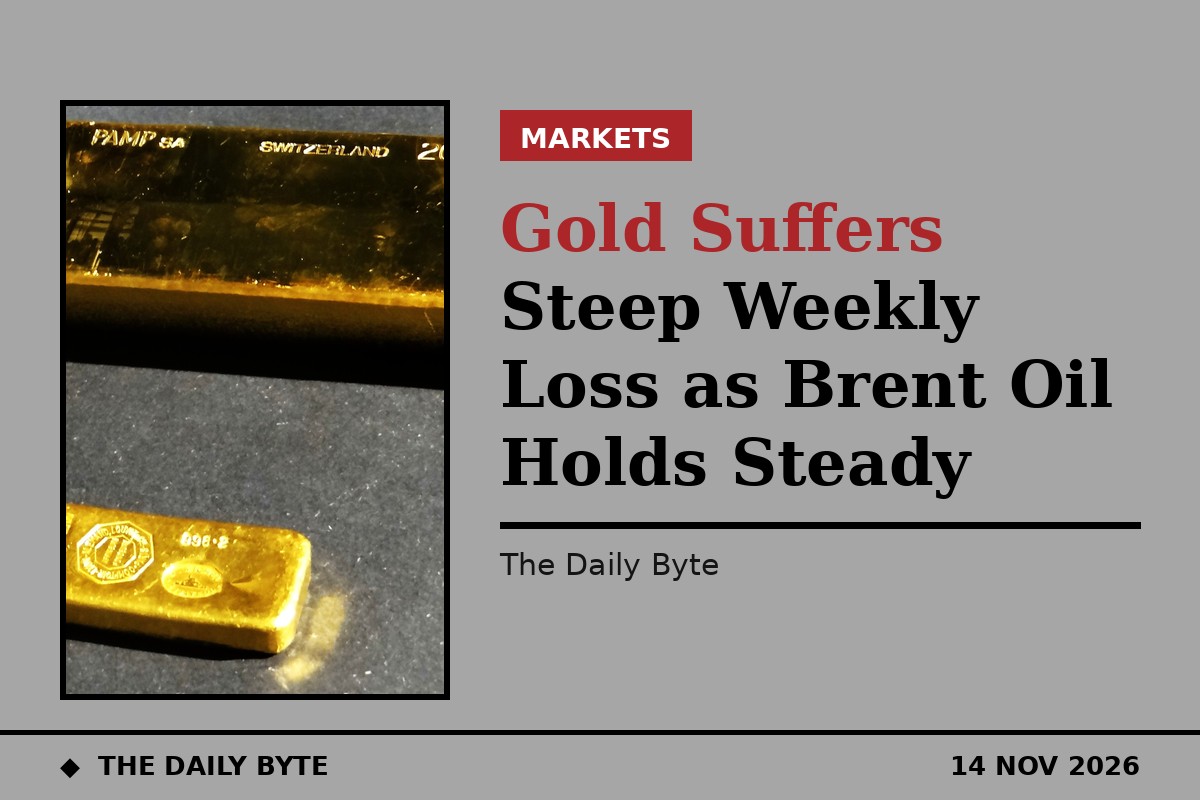
Gold steadied on Friday 13 November 2026 but still ended the week with a steep loss, as rising US Treasury yields and expectations of further Federal Reserve rate rises weighed on precious metals. Spot gold traded near 3,883.40 US dollars an ounce in late US trading, up 7.00 dollars, or 0.18%, on the day, yet it was down about 4.6% on the week, having fallen from 4,074.90 dollars the previous Friday.
Brent crude settled almost unchanged at 95.84 dollars a barrel, up just 2 cents, while West Texas Intermediate slipped about 0.2% to 88.56 dollars. Both oil benchmarks recorded their second consecutive weekly loss, with Brent down 2.2% on the week, Kitco reported.
Gold steadied on Friday after a bruising week
Gold stabilised after Thursday's steep losses, supported by bargain hunting, but silver remained under pressure. Spot silver traded near 48.63 dollars an ounce, down 1.32 dollars, or 2.63%, on the session, amid concerns about industrial demand and restrictive financial conditions.
The weekly damage was done earlier in the week. Gold fell 2.1% on Tuesday after a stronger-than-expected US consumer inflation reading, then dropped 2.9% on Thursday, touching 3,857 dollars, near its lowest level of the year. The metal's next upside target is the 3,903 to 3,934 dollar resistance zone, while a break below 3,852 dollars would open the way to deeper losses, according to Kitco's technical assessment.
Brent flat as surplus forecasts offset Gulf risks
Crude oil futures finished mixed on Friday as supply concerns around the Persian Gulf competed with expectations of improving global petroleum availability. Brent's week was volatile: it fell 5.9% on Monday to 92.57 dollars on hopes of US-Iran diplomacy, touched a low of 89.16 dollars on Tuesday, then rebounded 3.3% on Thursday as the US blockade and risks in the Strait of Hormuz stayed in focus.
The International Energy Agency's expectation of a fourth-quarter global supply surplus, the first since the start of the US-Iran war, and an unexpected increase in US crude inventories helped offset some of the geopolitical risk premium attached to Gulf shipping. The Strait of Hormuz and the US-Iran situation remained a significant source of uncertainty on Friday, with Washington continuing its naval blockade of Iran while signalling that renewed large-scale military action was not its immediate priority.
President Donald Trump indicated on Thursday that a diplomatic agreement with Tehran was no longer necessary, reducing expectations of an imminent negotiated settlement. Attacks attributed to Iranian-aligned Houthi forces against Saudi energy infrastructure and continuing threats to commercial tankers underlined how fragile regional petroleum supplies remain.
Rate-rise bets kept pressure on bullion
The US Labor Department reported on Friday that the producer price index rose 0.3% in October, below expectations of a 0.4% gain, while annual producer inflation accelerated to 6.5%, its highest level since November 2022. The report followed Tuesday's stronger-than-expected consumer inflation figures and last week's October employment report, which showed 165,000 additional jobs and unemployment falling to 4.1%.
Market attention is now fixed on the Federal Reserve's meeting on 8 and 9 December, with futures pricing pointing to an 89% probability of a 25-basis-point increase and an 11% probability of a 50-basis-point move. The benchmark 10-year Treasury yield rose towards 5.15% on Friday, increasing the cost of holding non-yielding bullion, while the dollar remained comparatively firm.
US equities finished mixed on Friday as weakness in semiconductor and artificial intelligence shares weighed on the major benchmarks despite the softer-than-expected headline producer price reading. The Dow Jones Industrial Average gained about 0.1% to close at 52,347.55, the S&P 500 fell 0.4% to 7,561.67 and the Nasdaq Composite lost 0.9% to finish at 25,136.27. Nvidia remained under pressure after the resignation of chief executive Jensen Huang.
What to watch next week
Next week's main economic events are Tuesday's October retail sales report and Wednesday's release of the Federal Reserve's October meeting minutes. Stronger consumption or hawkish policy commentary could reinforce tightening expectations, while weaker demand could support gold through lower yields. For oil, traders will watch whether the expected fourth-quarter surplus materialises and whether Gulf shipping risks ease or escalate, NordFX reported.