Google Meet Now Translates Speech in 63 Languages
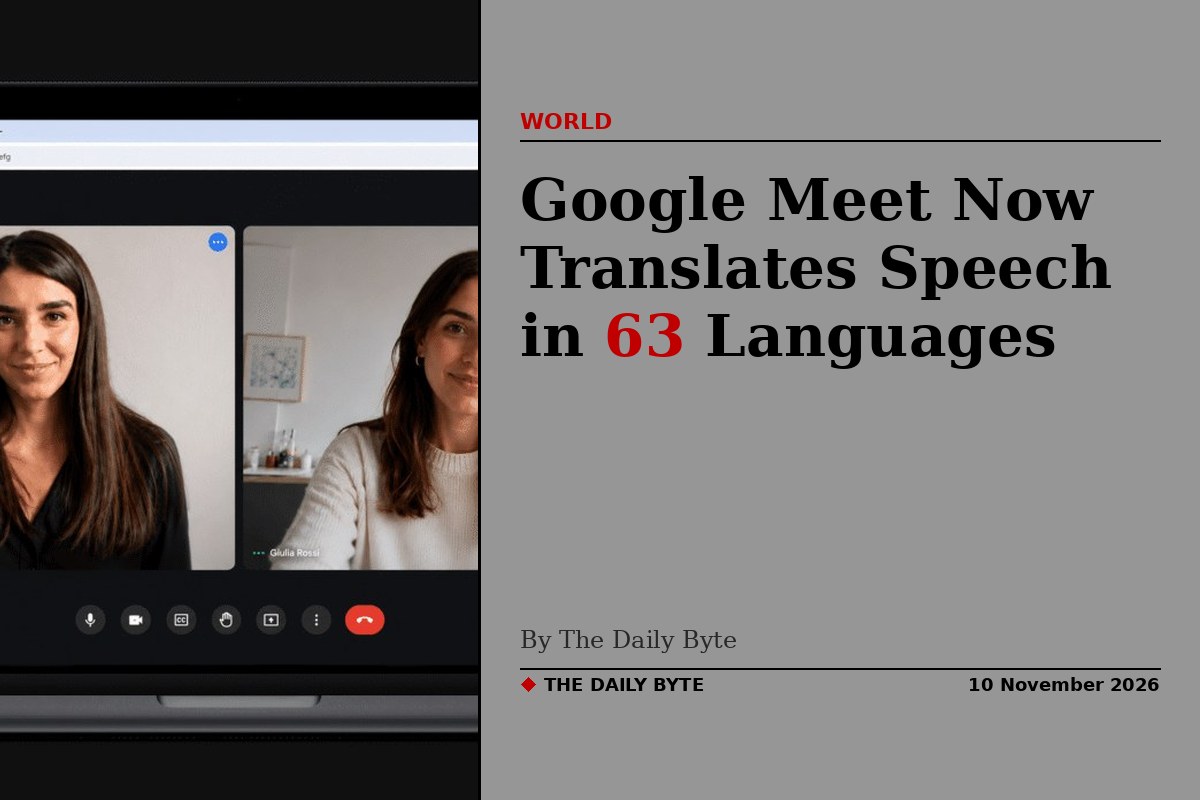
Google Meet can now translate spoken conversation between 63 languages in near real time, removing the need to set a single language pair for a whole meeting. The upgrade, powered by the Gemini 3.5 Live Translate model, is now reaching the last group of users as Google's staged rollout continues this month.
Previously, speech translation in Meet worked only between English and five other languages, with one language pair fixed for the entire call. The new version detects the language being spoken on its own, even when several languages are used in the same meeting or a speaker switches language halfway through a sentence.
How the new translation works
Each participant switches translation on for themselves from the toolbar in a call, choosing the language they want to hear. Meet then translates the speaker's words into that language, in a voice designed to sound like the speaker, and shows matching translated captions so what is heard and what is read stay in step.
Because the system waits for a speaker to finish a sentence before translating it, the translated audio arrives a few seconds behind the original speech. Participants can also tell Meet which languages they already understand, so those are left untranslated.
The feature works on the web and on Android and iOS, with listening support on Google Meet hardware in meeting rooms. People joining from another organisation can use it too, as long as the meeting organiser holds an eligible plan.
Who can use it and for how long
Speech translation is limited to paid plans. It is available to Google Workspace Business and Enterprise customers, Frontline Plus, Google AI Pro for Education, and people with Google AI Pro or Ultra accounts, along with the AI Expanded Access and AI Ultra Access add-ons.
On base Workspace plans and Google AI Pro, translation runs for up to 90 minutes per meeting. On Google AI Ultra and the AI Expanded Access and AI Ultra Access add-ons, the limit rises to eight hours per meeting.
Google says it does not store voice data or train its models on a user's voice, and each person chooses whether their speech is translated for others. Administrators can switch the feature on or off for their organisation.
Rollout and limits
Google began the rollout to Rapid Release domains on 22 October 2026, with full visibility within one to three days. Scheduled Release domains began receiving it gradually from 2 November, with Google saying it can take up to 15 days for the feature to appear, so the rollout should be complete by around 17 November.
There are limits. Speech translation does not work in live streams, meeting recordings, client-side encrypted meetings, dial-in calls, calls from third-party systems, or when adaptive audio is switched on. It is also subject to regional and age restrictions, and people joining from a conference room using Meet hardware can listen to translated speech but their own speech from the room is not translated for others.
The expansion follows a June announcement of the Gemini 3.5 Live Translate model, which Google said at the time supported more than 70 languages in the Translate app and its developer tools. The Meet feature itself covers 63 languages, including Arabic, Hindi, Japanese, Swahili, Amharic and Icelandic, alongside the main European languages.
For distributed teams, the change matters most in meetings where more than two languages are spoken. Instead of routing everything through English, a Spanish speaker and a German speaker can now each hear the other in their own language, in the same call, without anyone configuring pairs in advance.


