Google Pixel Tag Goes on Sale Today for $29.99
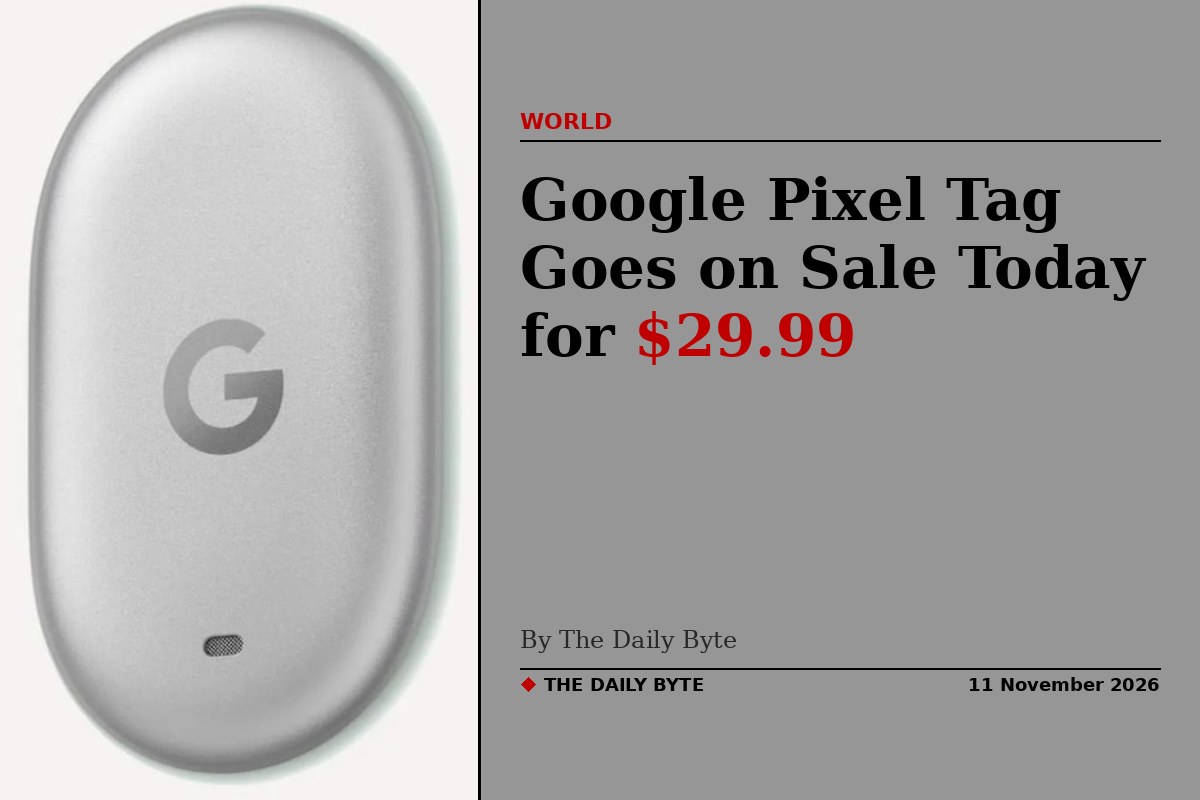
Google's first item tracker, the Pixel Tag, goes on sale today, Wednesday, 11 November 2026, three months after it was unveiled alongside the Pixel 11 phones. The slim oval tag costs $29.99 on its own, or $99.99 for a pack of four, and is Google's answer to Apple's AirTag.
The tag works with Find Hub, Google's device-finding network, which the company says draws on more than a billion Android devices. When a tagged item goes missing, nearby Android phones can anonymously report its location, so the owner can see it on a map even when it is far out of Bluetooth range. It pairs with any phone running Android 9 or newer.
Two radios for finding things nearby
For close-range finding, the Pixel Tag carries two precision radios rather than one: ultra-wideband and Bluetooth Channel Sounding. Together they are designed to guide the owner to within a short distance of the tag, rather than just showing a rough dot on a map. The tag measures 1.1 by 1.8 inches and 0.2 inches deep, making it narrower and flatter than Apple's AirTag, and it is rated IP67 for water and dust resistance.
Power comes from a replaceable CR2032 coin cell that Google says lasts up to a year, so there is no charging cable to remember. The tag can be shared with up to 10 people, useful for keys or luggage that more than one person uses. It comes in a single greyish colour called Fog, and Google sells no case of its own, pointing buyers instead to third-party cases such as Bellroy's silicone case at $24.99 and leather case at $29.99.
A surprise chip under the battery door
One detail Google did not mention at the August launch only emerged when reviewers took the tag apart: 9to5Google found an NFC chip under the battery door. Google has not said what the chip is for, and it is not part of the advertised feature list, but its presence suggests the hardware may have uses beyond simple tracking.
The launch follows a day after Google's November Pixel Drop began rolling out, bringing new Gemini Intelligence features to Pixel 10 phones, so owners of recent Pixel handsets get new software and a new accessory in quick succession. The Pixel Tag enters a crowded market: Apple's AirTag and Motorola's Moto Tag already do much the same job, and the Moto Tag uses the very same Find Hub network. Google's advantage is that the tag is its own hardware, built to sit at the centre of the Android ecosystem rather than at its edge. Source links: Tech Prolonged and Pandromeda.


