Google's Sashiko AI Reviews Linux Kernel Patches
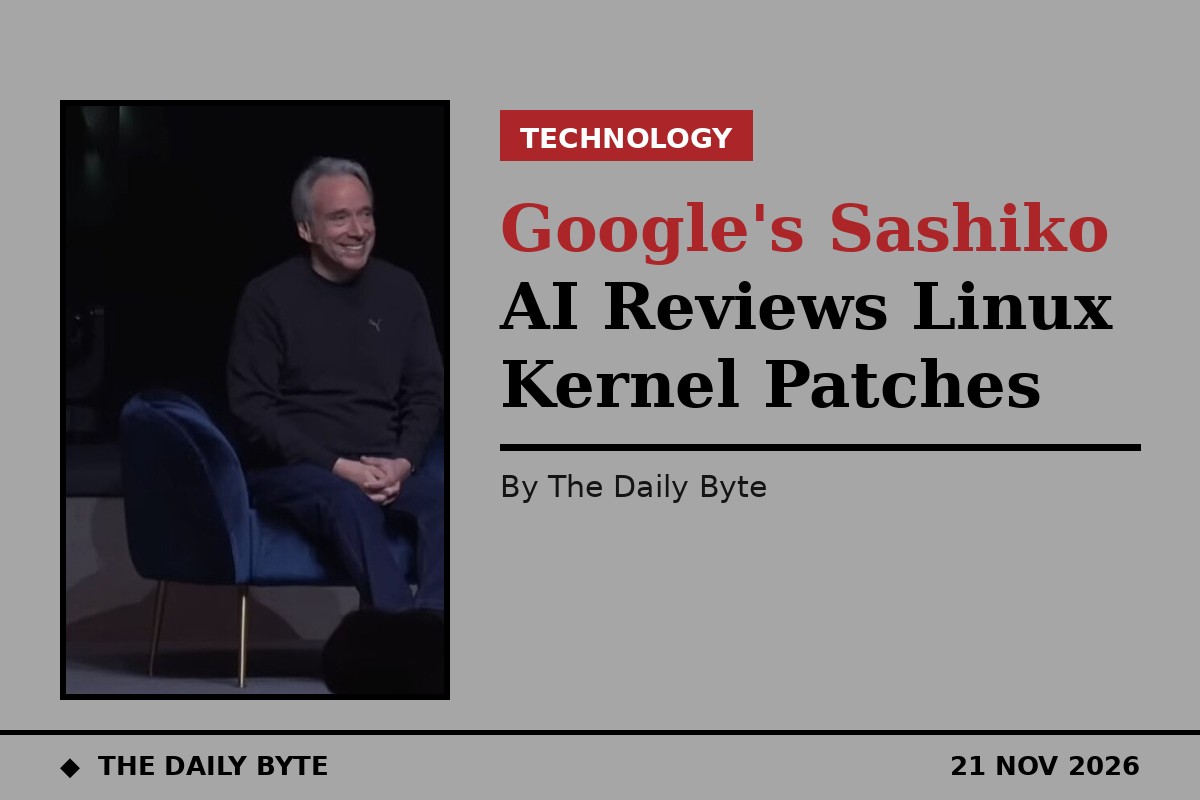
Google has described how an artificial intelligence system it built now reviews about 1,200 Linux kernel patches a day, checking the code that runs much of the world's computing before human maintainers ever see it. The system is called Sashiko, an open-source, agentic code review tool powered by Gemini, built by Google's AI and Infrastructure team and donated to the Linux Foundation earlier this year.
The name comes from the Japanese word for a stitching technique used to reinforce worn cloth, and the idea is similar: strengthen existing software by finding weaknesses in proposed changes. Google says the problem Sashiko was built to solve is that in large open-source projects, development speed is limited by code review, not by code generation. The Linux kernel spans more than 35 million lines of code, and over 85,000 changes land every year.
How Sashiko reviews a patch
Sashiko starts by gathering context around the proposed change: the modified functions, the struct definitions and the direct callers, plus the subsystem's domain guides, so the changed lines are never judged in isolation. A planner then picks the specialist passes to run and sets a reasoning budget for each one.
Up to seven specialist sessions run in parallel, each focused on a single class of problem: commit intent, implementation match, control flow, resource lifetimes, locking, security and hardware. Each session uses git tools to search and read the repository, averaging about 100 tool calls per review, and each one outputs both the concerns it believes are real and the concerns it ruled out, with the supporting code.
The central design choice is to separate finding candidate bugs from verifying them. Instead of checking all difficult cases in one shared prompt, Sashiko gives each difficult case its own verification agent. The finished report reads like a human maintainer asking questions about the proposed change, matching the style expected on a Linux mailing list.
The service is free for developers. Google runs it at sashiko.dev, reviewing patches sent to public Linux kernel mailing lists, and review emails go only to lists whose maintainers opt in. Every prompt, tool call, reasoning step and ruled-out bug is public. The project began with open-source Linux review prompts started by Chris Mason, and more than 100 contributors, including prominent kernel maintainers and engineers, have since helped to improve it.
What seven months of data shows
Since March 2026, Sashiko has completed about 241,000 patch reviews, and more than 1,500 kernel developers have engaged with its reports. More than 70 subsystem mailing lists have opted in. Its findings have been cited in over 2,000 mainline kernel commits and more than 500 official Linux kernel CVEs for 2026.
The share of merged commits needing a follow-up fix within 60 days fell from a historical average of 3.4 percent across Linux 6.2 to 6.19, to 2.8 percent in Linux 7.1 and 2.2 percent in Linux 7.2, a drop of about 35 percent. Among 21,500 tracked mainline commits, 0.9 percent of patches Sashiko judged problem-free needed a fix, compared with 7.6 percent of patches merged despite a critical warning. Google cautions that other factors can affect the figures and that the entire decline cannot be credited to Sashiko alone.
Google also tested the system against a benchmark of nearly 1,000 real kernel bugs that had passed expert review, reached mainline and later required fixes. Sashiko using the Gemini 4 Carbon model caught 75.8 percent of the bugs human reviewers had missed, at a high thinking level. The authors are candid about the weaknesses of AI reviewers: models tend to cut corners and dismiss concerns without proper investigation, they are easier to bias, and a commit log can sway the result. They count the model's lack of persistent memory as a plus, because it reviews similar patches as if each one were new.
What comes next
Version 0.9.4 adds an experimental four-stage design review for entire patch series, expanding beyond individual patches, and formal review support for e2fsprogs, the tools that manage ext file systems. The authors say Sashiko could extend beyond Linux to foundational projects such as GCC, LLVM and Git, because its core review engine is not limited to C or to kernel-specific rules.
If the results hold up under scrutiny, the lesson reaches further than one operating system. The hardest part of shipping software at scale has always been the review, and Sashiko suggests that a careful, evidence-led AI reviewer, one that shows its work and records what it ruled out, can do a useful share of it.


