Google Agrees Privacy Curbs in Spirit Data Sale
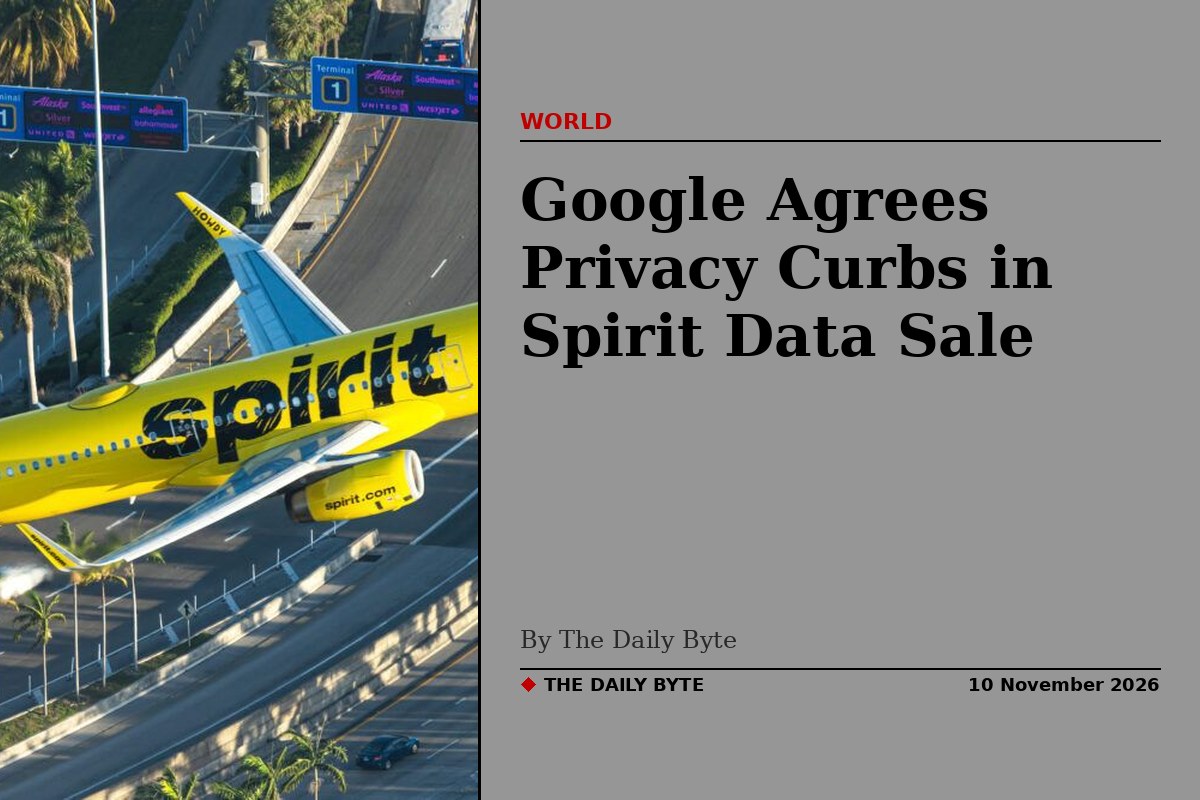
Google has agreed to additional privacy protections for former Spirit Airlines workers in its deal to buy the defunct airline's internal data to train artificial intelligence models, the flight attendants' union said on Tuesday, 10 November.
The agreement clears the way for a bankruptcy court to approve the $10 million deal next week, Reuters reported. The Association of Flight Attendants-CWA (AFA) said it withdrew its objections to the sale on Monday night after the protections were agreed.
What data is now excluded
Under the agreement, several categories of employee data are excluded from the sale altogether. The AFA said the excluded material includes health and medical information, records of drug and alcohol testing, disciplinary records, records from safety programmes and identification documents.
The data that is sold must go through a stricter de-identification process than Spirit had originally planned. The union said the process will follow ISO 27559, an international standard, rather than the US-based standard Spirit intended to use. An independent verification agent, chosen in consultation with the AFA and other unions, will review the de-identified data.
Google is also barred from trying to re-identify the data. The company must process it in a secure environment and treat it as confidential, the union said.
How the deal came about
Spirit Airlines stopped flying in May 2026 and has been selling off its assets since. In August, Google won an auction for the airline's internal data, offering $10 million for material drawn from emails, spreadsheets and calendars, as well as marketing, productivity and operations records.
Court findings cited by the office of Representative Steven Horsford put the archive at roughly 100 million emails and 500 million Microsoft Teams messages. Passenger profiles, about 97.5 million of them, were marked as not included in the sale.
The AFA filed an objection in the bankruptcy court as soon as the sale was disclosed in a Friday-night court filing in mid-August. The Air Line Pilots Association, the International Association of Machinists and Aerospace Workers, the Professional Airline Flight Control Association, Transport Workers Union Local 570, the Allied Pilots Association and the Southwest Airlines Pilots Association joined the objections in September.
More than 100 members of Congress also raised concerns, warning that removing names and other direct identifiers does not necessarily make a dataset anonymous.
Why unions fought the sale
The unions argued that the records were created by workers as a condition of their jobs and include sensitive material, from medical accommodation requests to fatigue reports and grievances. Collective agreements covering flight attendants and pilots treat much of that material as confidential.
They also warned that selling safety-related records could discourage staff from taking part in voluntary safety and training programmes, which rely on assurances that the information shared will stay private.
About 17,000 flight attendants, pilots and other workers lost their jobs when Spirit collapsed. The agreement does not give individual workers a right to opt out of the sale, but it sets limits on what data changes hands and how it must be handled. FlightGlobal reported that the deal also gives Google a chance to walk away.
What happens next
The bankruptcy court is expected to consider approval of the sale next week. The AFA said it still has four other active filings before the court in the Spirit bankruptcy case.
The case is being watched beyond aviation. As the public data that AI models were first trained on runs short, developers are turning to new sources, and the Spirit sale is one of the first tests of what happens to workers' records when a company that collected them no longer exists.


