Google Unveils TPU 8tx and 8i Max AI Chip Systems
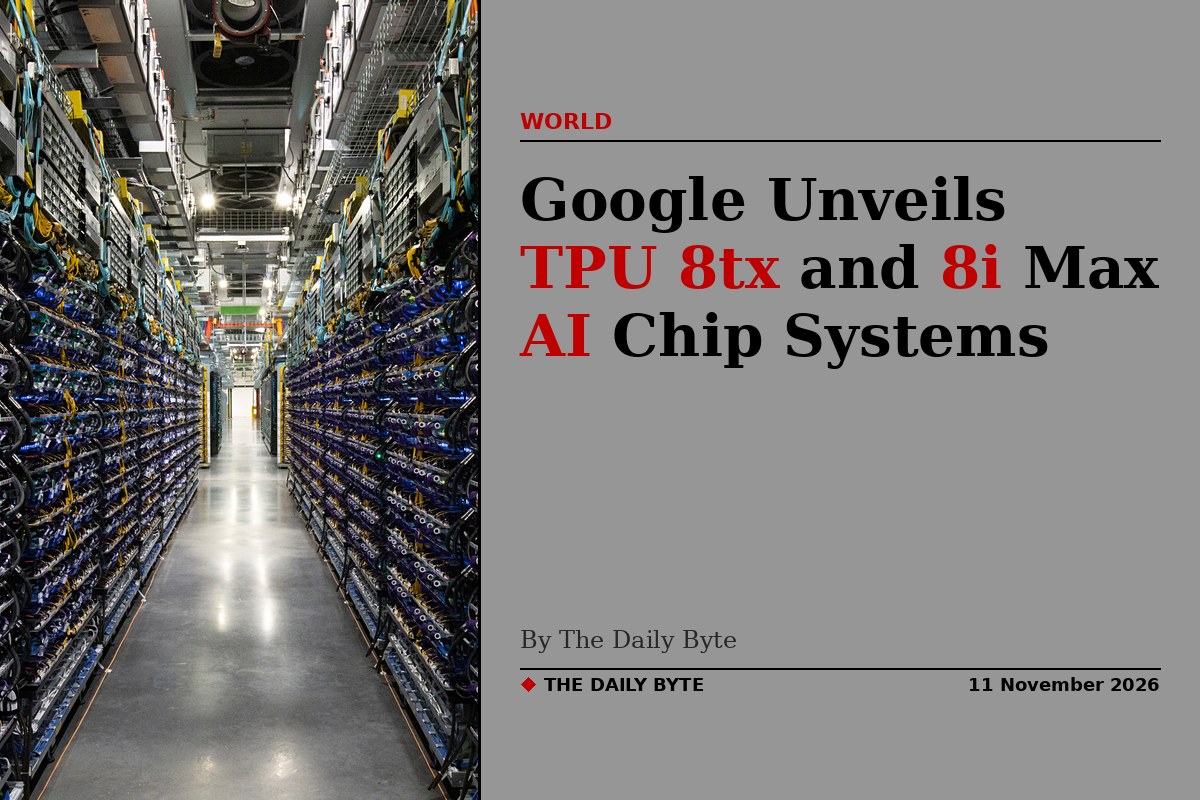
Google has unveiled two new AI computing systems, the TPU 8tx and the TPU 8i Max, extending its eighth generation of Tensor Processing Units. The announcement was made on 9 November 2026 and brings the eighth-generation family to four systems in a single year.
The two new systems join the TPU 8t, built for large-scale training, and the TPU 8i, built for low-latency inference, both introduced at Google Cloud Next in April. Google says it is the first time it has introduced four TPU systems in one year.
TPU 8tx: built for confidential computing
The TPU 8tx is designed for secure and confidential AI inference. It is aimed at regulated enterprises and governments that want to run frontier or proprietary AI models and autonomous AI agents while keeping sensitive data protected.
Google says the system builds security directly into the hardware, isolating data and model weights during active use inside a hardware-isolated trusted execution environment. That matters because encrypting data in storage or in transit does not by itself protect it while a processor is working on it.
The TPU 8tx is paired with fifth-generation AMD EPYC CPU hosts, which handle tasks such as preparing data and coordinating the accelerators. It also supports fine-tuning models with private data, distilling large models into smaller ones and training AI agents through reinforcement learning. Google claims it delivers up to twice the speed of the TPU 8t on some operations, with almost no performance penalty from the security features. That claim has not been independently tested.
TPU 8i Max: built for long-context work
The TPU 8i Max addresses a different problem: the memory wall, where a processor stalls because memory cannot supply data quickly enough. It combines two TPU 8i chips in a single package, doubling compute, on-chip SRAM and high-bandwidth memory compared with a single TPU 8i.
Google puts the system at 384GB of high-bandwidth memory, about a third more than the TPU 8i’s 288GB, with memory bandwidth rising from 8.6 terabytes per second to 17.2 terabytes per second. The design is aimed at workloads with very long contexts, such as coding assistants working across entire codebases, mathematical reasoning, scientific research, drug discovery and systems analysing hours of video.
Availability, pricing and open source
Neither system is shipping yet. Google has provided no pricing or regional availability for either, and Amin Vahdat, the company’s senior vice president and chief technologist for AI and infrastructure, told Bloomberg to expect them in 2027.
Alongside the hardware, Google has open-sourced TorchTPU under the Apache 2.0 licence, allowing PyTorch code and Hugging Face models to run natively on TPUs, as well as the XLA Serving Engine and TPU Sync, which Google says reduces the time taken to move working data between chip memory by more than 90%.
Frequently asked questions
What is the Google TPU 8tx? It is a new eighth-generation TPU system built for confidential computing, keeping data and model weights isolated in hardware while they are being processed.
What is the Google TPU 8i Max? It is a system that puts two TPU 8i chips in one package to double compute and memory bandwidth for long-context AI workloads.
When will the TPU 8tx and 8i Max be available? Google has given no firm date. Its chip chief told Bloomberg to expect them in 2027, and no pricing has been announced.
Sources: Gadgets 360 and RCR Wireless News.


