Google unveils TPU 8tx and 8i Max AI chips
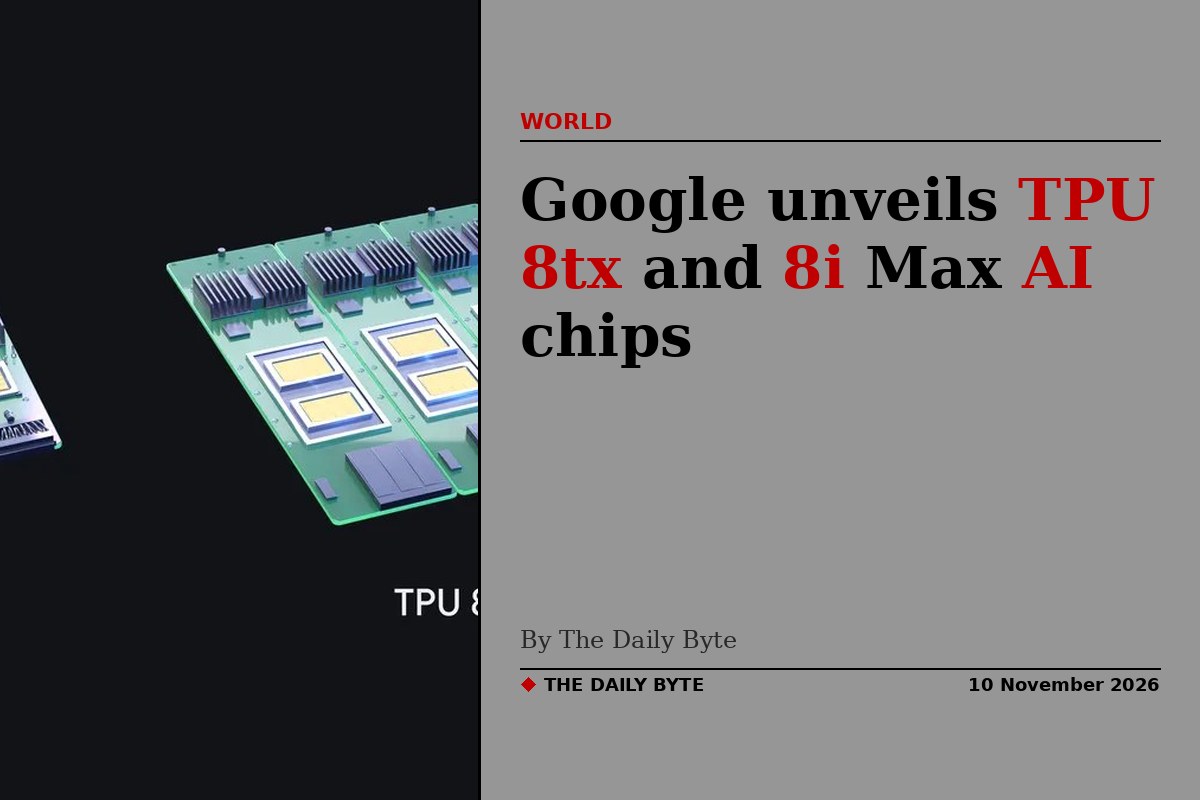
Google has expanded its eighth-generation Tensor Processing Unit (TPU) range with two new systems, TPU 8tx and TPU 8i Max, aimed at the different pressures now facing artificial intelligence workloads. The company announced the systems on 9 November 2026.
The two additions bring Google's eighth-generation TPU portfolio to four systems introduced in a single year, which Google says is a first. TPU 8t, built for large-scale training, and TPU 8i, built for real-time reasoning, were introduced at Google Cloud Next in April.
TPU 8tx targets confidential inference
TPU 8tx is designed for secure and confidential inference, and Google says it also suits small-scale training. It is built on the same silicon as TPU 8t, paired with fifth-generation AMD EPYC host processors and a low-latency Boardfly network.
Google describes the system as keeping sensitive data and model weights protected and isolated even while they are in active use, making it relevant to regulated industries and government organisations handling private data. Google claims up to two times lower latency than TPU 8t with a near-zero performance penalty, a figure from the company's own testing rather than an independent benchmark.
TPU 8i Max takes on the memory wall
TPU 8i Max is built for a different problem, which Google calls the memory wall. It combines two TPU 8i chips in a single package, doubling compute, on-chip SRAM and high-bandwidth memory bandwidth compared with TPU 8i.
Google positions the system for workloads with very large context windows, multi-agent work and memory-bound inference, and says it offers the highest compute density per rack in the range.
No price or launch date yet
Google has not published pricing, a general availability date or a list of regions for either new system. The announcement is therefore a capability statement rather than a sign that every Google Cloud customer can provision the systems today, and customers will be watching for those details.
The launch underlines how central custom silicon has become to the AI race. Google's TPUs power its own services and are rented to cloud customers, competing with Nvidia's graphics processors and with rival chips from Amazon and Microsoft. As AI agents and long-context models demand more memory and stronger privacy guarantees, Google is betting that specialised hardware, rather than one general-purpose chip, is the way to meet both. The eighth-generation range now covers the full spread of AI work, from training large models to running them securely and reasoning over very long documents.


