Government Drops Henry VIII Jury Trial Powers
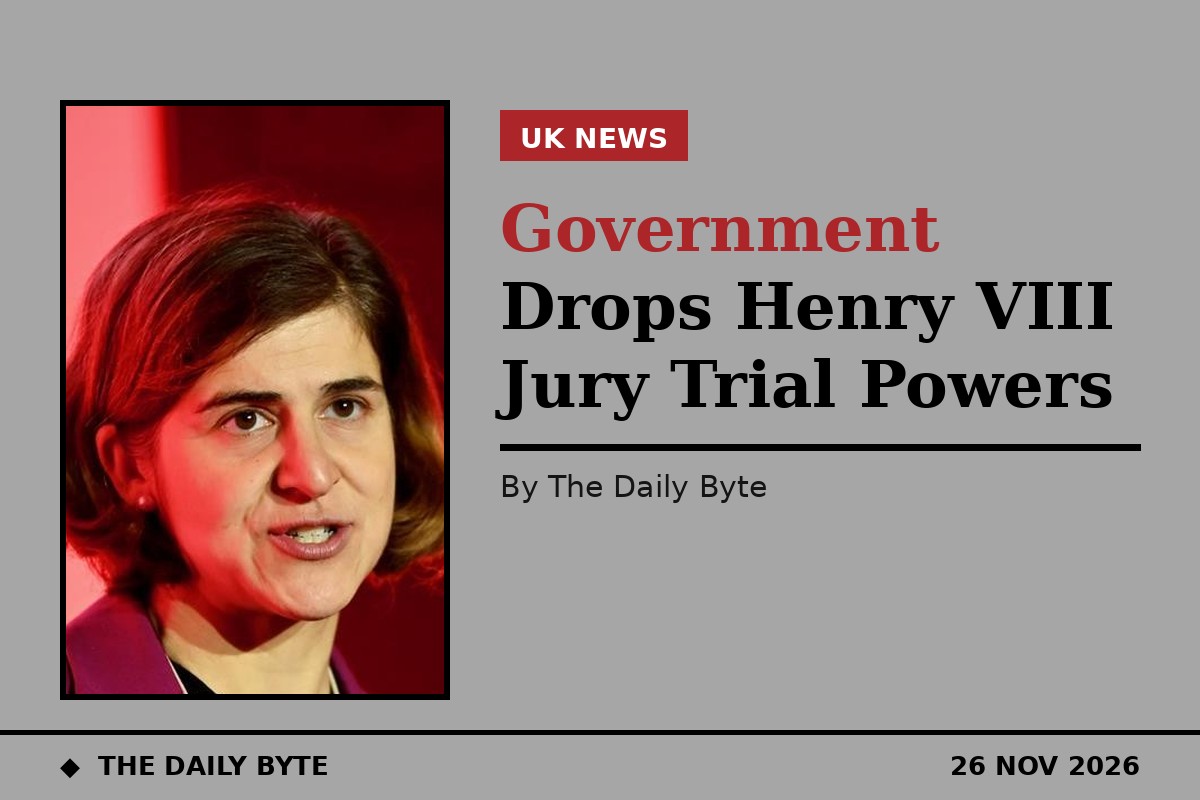
The government has dropped the power to widen judge-only trials by ministerial order, after peers from all sides of the House of Lords called it an inappropriate delegation of power.
Courts and legal services minister Sarah Sackman KC MP announced the climbdown on 25 November 2026, in amendments to the Courts and Tribunals Bill. She said the government had listened carefully to concerns raised as the bill progressed through Parliament and was strengthening the safeguards alongside the reforms.
What the government has conceded
Any additions to the list of offences that can be tried without a jury will now need primary legislation, the government promised. Ministers will no longer be able to add offences to the list by secondary legislation. The amendments also require any increase in magistrates' sentencing powers to be enabled by affirmative secondary legislation, subject to a vote in Parliament.
Why the power caused outrage
The controversy centred on paragraph 20 of a new Schedule 3ZA to the Criminal Justice Act 2003, inserted by the bill. The paragraph would have allowed the Secretary of State to amend the list of offences eligible for judge-only trial by order, adding offences or removing them. The initial list focuses on fraud and other serious economic crime, and indictable-only homicide and sexual offences are excluded. But the government's own explanatory notes were candid that the Secretary of State could add offences not related to fraud or financial crime, and its memorandum anticipated that new offences created by technological advances might be added over time.
The House of Lords Delegated Powers and Regulatory Reform Committee described the power as an inappropriate delegation of power and recommended its removal. It said the power conferred on the Secretary of State a significant power to amend, by order, principal aspects of the policy contained in the bill, and that it was unconvinced by the government's justification. The committee was unanimous. The cross-party law reform organisation JUSTICE wrote to the committee on 28 October warning that the draft affirmative procedure was an insufficient safeguard for a change of such constitutional significance.
Peers raised the issue at second reading and again in committee on 10 November, when Lord Keen of Elie moved an amendment to remove the power. Baroness Chakrabarti told the House that the committee had been unanimous and that the question should be settled in primary legislation, not by statutory instrument. The Constitution Committee shared the concerns, recommending that the power be expressly limited to fraud and financial offences.
What stays in the bill
The government had already narrowed its jury trial reforms once before. On 3 October, the Lord Chancellor Alex Norris announced a partial U-turn, scrapping the wider expansion of judge-only trials and the proposed Crown Court Bench Division. Judge-only trials are now limited to some fraud and financial offences. But the government kept the plan to remove a defendant's right to elect a Crown Court jury trial for either-way offences, such as theft and burglary, leaving the court to decide where those cases are heard. It is also proceeding with wider measures to tackle the backlog, including giving magistrates greater sentencing powers.
The reforms follow Sir Brian Leveson's independent review of the criminal courts, which made 180 recommendations. The government published its response on 12 October, accepting the overwhelming majority of them. The Crown Court backlog stood at almost 81,000 cases at the end of June 2026, with nearly a third waiting a year or more, and the government says the reforms are needed to cut delays.
What happens next
The bill goes to report stage in the House of Lords on 1 December. None of the changes is law until the bill passes.


