PTI Equal Representation Demand Rejected by Government
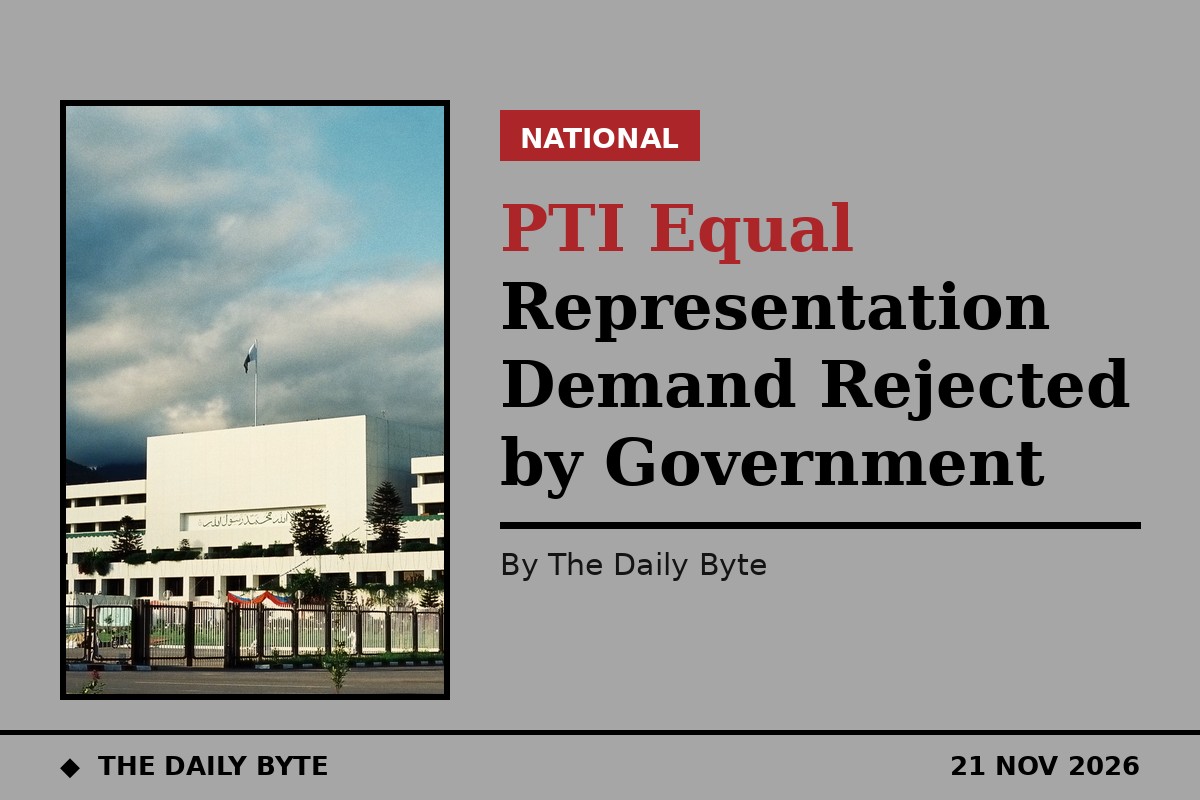
The government has rejected Pakistan Tehreek-e-Insaf's demand for equal representation on the parliamentary committee on electoral reforms, deciding instead that seats will be allocated according to each party's strength in parliament. The decision was conveyed to PTI chief whip Aamir Dogar by Federal Minister for Parliamentary Affairs Tariq Fazal Chaudhry.
According to sources cited by Pakistan Point, Chaudhry told Dogar that there was no precedent for giving the government and the opposition equal representation on parliamentary committees. The minister said he had reviewed the records of all parliamentary committees formed on electoral reforms in the past and that the government's formula was in line with previous parliamentary traditions.
Chaudhry confirmed that the government had rejected the PTI's demand and said the party's objection to the government's formula for forming the committee was unacceptable. Dogar said he would inform the party leadership of the government's decision, and that a final decision on joining the committee would be made after consultations with the parliamentary party and opposition leaders.
Five names from the National Assembly, two from the Senate
Alongside the rejection, the government asked the PTI to provide the names of five members from the National Assembly and two from the Senate for the committee. That request puts the ball in the PTI's court: the party must decide whether to take part in a body whose composition it has publicly opposed.
The committee has been slow to take shape. The National Assembly approved a 30-member parliamentary committee on electoral reforms on 31 October, and on 5 November Chaudhry announced the Senate seat allocation: two seats each for the PML-N, the PPP and the PTI, and one seat each for the Awami National Party, the Balochistan Awami Party, the National Party and the Jamiat Ulema-e-Islam-Fazl.
The PPP has since submitted seven nominees, five from the National Assembly and two senators, and Deputy Prime Minister Ishaq Dar is to make the final decision on membership after consultations. Chaudhry has said the National Assembly Speaker will issue the notification formally establishing the committee as soon as the opposition's nominations are received.
Why the PTI wants parity
The PTI's objection is about the balance of the committee. In the National Assembly portion, the government side would hold 15 seats against five for the opposition, a split the party says leaves it with no meaningful role in shaping reforms. Dogar has asked the government to look at the electoral reforms committee constituted in 2013 and study its structure before finalising the new arrangement.
The party has pointed to the 2017 electoral reform process as a precedent for equal representation, arguing that an equal share of seats would prevent either side from dominating the committee's decisions. It has also questioned the purpose of discussing reforms while its chief minister in Khyber Pakhtunkhwa and around a dozen of its lawmakers are in detention or facing arrest.
There is a further complication inside the PTI. Its founder, Imran Khan, previously directed party members not to join committees of the National Assembly or the Senate, but he has issued no specific direction about the proposed electoral reforms panel. The party's parliamentary party meeting, which will decide the question, has been delayed, and the PTI also plans to consult opposition allies including Mahmood Khan Achakzai and Raja Nasir Abbas before settling its position.
What happens next
Chaudhry has urged the PTI to join the committee and present its position there, saying the panel could discuss the political situation as well as the next general election and that constructive proposals would be incorporated into the draft reforms. The government has presented the committee as a forum for negotiating changes before the next general election, and the dispute at this stage is over who sits on the panel and how the seats are divided, rather than over the wording of any reform.
Until the PTI's parliamentary party meets, the committee remains unformed. If the party refuses to submit names, the government will have to decide whether to proceed without the main opposition party or to keep negotiating over the composition. Either way, the disagreement over equal representation has become the first test of whether the reform exercise can command support across the political divide.