GPT-6 Astra Helps Define Standard Model on a Lattice
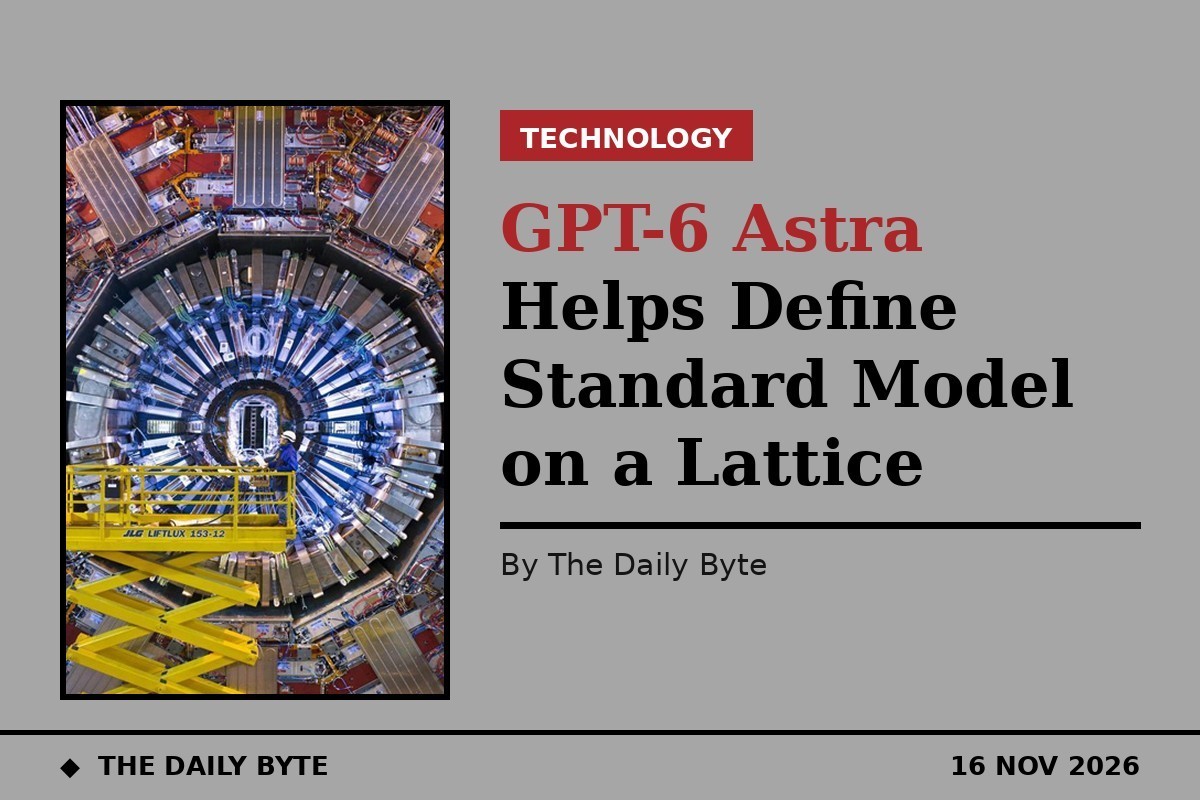
OpenAI's GPT-6 Astra model helped a physicist develop a candidate definition of the Standard Model of particle physics on a lattice, tackling a foundational problem that has been open for more than fifty years. The work was published on 15 November 2026 as the first guest post on OpenAI's new science blog.
The post was written by Nathaniel Craig, a visiting scientist at OpenAI who leads the particle theory group at the University of California, Santa Barbara. Craig says he proposed the candidate definition in an October preprint prepared with the aid of GPT-6 Astra, and credits the model with turning his strategy into a construction and taking the lead in developing the detailed proof.
Why the Standard Model still lacks a full definition
The Standard Model describes the known elementary particles and three of the four fundamental forces: the strong force, the weak force and electromagnetism. Its predictions agree with experiment across eighteen orders of magnitude, from the radio emission of hydrogen to collisions at the Large Hadron Collider. Yet for all that success, physicists still lack a complete definition of the full theory that does not rely on treating its interactions as small corrections.
Most calculations use perturbation theory, which starts with the interactions switched off, solves that simpler problem exactly, and then adds the interactions back as a series of small corrections. That approach has produced extraordinarily precise results, including predictions of the electron's magnetism accurate to a few parts in a trillion. But much of the theory lies beyond its reach: the mass of the proton comes mainly from the motion and interactions of quarks and gluons inside it, so switching off the strong force does not help at all.
A promising alternative is to discretise spacetime into a grid, known as a lattice. A lattice gives a rigorous definition of a theory at a given grid spacing and lets researchers calculate its predictions directly on a computer. The method has already delivered a quantitative understanding of the proton's mass from first principles. The difficulty is extending it to the whole Standard Model.
The chiral problem that blocked progress
The obstacle is that the Standard Model is a chiral theory: the weak force treats left-handed and right-handed fermions differently. Putting a left-handed fermion on a lattice in the most straightforward way produces an unwanted right-handed partner, an effect known as doubling.
Physicists have developed tools to deal with doubling, including overlap fermions, which keep only the left-handed particles wanted. But one piece remained missing for more than 25 years: how to set the phase of the fermion measure for the full Standard Model. The physicist Martin Lüscher had worked out the phase prescription for simpler theories, but the alignment for the complete theory stayed open.
Craig's idea was to take the force fields on the grid where the theory is to be defined and represent those same fields on a succession of finer grids. Comparing the allowed fermion states on two successive grids gives one part of the phase correction for a small change in the forces, and adding up those parts gives the phase rule on the original grid. The proof, he writes, shows that it gives the right correction around every allowed loop.
What Astra did, and what humans checked
According to Craig, GPT-6 Astra was essential to turning that refinement idea into a working construction. The model suggested the right way to carry a given set of force fields onto finer grids, showed that the comparisons would converge to a definite answer, and took the lead in developing the detailed proof. Human experts also played a key role: lattice field theorists Maarten Golterman, Andreas Kronfeld and Yigal Shamir reviewed the proof and asked probing questions that helped build confidence in the result.
Craig is careful about what the work does and does not establish. The construction is a candidate definition, not a settled one, and he calls it much more an answer in principle than an answer in practice. Scientific dialogue among experts is still needed to decide whether the prescription has all the properties physicists want, and much work lies ahead before it is useful for realistic lattice simulations. He is now examining whether the construction satisfies reflection positivity at finite lattice spacing, a condition that helps connect calculations in the lattice model to a quantum theory in which probabilities are conserved.
The work also builds on OpenAI's recent proof of the existence of Yang-Mills theory, which Craig describes as the missing piece for taking the continuum limit. He says he is optimistic that these developments will lead to new progress in understanding the Standard Model, while stressing that the lattice definition is a beginning rather than an end.


