Great Sea Interconnector Surveys Sail Amid Turkey Dispute
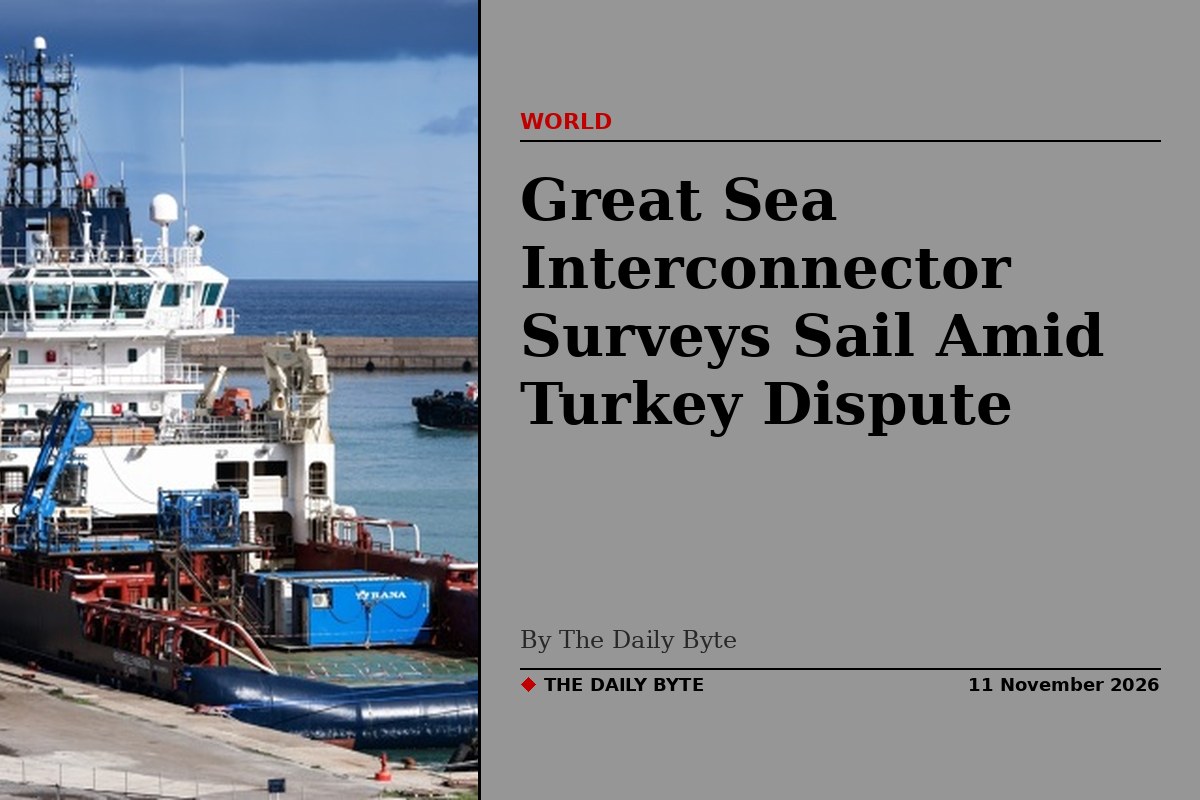
The French survey vessel Abeille Marengo has sailed from the port of Heraklion in Crete to begin seabed surveys for the Great Sea Interconnector, the planned undersea electricity cable linking Greece and Cyprus, despite objections from Turkey.
The vessel left Heraklion shortly after 18:00 on Monday 10 November, Greek public broadcaster ERT reported from the scene, heading towards waters south-east of Karpathos. It will calibrate its equipment before surveying the seabed to identify the safest route for the cable. The departure does not mean seabed mapping or cable laying has started.
Hours later, Greece issued a fresh maritime notice in the early hours of 11 November, reaffirming its authorisation for the survey work after Turkey issued a counter-notice disputing it. Heraklion station issued NAVTEX 1441/26, transmitted at 22:05 UTC on 10 November, declaring the Turkish warning invalid and restating the earlier Greek notice, 1411/26.
A cable years in the making
The Great Sea Interconnector is a planned undersea cable linking Greece, Cyprus and eventually Israel. It is being developed by Greek grid operator IPTO and French cable maker Nexans. The 1.9 billion euro project is recognised as a project of European common interest, and would connect Cyprus to the European electricity grid for the first time.
The project has faced repeated delays, from financial disagreements and from disputes between Greece and Turkey over maritime jurisdiction in the eastern Mediterranean. Survey work south of Kasos stopped in 2024, when Turkish warships appeared in the area during research activities. The Abeille Marengo, which sailed from Naples in October, had been waiting at Heraklion for clearance before it could resume the work.
On 6 November, Greek authorities completed licensing for the surveys and cable laying. The foreign ministry issued the decision after a favourable opinion from the interministerial marine research licensing committee, following a request submitted by Nexans on behalf of the project company GSI. The Greek NAVTEX, 1411/26, covers survey work from 6 November 2026 to 6 March 2027 in the eastern and south-eastern Cretan Sea and the eastern Mediterranean.
Competing claims over the same waters
Turkey issued its own notice, 1105/26, on 6 November, saying part of the survey area lies on its continental shelf, under a submission it made to the United Nations in 2020. Ankara says it has not granted consent and that research in those waters must be coordinated with Turkish authorities.
Greece rejects that position. Greek officials say Athens alone licenses activity in these waters and that the surveys need no Turkish consent. The Greek notice states that a significant part of the survey lines lies within Greece's exclusive economic zone and continental shelf, and cites Greek permits. Greece's foreign minister, Giorgos Gerapetritis, and Cyprus's Konstantinos Kombos coordinated the two countries' notices before issuing them.
France has also been drawn into the diplomatic exchanges. Deputy Foreign Minister Tasos Chatzivasileiou said France's diplomatic note to Ankara was notification of the work rather than a request for permission. Environment and Energy Minister Stavros Papastavrou restated Athens's position that Turkey did not authorise the surveys.
Turkish Foreign Minister Hakan Fidan struck a calmer note on 7 November, telling Greek media that everything is normal and everything is fine, though he gave no details of any agreement. Greek and Cypriot officials say they reached no arrangement with Turkey and that licensing proceeded on their own authority.
Prime Minister Kyriakos Mitsotakis reaffirmed on 8 November that Greece and Cyprus authorise the surveys. Attention now turns to whether the work proceeds as planned, and whether Turkey stops at its counter-notice or takes further steps at sea, as it did near Kasos in 2024.


