Greece joins Poland's MikroSAR satellite plan
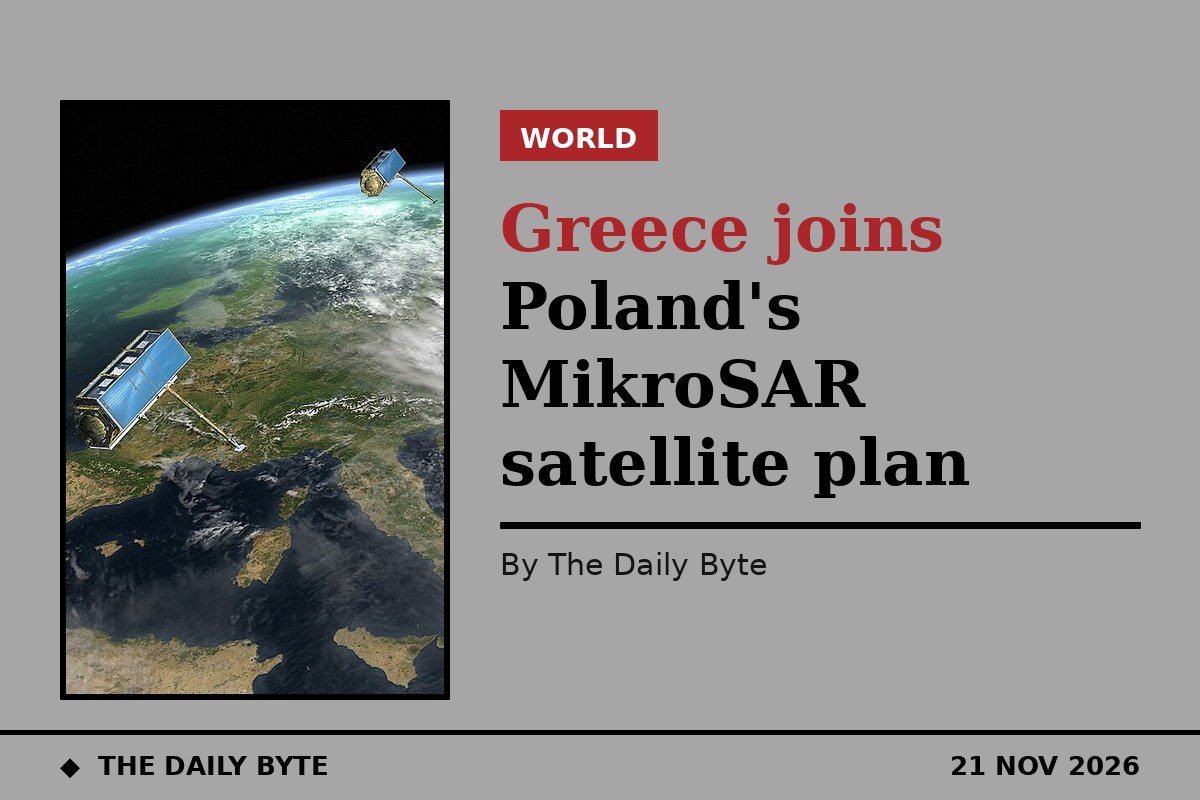
Greece and Poland have signed a memorandum on the joint purchase of radar satellites, a deal that could bring Athens into Poland's MikroSAR programme and give the two countries a shared set of eyes in orbit. The document was signed in Warsaw on Thursday 19 November, and reported on Friday and Saturday as the two defence ministries set out what comes next.
The memorandum was signed at the Warsaw Garrison Command Club in the presence of Magdalena Sobkowiak-Czarnecka, secretary of state in Poland's Ministry of National Defence, and Athanasios Davakis, Greece's deputy minister of defence. It was signed on the Polish side by Brigadier General Romuald Maksymiuk, the national armaments director, and on the Greek side by Major General Ioannis Bouras, his counterpart and director general for defence investments and armaments.
What the memorandum does — and does not — commit
The agreement sets up a framework for the two defence departments to cooperate on buying radar Earth-observation satellites using synthetic aperture radar, or SAR, technology. Unlike ordinary cameras, SAR instruments can observe the ground through cloud and at night, which makes them valuable for watching borders, coastlines and military movements in a region where the weather rarely cooperates. The two governments intend to explore financing through the European Union's SAFE defence-lending instrument, using part of the loan available under that scheme.
For Poland, the practical next step runs through its Armament Agency. The memorandum allows the agency to take steps towards expanding a contract signed in May 2025 with a consortium of ICEYE Polska and the Military Communication Works No. 1 so that it also covers the Greek side. That contract covers the delivery of satellites under the MikroSAR project, Poland's home-grown radar satellite system. Both sides were careful to stress the limits of what they signed: the memorandum does not oblige either country to enter into a framework agreement or any specific executive contract, and no contract value or delivery timetable was announced.
Poland's growing fleet — and why Greece wants in
Poland has been building its space-based surveillance quickly. The May 2025 contract with ICEYE, the Finnish radar-satellite maker working through its Polish arm, was worth 860 million zloty, about 200 million dollars, for three satellites with an option for three more. Polish defence officials have said four of the satellites are already in orbit, with a final option for two more exercised, and that the ministry aims to have twelve intelligence, surveillance and reconnaissance satellites in orbit by the end of 2027. Poland also has four Mikroglob electro-optical imaging satellites in orbit, launched this October on a SpaceX Falcon 9, and two Airbus-built Pléiades Neo satellites ordered in 2022.
For Greece, joining an existing programme is faster and cheaper than starting its own. Athens gets access to radar imagery of the eastern Mediterranean and the Aegean, where it watches Turkish naval movements and migration routes, without having to fund a satellite constellation from scratch. For Warsaw, a Greek order would be the first export of a Polish-led satellite system, and Sobkowiak-Czarnecka presented it in exactly those terms, calling the signing a good day for the Polish arms industry and, above all, for the Polish-Greek partnership. She added that it was proof that, under the SAFE mechanism, other countries would buy from the Polish defence industry.
The signing was accompanied by a Polish-Greek Defence Industry Day, at which 84 company representatives — 53 from Poland and 31 from Greece — met to develop direct cooperation between firms from the two countries. Further negotiations must now establish the final scope of the cooperation, including how many satellites Greece would take and how the SAFE loan would be divided. The deal also lands in a week when the war in Ukraine has again spilled into NATO airspace, with a Russian missile and a drone coming down in south-eastern Poland on Friday and a drone alert in Estonia on Saturday — a reminder of why both countries are investing in watching their skies from above.
Sources: Europe Says and Warsaw Business Journal and Breaking Defense.


