Greece renews Parthenon Marbles return demand
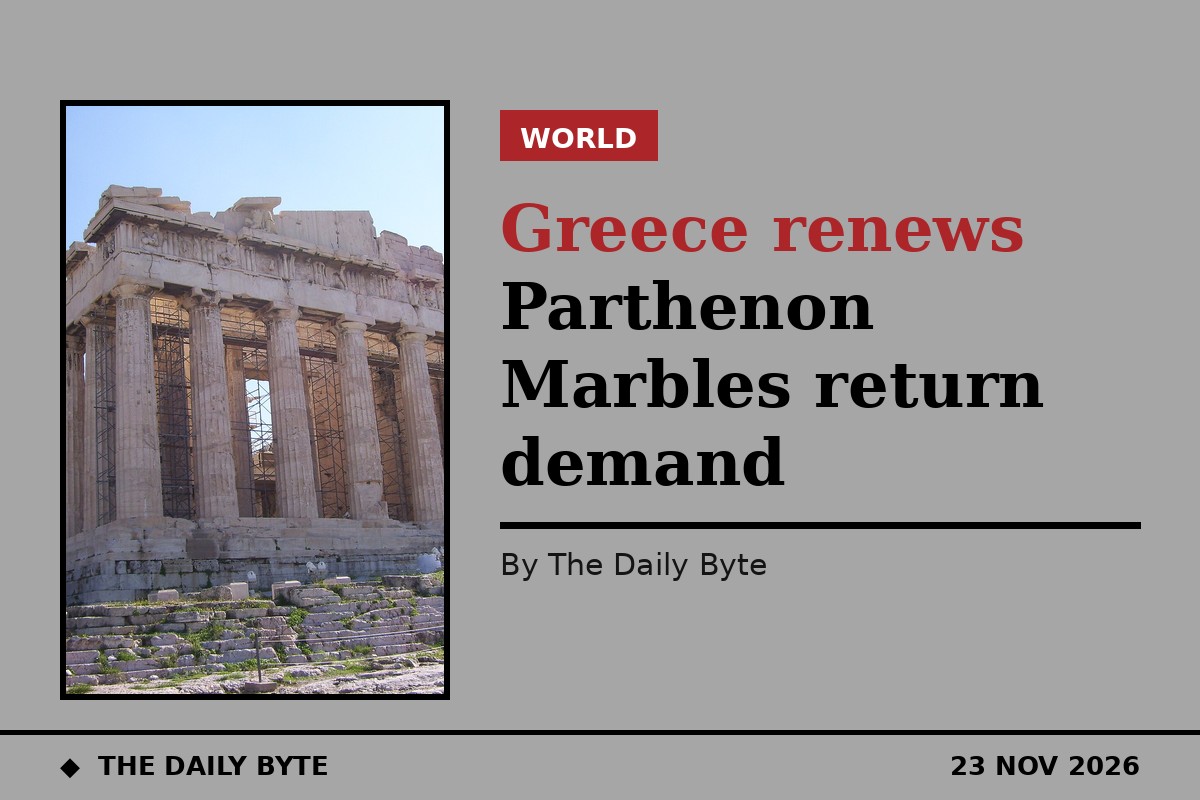
Greece has renewed its demand for the return of the Parthenon Sculptures from the British Museum, with Prime Minister Kyriakos Mitsotakis calling their reunification in Athens a non-negotiable national goal. He made the remarks on Monday, 23 November, at the reopening of the Old Acropolis Museum, a 19th-century building standing a few metres from the Parthenon itself.
"The return and reunification of the Parthenon Marbles remains our great and non-negotiable national objective," Mitsotakis said at the inauguration ceremony. "The place of these priceless masterpieces is here, under the Attic light and in direct contact with the temple to which they belong."
The Old Acropolis Museum has been closed to the public since 2007, nearly 20 years. Its collections were moved to the new Acropolis Museum, which opened in 2009 at the foot of the hill, and the old building was left as offices and storage space. Its reopening restores it as a public cultural space on the Acropolis, and Mitsotakis said it was the 34th museum inaugurated under his government's cultural programme.
The renovated museum opens with four sections. The first, "Athens: City, Idea", traces the history of ancient Athens through finds including objects shown to the public for the first time. A second permanent display presents architectural fragments and inscriptions from the Acropolis, including decrees, treaties and lists of magistrates. A third, "Parthenon Alive", developed with the Technical University of Crete, uses digital technology to reconstruct the Parthenon and explain how it originally looked. The fourth brings in contemporary art through a project by Iraqi-American artist Michael Rakowitz.
No deal that recognises foreign ownership
Mitsotakis used the occasion to set out a firm limit on any future agreement. He said Greece would not accept the sculptures coming back as a loan, and that no solution could be based on recognising foreign ownership over what he called Greece's national treasures. He said Athens would keep pursuing the return through diplomatic engagement and documented arguments, and expressed confidence that the effort would eventually succeed, without announcing a new agreement or a timetable.
He argued that the sculptures should not be treated as separate museum objects, but as integral parts of a single monument conceived as a unified architectural and sculptural work. Athens, he said, has shown through the Acropolis Museum that it can conserve and exhibit the sculptures under suitable conditions, in direct visual connection with the temple.
A dispute going back decades
Greece has sought the return of the sculptures for decades. Athens maintains they were looted in 1802 by a British diplomat, Lord Elgin, and removed from the Parthenon. The British Museum maintains that the sculptures in its collection were legally acquired, a position Greece disputes. The works are sometimes known in Britain as the Elgin Marbles.
The new Acropolis Museum, opened in 2009, symbolically included a space reserved for the sculptures, underlining Greece's argument that Athens is ready to receive them. The debate has continued through years of talks with the British Museum, with no agreement reached on a permanent return.
What the reopening changes
Beyond the sculptures dispute, the reopening adds another exhibition space to the Acropolis, Greece's most visited ancient site, which recorded more than 4.6 million admissions last year. Mitsotakis also spoke about continuing work on the site, including improved access to the eastern plateau, the Acropolis lift for visitors with disabilities, and closer links between the Acropolis, the Ancient Agora and the Kerameikos site. Restoration work on the hill continues, and the Parthenon recently shed its heavy scaffolding for the first time in years.
Visitors who pay 30 euros to enter the Parthenon will pay a further 15 euros to see the refurbished museum, according to organisers. For now, the reopening changes the setting of the argument rather than its outcome: the museum is open again, the sculptures remain in London, and Greece's demand, restated in the shadow of the temple itself, is unchanged.


