Greenland Backs US-Denmark Security Deal 16-0
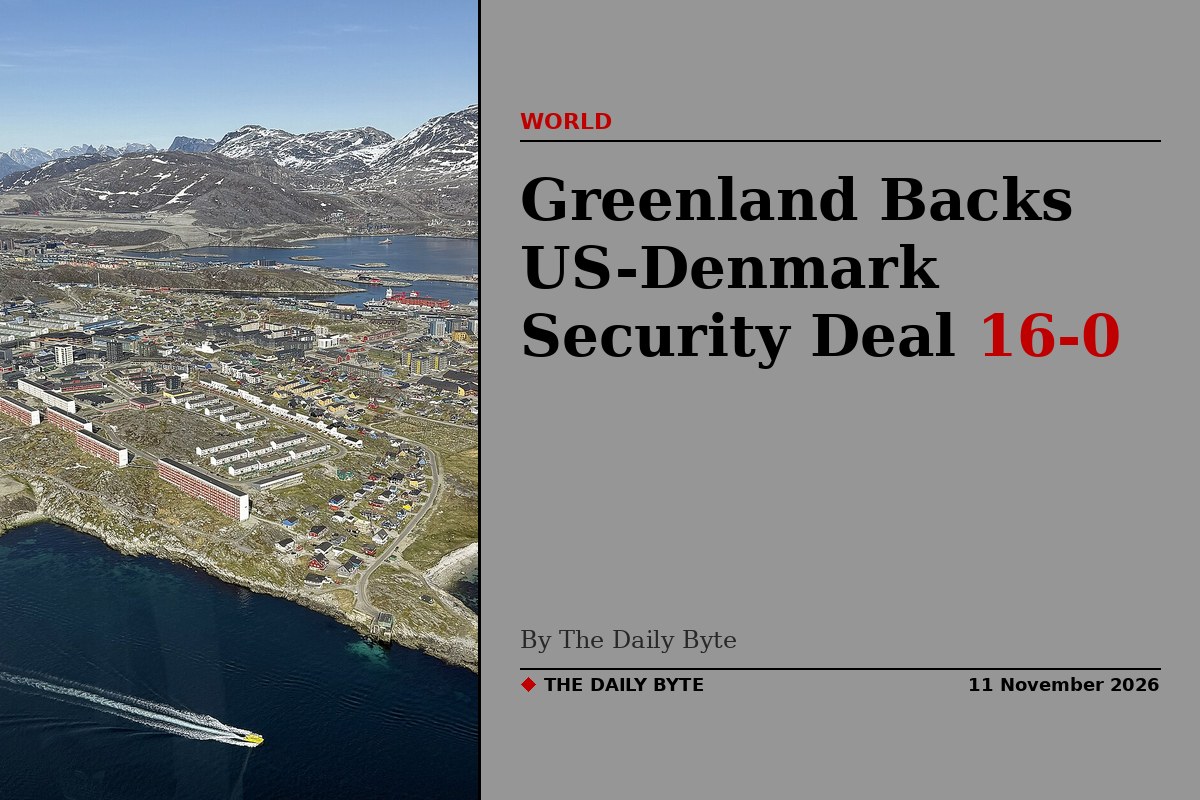
Greenland's parliament has approved a security agreement with Denmark and the United States, voting 16-0 in favour, with seven abstentions, on 3 November 2026. The decision, taken by the Inatsisartut in Nuuk, moves the September accord a step closer to taking effect, although it does not itself create a new military base or bring the agreement into force.
The agreement was signed in New York on 22 September 2026 by United States President Donald Trump, Danish Prime Minister Mette Frederiksen and Greenlandic Prime Minister Jens-Frederik Nielsen, on the sidelines of the United Nations General Assembly. It updates the defence framework originally established in 1951 and is intended to strengthen security in the Arctic and the North Atlantic.
What the Greenland vote approved
Under the agreement, the United States will be able to expand military activities at Pituffik Space Base in north-west Greenland. It also provides for new defence areas at Narsarsuaq in southern Greenland and Mestersvig on the eastern coast, although technical arrangements for those sites still have to be agreed between the parties.
The text reaffirms Danish sovereignty and the right of Greenlanders to self-determination. It does not transfer ownership of Greenland, and the agreement would still apply if Greenland eventually chooses independence. Washington is treating the accord as an executive agreement rather than a treaty, so no approval is required from the United States Senate.
The Associated Press reported that the deal paves the way for more United States bases in Greenland and eases tensions over Mr Trump's repeated calls for the vast island to become part of the United States. The agreement followed months of pressure over the strategic future of the self-governing territory of a NATO ally.
A tense debate before the vote
The vote in Nuuk did not take place without dispute. Before lawmakers voted, Greenlandic Foreign Affairs Minister Múte B. Egede accused the opposition party Naleraq of disclosing confidential information from a closed meeting of the parliamentary foreign and security policy committee. The party disputed the allegation, and the presidium of the Inatsisartut referred the allegation to police.
Naleraq then submitted a motion of no confidence in Mr Egede, objecting to his remarks about trust between the government and parliament. The party has also criticised the deal for failing to secure sufficient financial and environmental benefits for Greenland, and it had sought a referendum on the agreement.
After the vote, Danish broadcaster DR quoted Mr Egede as saying he was happy and relieved, adding that it had been a long road. The 16-0 result, with seven abstentions, showed approval without a recorded vote against, although the abstentions also underlined that support was not unanimous.
What happens next in Denmark
The agreement is not yet in force. Denmark's parliament, the Folketing, must still approve it. According to the official parliamentary timetable reported by Nordisk Post, the Folketing is scheduled to hold its first debate on 12 November and a final debate on 19 November. The Associated Press reported separately that Danish lawmakers are set to debate the agreement later this month.
The deal will enter into force only once the necessary parliamentary processes of the Kingdom of Denmark, in conjunction with Greenland, have been completed, and the United States has been formally notified that the required approvals are complete.
For now, the Greenland vote clears the first parliamentary hurdle. The next decisive step is in Copenhagen, where Danish lawmakers will decide whether the agreement that was signed in New York in September becomes law in the Kingdom of Denmark.


