Guyana urges Caribbean to adopt final CCJ court
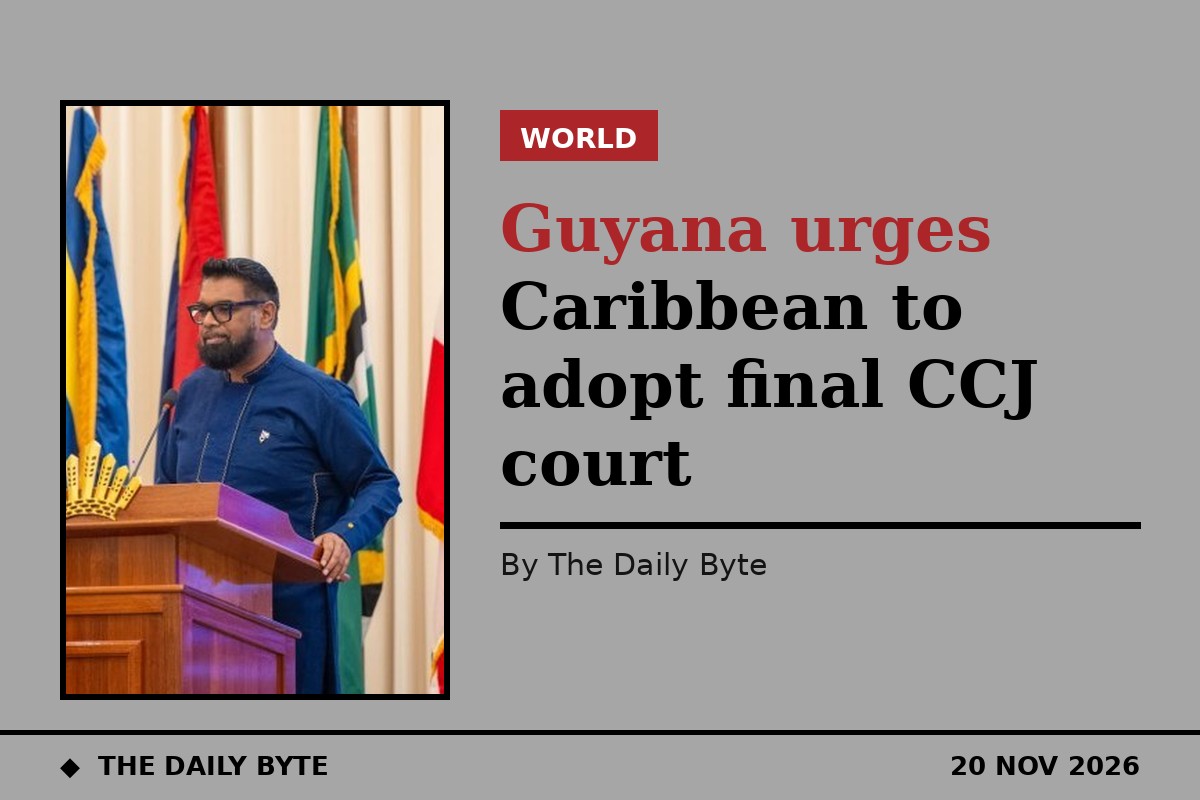
Guyana's President Irfaan Ali has urged Caribbean countries to make the Caribbean Court of Justice (CCJ) their final court of appeal, saying the region should trust the judicial institution it built for itself.
President Ali was speaking on Thursday at the opening of the 9th Biennial Conference of the Caribbean Association of Judicial Officers (CAJO) at the Marriott Hotel in Kingston, Georgetown. The three-day conference, held under the theme "Changing Fundamentals of Judging", brought together 194 delegates from across the Caribbean and beyond. It ends on Saturday.
"We should also take immense pride in the Caribbean Court of Justice. The CCJ remains a credit to our region, an institution that demonstrates our capacity to build and sustain institutions of the highest judicial standing," he said.
Five countries in, the rest still out
Only five countries — Guyana, Barbados, Belize, St Lucia and Dominica — use the CCJ as their final court. The remaining CARICOM members take part only in the court's Original Jurisdiction, where it acts as an international tribunal interpreting the Revised Treaty of Chaguaramas, the agreement governing regional integration.
The CCJ was established in February 2001, when CARICOM leaders signed the agreement creating it in Barbados, and was inaugurated on 16 April 2005 in Port of Spain, replacing the London-based Privy Council as the region's highest court.
President Ali said it was hard to explain why, amid the push for reparations and talk of freedom from colonial rule, the region could not agree to make the CCJ its final court. "That we speak so loftily about freedom and independence and being away from colonial rule, and we cannot be brave enough. We cannot trust ourselves enough to make the CCJ our final court," he said.
He added that the CCJ had helped shape jurisprudence in areas including constitutional rights, democratic governance, the rule of law and regional integration, calling it "an example of what the Caribbean is capable of building for itself".
Trust, technology and social media
President Ali told the conference that public trust helps safeguard judicial independence, and highlighted three aspects of that trust: adapting to rapid technological and social change, and providing timely and accessible justice, which he described as an unchanging pillar.
On technology, he noted that not every Caribbean country has the fiscal room to build what the modern world requires, and asked delegates to produce a paper that could widen the discussion among policymakers.
He also proposed a mechanism to brief judges on regional security threats, including intelligence on criminal networks and terrorism, arguing that the separation of powers should not mean separating information.
Turning to social media, he said scrutiny of the courts was legitimate, but criticism had to be distinguished from intimidation. "A court cannot decide a case by counting the number of likes, shares, or comments," he said.
What the conference will do next
CAJO chairman and CCJ judge Peter Jamadar said the theme was chosen because the fundamentals of judging were being reshaped by technological advances, changing societal expectations and emerging challenges to the rule of law.
"Through this conference, we hope to explore how Caribbean judiciaries can respond to these changes while safeguarding the principles that underpin the administration of justice," he said.
Acting Chancellor of the Judiciary Justice Roxane George thanked President Ali and the Government of Guyana for their support in planning and hosting the conference. No country has yet announced that it will follow his call and adopt the CCJ as its final court.
Sources: Caribbean Media Corporation (CANA News); Department of Public Information, Guyana.


