Guyana: US Not Pushing Venezuela Talks on Essequibo
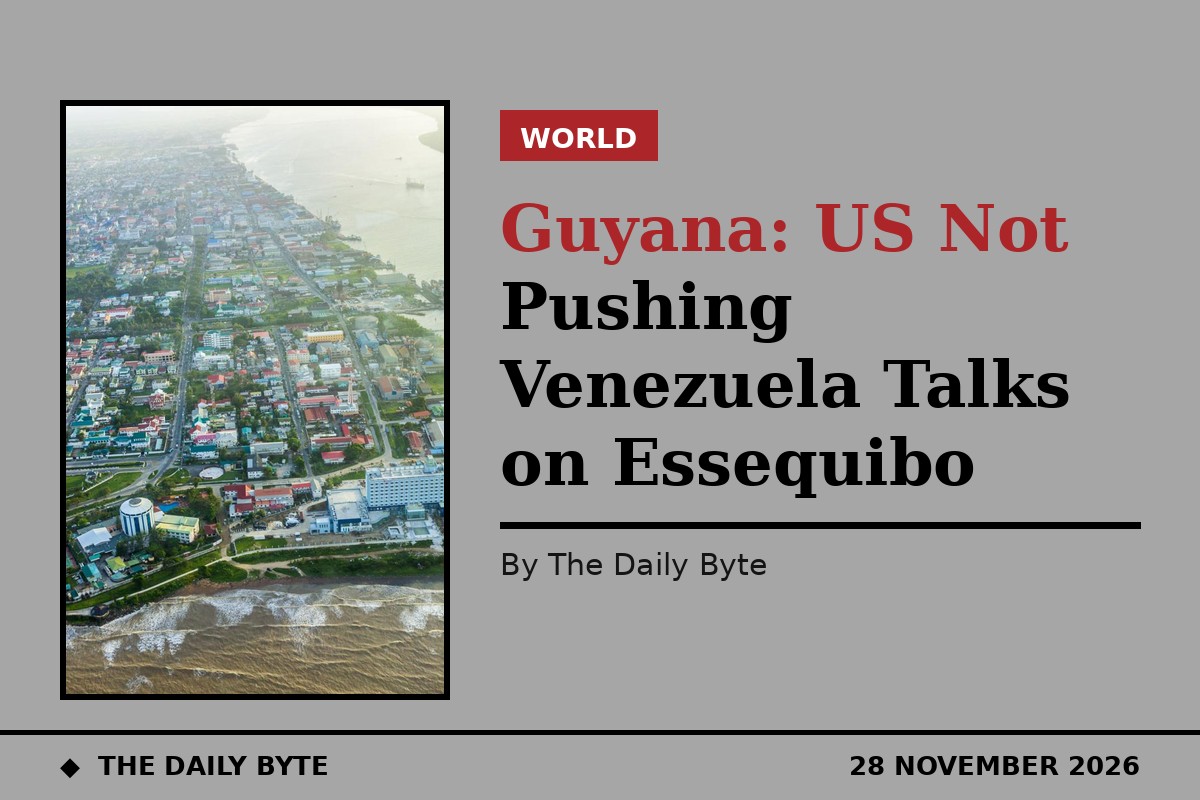
Guyana has said the United States is not pushing it into bilateral talks with Venezuela over the disputed Essequibo region, after reports that a former senior American official had raised the idea of Caracas taking partial control of the territory.
Vice President Bharrat Jagdeo made the point at the 2026 Guyana Manufacturing and Services Association award ceremony on Thursday night. “People thought that they were pushing us to have bilateral discussions with Venezuela and that is furthest from the truth,” he told the audience in Georgetown.
The remarks follow a Reuters report published on 19 November that Jeremy Lewin, who served as the United States State Department’s director of policy planning until the end of October, had floated the possibility of Venezuela taking partial control of the Essequibo during a meeting in Washington in September with Guyanese Foreign Secretary Robert Persaud. Lewin later confirmed to Reuters that he had held preliminary and confidential discussions with representatives of both Guyana and Venezuela, saying the conversations were authorised by the White House and followed a letter in May from Venezuela’s acting President Delcy Rodríguez to President Donald Trump seeking American help in arranging direct negotiations with Guyana.
No bilateral talks, Georgetown says
Georgetown’s response has been firm and consistent. Foreign Affairs Minister Hugh Todd said in a statement that Guyana would not hold bilateral talks with Venezuela on the controversy and that the dispute must be settled by the International Court of Justice. He added that a judgment could come as early as the first quarter of 2027, and that Guyana firmly believed the 1899 Arbitral Award, which established the boundary between the two countries, was “perfect, final, and complete”.
Todd also confirmed that Persaud had made it clear during the September discussions with Lewin that Georgetown would pursue the outcome of the court proceedings and no other option. “Those discussions were minuted, and we, at the Foreign Ministry, are in possession of those notes,” Todd said. The United States State Department and its embassy in Georgetown have since reaffirmed that Washington’s official position on the boundary has not changed, and the American ambassador to Guyana, Nicole D. Theriot, was present at the ceremony where Jagdeo spoke. Jagdeo thanked her for what he called the strong reiteration of American support for the 1899 award.
President Ali: no surrender
President Mohamed Irfaan Ali had already delivered an unequivocal message days earlier. Speaking on 22 November at the commissioning of a water treatment plant on Leguan Island, he declared: “Leguan is Guyanese. Essequibo is Guyanese and Essequibo shall remain Guyanese. There is no debate about that.” He added that all of the Essequibo belonged to Guyana and none of it would be surrendered, while reaffirming his government’s commitment to the International Court of Justice and to abiding by its ruling.
The dispute is one of South America’s oldest. Venezuela has claimed the Essequibo, the mineral-rich region that makes up the western two-thirds of Guyana, for more than 180 years. Guyana took the case to the International Court of Justice in 2018, asking the court to confirm the validity of the 1899 award. Venezuela held a referendum in 2023 in which voters backed claiming the territory, and the dispute has gained new urgency as offshore oil discoveries have transformed Guyana into one of the world’s fastest-growing oil producers.
The opposition in Georgetown has backed the government’s line. Aubrey Norton, leader of the People’s National Congress Reform, pledged his party’s support for the position that the 1899 award finally settled the land boundary, while acknowledging that if the court ruled the award invalid, the two countries would have to hold talks. He said he was confident the court would rule in Guyana’s favour but stressed that the government needed to engage the opposition so the country kept a consistent approach to protecting its sovereignty.
For now, the message from Georgetown is unchanged: no bilateral negotiations, no territorial concession, and a ruling from The Hague as the only acceptable route to settling a dispute that has shadowed Guyana since independence.


