420 Metres of Tunnels Cleared Beneath Hagia Sophia
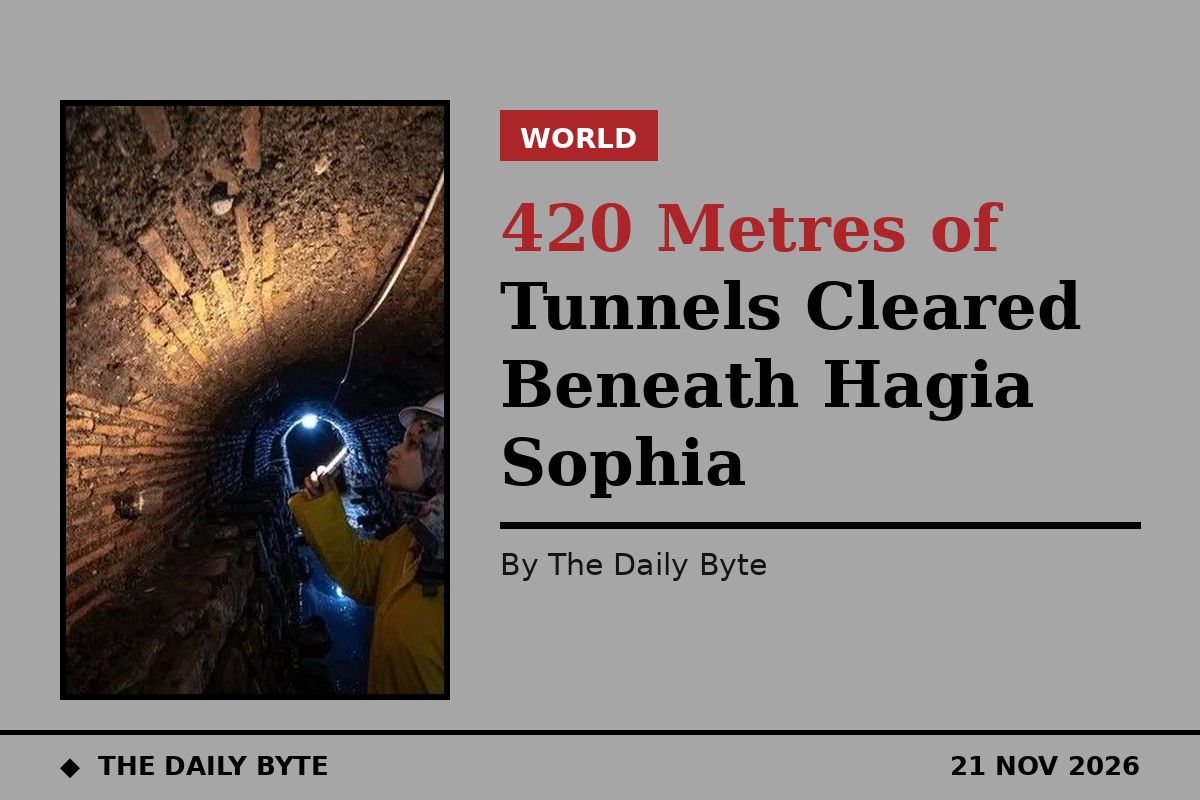
Restoration work beneath Istanbul's Hagia Sophia has cleared about 420 metres of historic tunnels, revealing underground chambers, ancient water channels and architectural remains that may predate the present 1,500-year-old monument. Nearly 3,000 tonnes of accumulated soil and debris have been removed.
The findings were set out on 20 November, when Türkiye's Culture and Tourism Minister Mehmet Nuri Ersoy inspected the works. The project is part of a major conservation effort at the sixth-century building, where archaeologists and restoration specialists are examining the underground structures around the monument.
In the western garden, researchers have documented six underground spaces connected with nine tunnels. Three of the chambers have been identified as basement structures associated with an ancient atrium, the courtyard that once formed part of the monumental complex. Seven of the nine tunnels have been cleared of accumulated deposits, while surveying and documentation continue in the remaining two.
A burial chamber older than the monument?
One of the most significant developments comes from an underground burial structure, or hypogeum, located near Hagia Sophia's north-eastern corner. The interconnected complex contains a main chamber measuring about eight metres long and eight metres wide, with passages extending east and west. Researchers have cleared the eastern passage for about 25 metres, while investigations continue along the western route.
During excavation, workers removed mud and sediment to reach a level about 1.5 metres below the previously exposed floor. Ersoy said the newly examined section is believed to belong to a period earlier than the present Hagia Sophia, although its precise date has yet to be established.
The present building was completed in AD 537 under Byzantine Emperor Justinian I, following the destruction of an earlier church during the Nika Revolt of 532. That building had itself replaced an earlier church associated with the fourth-century development of Constantinople. Whether the newly investigated underground remains can be linked to any of these earlier construction phases is still unclear, and further archaeological examination will be needed before researchers can establish their chronology and original purpose. The excavation of the hypogeum itself has been completed, although work continues along associated underground channels.
Water, streets and Tunnel 4
One of the most substantial passages, designated Tunnel 4, extends about 180 metres. It runs parallel to Hagia Sophia's entrance facade, from the vicinity of the Fatih Madrasa toward the present visitor entrance, following a gradient of roughly three percent. Researchers are investigating whether the passage was associated with an ancient Roman street believed to have crossed this area of Constantinople. Professor Ahmet Güleç, a member of Hagia Sophia's Scientific Committee, said historical maps suggest a route extending from Little Hagia Sophia toward Sarayburnu, although its exact course has not been confirmed. He said some of the underground structures may date to the Roman period and appear to have undergone modifications during later centuries.
The tunnels are also offering clues about the city's historic water infrastructure. One passage extends southward toward the Basilica Cistern, the enormous Byzantine reservoir built to supply water to Constantinople. Water still flows through parts of the underground network, but researchers have not yet identified its source. Güleç explained that the water could originate from a natural spring or from an older distribution system associated with the city's aqueduct network, including the Valens Aqueduct.
Could the tunnels open to visitors?
The restoration project is also addressing structural damage within the underground complex. Conservation specialists have repaired sections of collapsed or weakened vaulting and reinforced passages where necessary, using materials selected to remain compatible with the historic structures. Restoration teams have reinforced sections of the tunnels with stainless steel supports, while technical studies are assessing the underground network's ventilation capacity.
Officials are considering whether some of the underground spaces could eventually be opened to visitors, offering access to a part of Hagia Sophia rarely seen by the public. Güleç emphasised that such a decision would require additional conservation work, safety assessments and suitable arrangements for public access. No final decision has been announced. Ersoy said the ministry plans an exhibition project for suitable underground sections, but the announcement did not set an opening date, and any future access will depend on conservation work, scientific assessment and visitor safety.
The present structure was built under Emperor Justinian between 532 and 537. It served as a church before becoming a mosque in 1453, a museum in 1934 and a mosque again in 2020. It stands within the Historic Areas of Istanbul, which were added to the UNESCO World Heritage List in 1985. The findings link the restoration to those successive periods: water channels, burial structures and vaulted spaces show the monument's history extends beneath its visible walls.