Hague Court Keeps Bonaire Climate Targets in Force
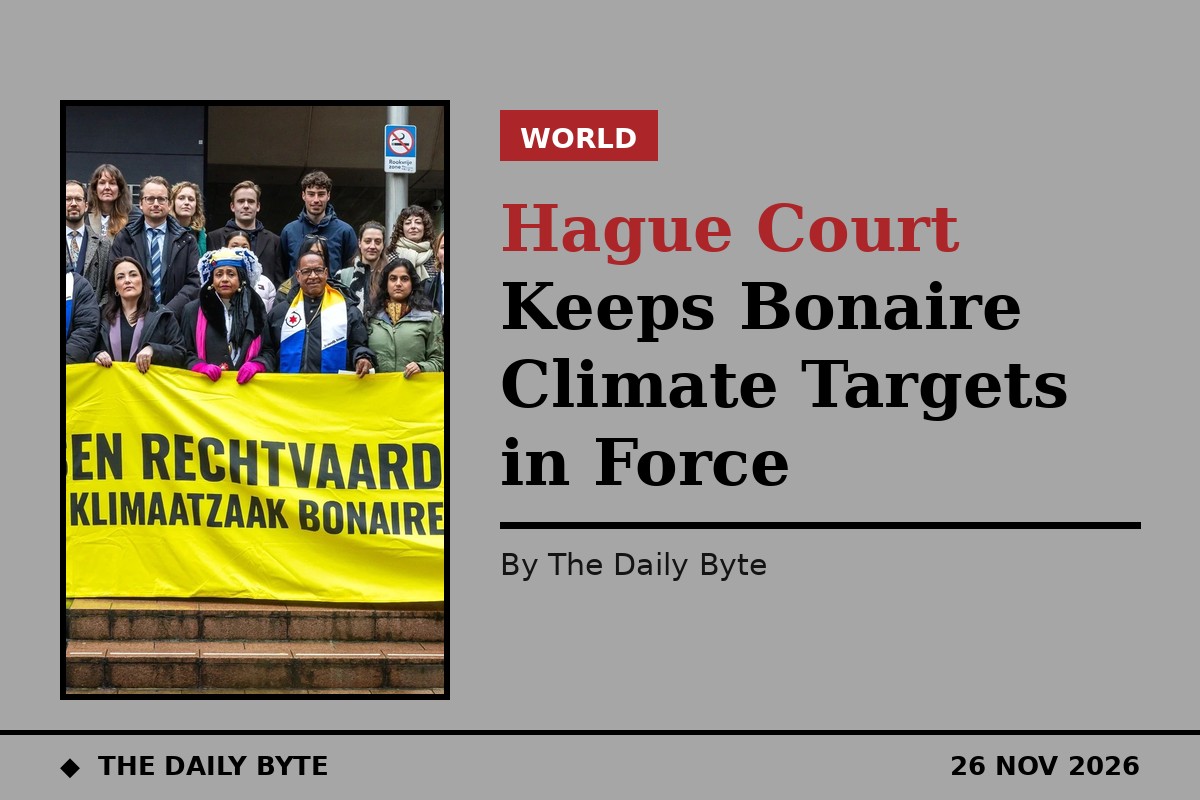
The Hague Court of Appeal has largely refused to suspend the Dutch state's duty to draw up binding national climate targets while its appeal in the Bonaire climate case continues, in a decision handed down on Tuesday 24 November.
The government must carry on drafting the targets even though it is challenging the underlying ruling, the court held. It gave the state its way on only one point: international aviation and shipping may be left out of the targets for now.
The case was brought by Greenpeace Netherlands together with residents of Bonaire, the Dutch Caribbean island. In January 2026 the Hague District Court ruled in their favour, finding that the Netherlands must do more to curb emissions and to protect islanders against the effects of climate change. It ordered the state to set absolute emissions-reduction targets for the whole economy within 18 months, and to do more to protect Bonaire itself.
That January ruling was declared provisionally enforceable, meaning it applies immediately even while the state appeals. The cabinet appealed in April and also asked the court to suspend the duty to carry it out straight away. The appeal itself is still under way, with an outcome not expected before the end of 2027.
What the court decided
The targets for cutting greenhouse gas emissions must be written into national rules by summer 2027. The deadline comes from the January ruling, which gave the state 18 months to set them; the appeal court confirmed that work must continue, with the deadline standing at 28 July 2027.
The court's refusal to suspend the duty means the government cannot wait for the outcome of its appeal before acting. The only exclusion it allowed was for international aviation and shipping, which may be left out of the targets for now.
Why Bonaire is at the centre
Bonaire became a special municipality of the Netherlands in 2010 and is highly exposed to sea-level rise, extreme heat and other consequences of global warming. The January ruling said the island is already suffering flooding from tropical storms and extreme rainfall, and that researchers expect this to worsen in the coming years.
Greenpeace argued that the Netherlands protects its European territory better than Bonaire. The district court agreed that the state had failed to do its fair share to cut emissions and to protect the island's residents.
What happens next
Marieke Vellekoop, director of Greenpeace Netherlands, said the state had again been reminded of its responsibility. "Carrying out the ruling is not an optional ambition, but an obligation," she said, calling it "incomprehensible that the State is doing everything it can to delay climate action" while the consequences of the climate crisis keep growing, "on Bonaire, but also here in Europe".
The cabinet must now keep working on the binding targets while its appeal runs its course. If it fails to put them into law by next summer, it will be in breach of a court order that is already in force.


