Hamas Chief Calls for Palestinian Unity Government
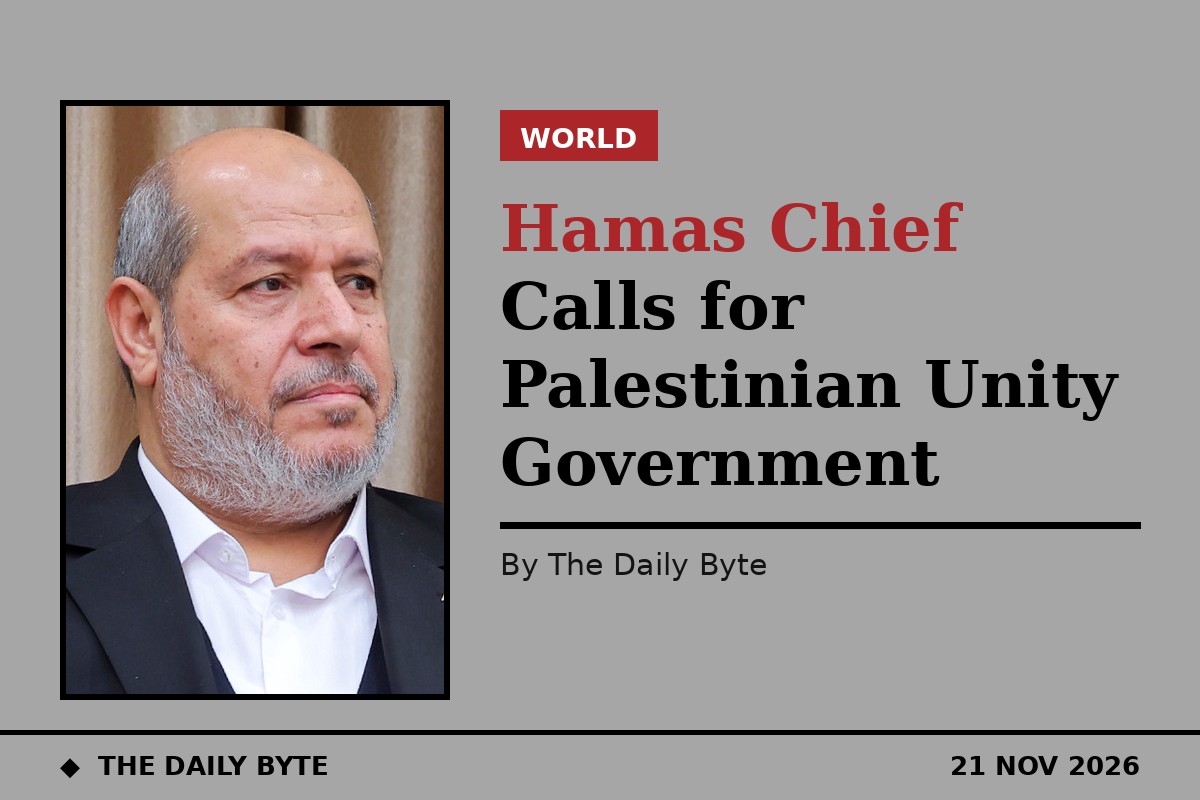
Hamas leader Khalil al-Hayya has called for a Palestinian national unity government, backed by an inclusive Palestine Liberation Organization, and for general, presidential, legislative and Palestinian National Council elections. He made the call on Saturday at the 35th Arab National Conference in Beirut, in the movement's most detailed pitch for Palestinian reconciliation in months.
Al-Hayya, who has chaired Hamas's Political Bureau since July 2026, told the conference that Palestinians needed a unified national leadership inside the PLO, a unity government spanning the West Bank and Gaza, and elections at every level. The three pillars, set out in an official Hamas note carried by the Palestine Chronicle, were presented as a single package: leadership, government and the ballot box.
Three pillars for unity
According to Hamas's note, the call for a unified leadership inside an inclusive PLO, a unity government and general elections would be "a step toward the unity of the Palestinian people and the achievement of national institutions to face the challenges". Al-Hayya said the movement was putting the proposal to Palestinians and to Arab and Muslim states gathered at the conference, which is meeting in the Lebanese capital.
The proposal is aimed squarely at the long-running split between Hamas, which has governed Gaza since 2007, and Fatah, which dominates the Palestinian Authority in the West Bank. The PLO was founded in 1964 and is recognised internationally as the sole legitimate representative of the Palestinian people, but Hamas and Palestinian Islamic Jihad have never been integrated into it. Every previous reconciliation attempt, most recently the 2022 Algiers declaration, has stalled at the same obstacles: the composition of a unity government, the fate of armed factions, and who controls the security forces.
Fatah's answer is still awaited
Fatah, for its part, has said any resumption of national dialogue depends on Hamas first giving written approval to eight points set out by President Mahmoud Abbas. Fatah spokesman Munther al-Hayek told the news agency Sawa on Thursday that Hamas had yet to reply officially, and that the movement's leadership was waiting for a written response before any implementation could begin. The eight points, as reported by Sawa, concern the form of resistance, the chain of command over weapons, and the unification of Palestinian institutions.
The election element of al-Hayya's call also lands in a changed calendar. Abbas announced in July that legislative elections would be held on 28 November this year, but he postponed them in October, with the vote now expected in September 2027 alongside a presidential election, according to the Washington Institute. Any election would be the first since 2006, when Hamas won the last legislative ballot and the split that followed tore the Palestinian territories apart.
Denunciation of Israel's campaign
Al-Hayya used the Beirut platform to denounce what he called Israel's policy of aggression and starvation in Gaza despite the ceasefire agreed in October 2025, forced displacement and land appropriation in the West Bank, and Israeli offensives across Lebanon, Syria, Iraq, Yemen and Iran. He warned that the project of a "Greater Israel" had "moved from the world of ambitions to its implementation phase", and insisted that "resistance in all its forms is the authentic way to protect rights and recover the lands and holy places".
The speech was delivered as the Gaza ceasefire enters its second month, with the territory's future governance still unresolved and international discussion continuing over the Board of Peace framework proposed by the United States. Al-Hayya's intervention puts Hamas's own answer on the table: a Palestinian government chosen by Palestinians, under a PLO that includes all factions, rather than an arrangement imposed from outside.
Whether Fatah or the Palestinian Authority responds, and whether the conference's delegates take the proposal further, will decide if Saturday's call becomes more than another entry in a long catalogue of reconciliation appeals.


