Hamas Rebuilds Gaza Rule as Ministries Reopen
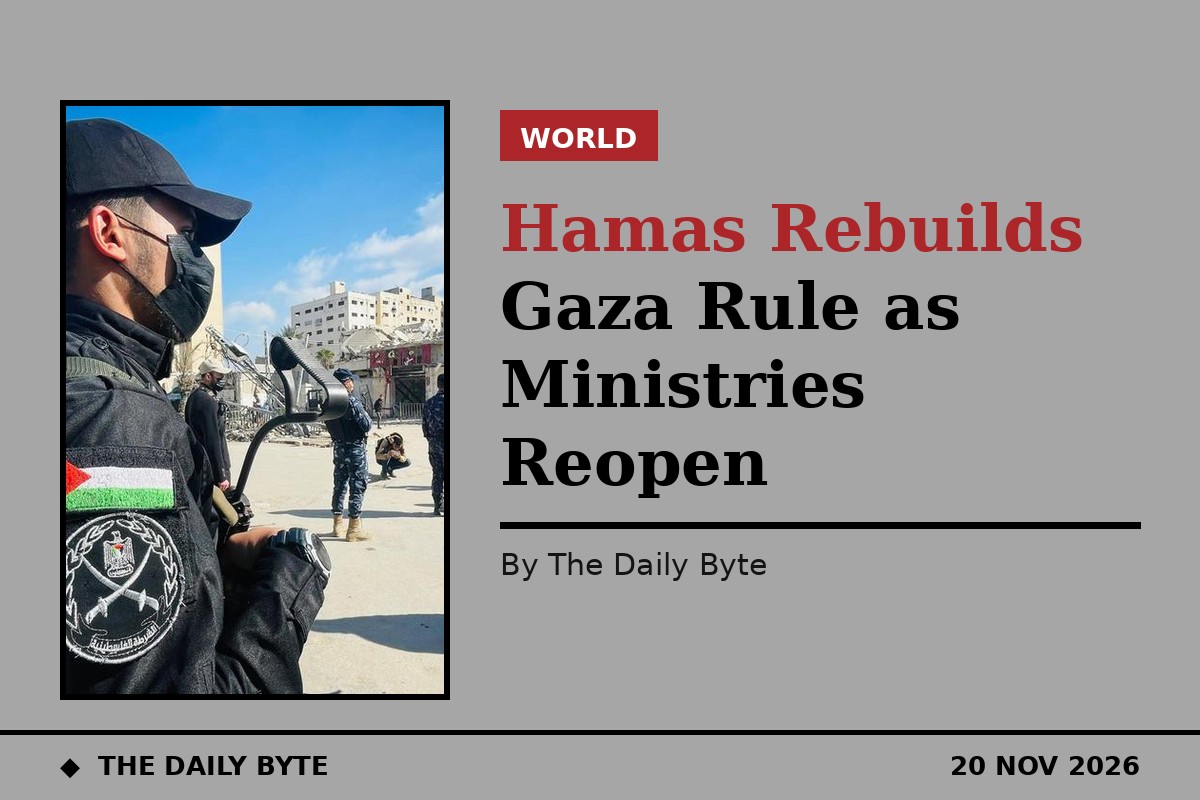
Hamas has restored all 17 of Gaza's government ministries and 22 of its 25 municipalities, according to an Israeli security establishment assessment published by the newspaper Yedioth Ahronoth and reported on Friday, 20 November. The assessment says the group has rebuilt much of its governing apparatus three years into the war, even though it was badly damaged by the fighting.
About 50,000 civil servants work in Hamas's governing institutions, the assessment says, alongside an estimated 30,000 armed operatives in its military wing — roughly 80,000 people across its civilian and security frameworks.
Ministries and municipalities back at work
Of the 25 municipalities that operated in Gaza before the war, 22 are functioning again. Fourteen kept working throughout the war in areas that remained under Hamas control, while eight more have resumed operations in territory the Israel Defense Forces (IDF) once held and Hamas now controls again. All 17 ministries that existed before the war have also resumed work and are providing services to residents.
The Interior Ministry runs the security apparatus and enforces public order. The Economy Ministry handles price enforcement, regulates the use of cash and collects taxes. The Health Ministry is expanding hospitals and opening new medical centres, the Transportation Ministry has reopened vehicle licensing centres, and the Agriculture Ministry supervises crops and produce markets.
Hamas's police and security services are once again operating openly, the assessment says. For much of the war they worked in a reduced and covert form because of the threat from IDF strikes. A wartime unit known as the Arrow Unit, which at its peak numbered several hundred operatives and worked mostly in secret, has shrunk significantly and is now almost inactive as regular policing returns.
Cash, taxes and recruitment
Money is one of Hamas's main difficulties, according to the assessment. The group has set up a special finance committee that collects taxes from merchants and business owners, in some cases demanding payment retroactively for commercial activity during the war. The committee summons people who brought goods and trucks into Gaza and demands large sums, including fees for coordination arrangements and a charge for every truck.
One collection point is Nasser Hospital in Khan Younis, according to the information. Hamas has also begun requiring businesses to accept cash for at least 30% of any purchase, and is expected to start fining those that do not comply — easing a cash shortage while extending control over private trade.
Recruitment is rising too. Israeli security officials assess that restoring mosques damaged during the war is helping Hamas re-establish its presence in local communities, particularly among young people and youth groups, and expand its pool of potential operatives.
Health system claims
One of the more unusual findings concerns Gaza's health system. According to information held by Israeli security officials, the Hamas-run Health Ministry has been selling medical documents to people connected to the organisation, enabling patients to leave Gaza for treatment abroad at an estimated price of $20,000 to $30,000 per person. The assessment also claims Hamas is working to replace the companions of patients leaving the Strip with its own associates.
Israeli security officials also maintain that Hamas uses Shifa, Shuhada al-Aqsa and Nasser hospitals for military purposes, cutting some departments' operating hours so operatives can move more freely inside. These are claims in the Israeli assessment, not independently verified findings.
Why the assessment matters
The assessment's own conclusion is mixed: Hamas took a heavy blow over three years of war, lost infrastructure and was stripped almost entirely of the semi-military frameworks it had on the eve of 7 October 2023. Even so, the revival of its governing institutions, security apparatus and economic system points to its continued hold on the Strip.
That matters because Gaza's political future remains undecided. Hamas formally dissolved its government in July 2026 and said it was ready to hand civilian control to a technocratic National Committee for the Administration of Gaza, but that committee has been unable to take on the role while Israel insists Hamas must disarm first. This week the IDF also carried out a tank raid west of the ceasefire's Yellow Line to destroy a tunnel — the first ground incursion of its kind since the October 2025 truce.
Frequently asked questions
How much of Gaza's government is working again? According to the Israeli security assessment, all 17 ministries and 22 of the 25 municipalities are operating — a far higher level than at the height of the war.
Does the assessment say Hamas has been defeated? No. It says Hamas was badly damaged but that its rule is far from collapsing, with its governing institutions, security apparatus and tax collection all functioning again.
Sources: JFeed | Europe Says


