Hartlepool Attackers' Sentences Increased on Appeal
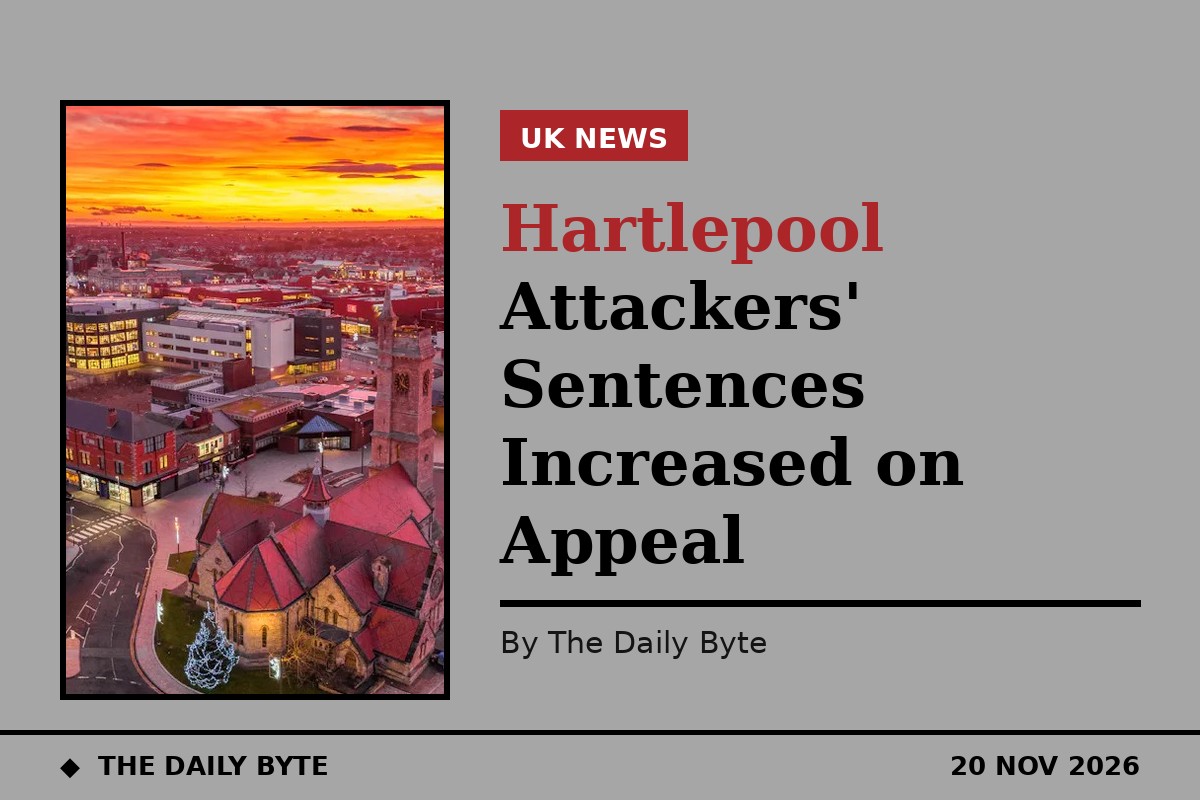
Two Hartlepool men who laughed while filming themselves beating a vulnerable man have had their prison sentences increased after the Court of Appeal ruled that the punishments handed down at Teesside Crown Court were unduly lenient.
John Robbins, 40, will now serve an extended sentence of 14 years and six months, made up of 11 years and six months in custody and three years on extended licence. Alan Metcalfe, 27, will serve eight years and six months in total, comprising five years and six months in custody and three years on extended licence.
The pair were originally sentenced at Teesside Crown Court on 23 April 2026 by Judge Richard Clews. Robbins received an extended term of 12 years, while Metcalfe was jailed for five years. The Attorney General referred both sentences to the Court of Appeal, arguing that they did not reflect the seriousness of the offending or the risk the men posed to the public.
In a judgment delivered on 3 November 2026, three senior judges — Lord Justice Stuart-Smith, Mr Justice Bryan and His Honour Judge Shaun Smith KC — agreed that the original sentences were unduly lenient and quashed them. The case is reported as [2026] EWCA Crim 1469.
Vulnerable man beaten and filmed
The appeal judges examined a prolonged attack on Darren Coull on 16 April 2025. Mr Coull had spent the evening at a friend’s flat, where Robbins and Metcalfe had been smoking crack cocaine. When Mr Coull said he had no money to buy more drugs, the men left the property with him and then suddenly turned on him.
Metcalfe struck Mr Coull in the face, knocking him to the ground, before both men repeatedly kicked and punched him in the head. The assault went on for several minutes as Mr Coull tried to protect himself, while the attackers filmed the violence and laughed as they took turns hitting him. The footage was later shown to a witness, who said the attackers appeared proud of what they had done.
Mr Coull suffered fractures to both eye sockets, his nose and his jaw, along with a brain bleed. He needed surgery to insert plates and screws into his face and spent about three weeks in hospital. The court heard that he was left with nightmares, anxiety and an ongoing fear of leaving his home, and that he had some learning difficulties and was described by a witness as easily led.
Threats to a witness and a second stabbing
While Mr Coull was recovering in hospital, his aunt contacted Metcalfe on Snapchat after learning about the footage. Instead of showing remorse, Metcalfe threatened to petrol bomb her home if he was identified as being responsible, and threatened to attack the property. The judges treated the threats as highly relevant to the risk he posed.
The court also heard that Metcalfe had been released from prison on licence on 2 April 2025, only two weeks before the attack on Mr Coull, after serving time for robbery. Weeks later, on 14 May 2025, police pursuing burglary suspects in Hartlepool saw him flee a property. He threatened to stab a police sergeant, and officers recovered a Stanley knife, a screwdriver and cannabis.
The judges also considered a separate attack by Robbins on 21 October 2025, in which a man identified as Mr Rofe was stabbed. A blanket was thrown over his head and he was dragged into a living room before Robbins stabbed him in the thigh as he tried to escape. Another man then picked up the knife and stabbed him again after Robbins told him to finish the attack. Mr Rofe suffered two serious puncture wounds, including one about eight centimetres deep that damaged an artery. He lost an estimated 1.5 litres of blood and needed emergency surgery to save his life.
Criminal histories weighed by judges
Robbins had also entered a home in March 2025 and stolen two guitars worth about £2,000, his third conviction for dwelling burglary. He had 15 previous convictions covering 45 offences, including robbery, false imprisonment, threats to kill and assaults. Metcalfe had six previous convictions involving 10 offences.
The Court of Appeal found that the original sentences had failed to give enough weight to the aggravating features of the offending, including the men’s previous convictions, the drug-related circumstances, the degrading nature of the filmed assault and the fact that Robbins had committed a further serious violent offence while on bail. The judges also found that the reduction applied when combining Robbins’s sentences had been excessive, and that the evidence of Metcalfe’s dangerousness required an extended determinate sentence to protect the public.
Both men were assessed as presenting a significant risk of serious harm to the public.