Hedra Launches Model Factory for Physical AI
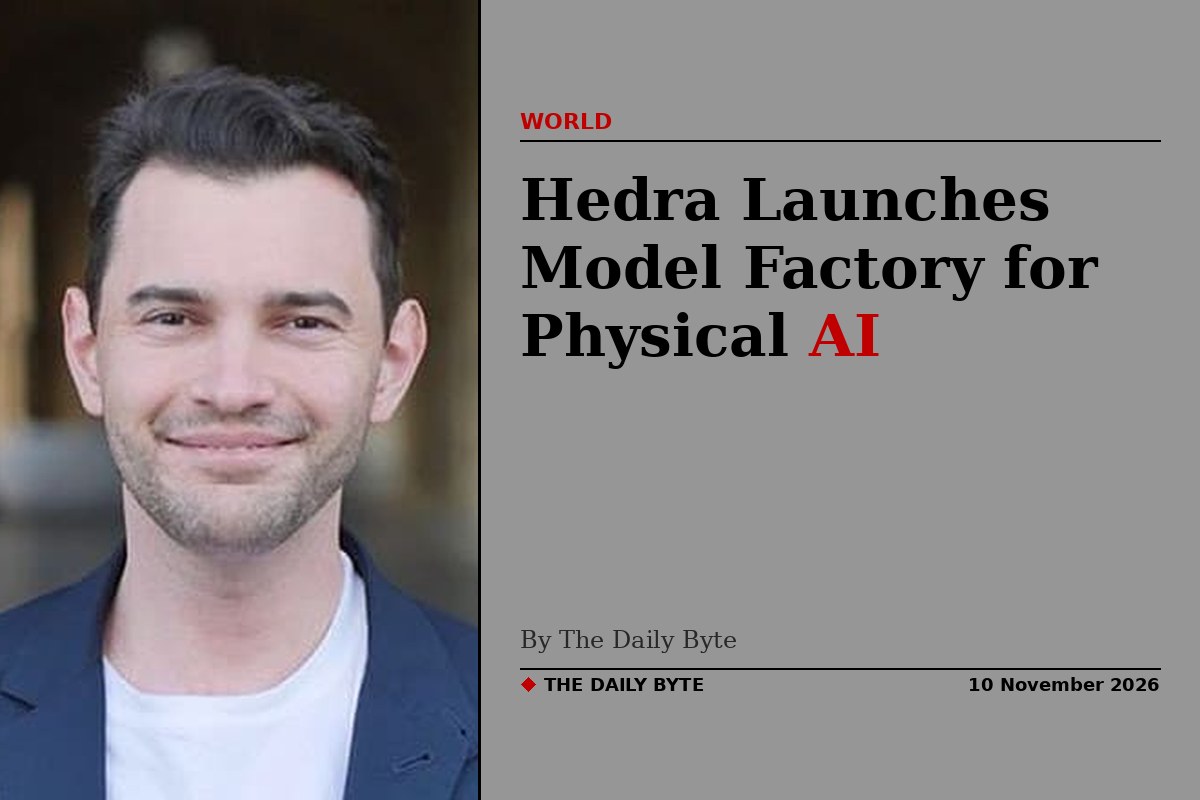
Hedra, the San Francisco research company behind AI video tools, has launched a new platform designed to take artificial intelligence out of the chatbot and into the physical world. Hedra Model Factory, announced on Tuesday 10 November 2026, offers post-training and inference for custom AI models built for robotics, manufacturing, biology and defence.
The company says the service gives teams the infrastructure to post-train, deploy and keep improving their own models, rather than relying on general-purpose systems that were never designed for a factory floor or a laboratory. It is available from today through the company's website, hedra.com.
What Model Factory does
Model Factory combines four elements, according to Hedra. Customers can rent flexible GPU sandboxes, work with Hedra researchers who run post-training alongside autonomous AI agents, deploy finished models on low-latency hardware, and feed real-world performance data back into the next version of each model.
Teams bring their own simulation engines and data. Hedra then helps build the reinforcement learning environments and datasets needed to train a model for a specific job, using tools such as vision-language models that caption and score data or give feedback while training is under way.
For customers without a research team of their own, Hedra says its researchers will also set up data capture, testing and the link between training a model and running it in production.
Recursive self-improvement
At the heart of the launch is an idea Hedra calls recursive self-improvement: AI systems that get better at improving themselves. Founder and chief executive Michael Lingelbach told SiliconANGLE that the approach has already had a major impact on how frontier models are developed, and Model Factory applies the same loop to real-world problems, where data is multimodal and hard to collect.
Once a model is in use, Hedra researchers study how it performs, retrain it and release only versions that pass the customer's own tests. The company says a simulated robot fitted with a new gripper went from near-zero success to near-100% success without retraining, an example it offered of the system adapting to new hardware.
Finished models can run on a customer's own servers or at a nearby partner data centre, and teams can also rent GPU capacity on its own or run an existing model on Hedra's inference engine. The model runs on MI355X hardware on Hedra today, the company said.
Growth behind the launch
Hedra, which is backed by venture firm Andreessen Horowitz, said it grew revenue 15 times over the past 12 months, and that Model Factory opens the research and infrastructure behind that growth to other teams that need custom models built on their own data.
The launch comes as robotics and so-called physical AI attract growing investment, with companies racing to put capable models into machines that operate in warehouses, hospitals and factories. Hedra is betting that the hardest part of that shift is not building a model once, but keeping it improving after it ships.
“Hedra Model Factory gives robotics, manufacturing, biology and defense teams the infrastructure to post-train, deploy and keep improving their own models,” Lingelbach said.


