Hera Reveals Giant Crater on Asteroid Dimorphos
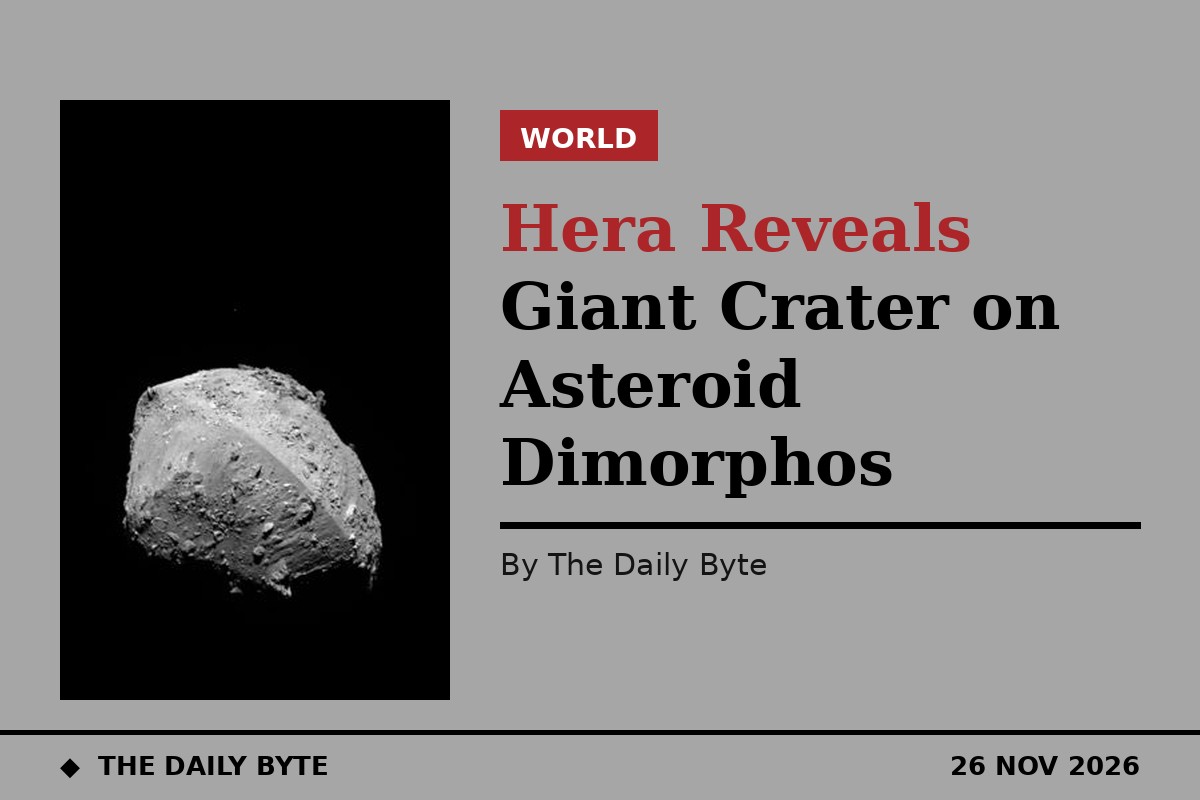
The European Space Agency has released the first close-up images of the asteroid humanity deliberately struck four years ago, revealing a stadium-size crater and a swarm of mysterious boulders circling the rock.
The images, unveiled at a briefing in Berlin on Wednesday, 25 November, come from ESA's Hera spacecraft, which arrived at the asteroid Dimorphos three weeks ago to survey the aftermath of NASA's DART mission. In September 2022, DART slammed into Dimorphos at 13,645 miles per hour in humanity's first planetary defence test, an attempt to prove an asteroid on a collision course with Earth could be knocked aside.
The crater left by the impact is enormous. "It's a big crater that is almost as large as the body itself, which is really spectacular," said Sabina Raducan, a planetary scientist at the International Space Science Institute in Bern and the Free University of Brussels, who is part of the Hera mission team. The impact flattened one of Dimorphos's previously rounded faces.
A tumbling rock, ringed by boulders
The strike also sent the 151-metre-wide asteroid into a chaotic tumble. Before the impact, Dimorphos always showed the same face to its larger companion, Didymos, much as the Moon does to Earth. Now, Raducan said, it moves like "a barrel that you throw down the stairs."
The biggest surprise from Hera's early observations is that hundreds of previously unknown boulders encircle the asteroid pair, including more than 100 between the size of a football and a washing machine. "As we approached Didymos and Dimorphos, we quickly realized the asteroids were not alone," said Naomi Murdoch, a planetary scientist at the University of Toulouse and a member of the mission team. "In fact, they had a lot of company."
Scientists do not yet know where the boulders came from. They may be debris thrown off by the DART impact, or material shed by Didymos itself. "We cannot say today, with the information that we have, whether these were debris coming from the DART impact or whether there's another origin," Murdoch said. The boulders are also a practical problem: they present a collision risk for the mission.
What happens next
Hera, which launched in October 2024, is currently about 30 kilometres from the asteroid pair, which orbits 193.5 million kilometres from Earth. In December, the spacecraft will move in to about 13 kilometres to take higher-resolution images and make the measurements needed to calculate Dimorphos's mass. That figure will show exactly how effective the DART impact was.
Two shoebox-sized CubeSats on board Hera are due to be released in January, to venture closer to the asteroids and eventually land on Dimorphos. The rest of the asteroid looks much as it did in DART's 2022 images: the boulder fields covering its other regions are unchanged, ESA said.
Neither Dimorphos nor Didymos poses any danger to Earth, but Dimorphos is about the size of the asteroids that could threaten the planet, making it an ideal testing ground. "Sixty-six million years ago, an asteroid impact changed the course of life on Earth," said Ian Carnelli, the Hera mission manager. "Today, for the first time in history, humanity is validating how to prevent such an event from happening again."


